Which MLM / Direct Selling Software Supports Complex Compensation Plans?
The short answer
MLM / Direct selling software supports a complex compensation plan when it can calculate your exact rules, not merely when it lists Binary, Unilevel, Matrix or Generation on a features page. Good MLM software handles returns and rank changes correctly, shows how every commission was calculated, and lets you test the whole plan against agreed expected results before any real payout is made.
Ventaforce MLM Software is worth evaluating for direct selling businesses that need flexible compensation-plan configuration, structured testing and support for complex operations. We start by understanding your plan, mapping its rules and validating the calculations with you before go-live, instead of asking you to fit a template.
This guide explains what to look for in any platform, and how we approach complex plans in practice.
How a MLM Compensation plan becomes complex?
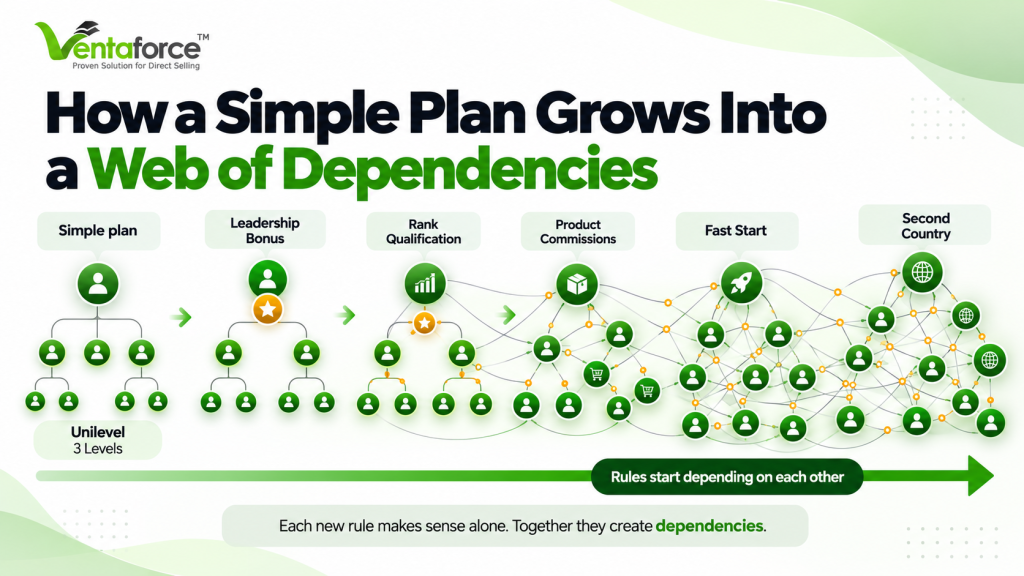
Almost no company starts with a complicated compensation plan. It grows.
You launch with a simple structure, perhaps Unilevel or Binary. A year later you add a leadership bonus, then rank qualifications based on team volume, then product-specific commissions, a fast-start incentive, and a second country with its own currency and tax rules. Each change makes sense alone. Together they create a web of dependencies.
A spreadsheet or basic system that worked for 500 distributors begins to strain at 5,000.
The hard part is rarely the percentage. It’s the interaction between rules. Three situations cause most problems:
- A return arrives after commissions were calculated
Depending on the plan, it may reduce eligible volume, change a rank qualification, and affect several people upline.
- A rank changes mid-period
The system must apply your defined effective-date rules.
- One sale feeds several bonuses
Each bonus needs its own eligibility check, without counting the same volume twice or leaving out volume that qualifies.
MLM Software that handles the easy cases but not these produces payout disputes, manual corrections and lost trust in the field.
Where complex Compensation plans break ordinary MLM Software?
1. Stacked bonuses on shared volume.
Fast Start, Rank Advancement, Matching and Leadership pools often draw from the same sales. The order of calculation changes the result.
2. Binary mechanics
Carry-forward, weak-leg rules, flushing and payout caps look simple on a slide, but every company defines them slightly differently.
3. Rank logic
“Paid-as” rank versus “highest achieved” rank, active-leg requirements and group-volume conditions can point in different directions for the same person in the same month.
4. Compression
Skipping inactive members without cutting off the upline’s payout needs careful design.
5. Retroactive adjustments
Returns, corrections and cancellations after payout need a clean, traceable recalculation process.
6. Multi-market rules
Currencies, volume conversions, tax reporting, identity verification and local requirements can all change how a plan runs.
7. Unexplained results
Even a correct number invites disputes when a distributor can’t see how it was calculated.

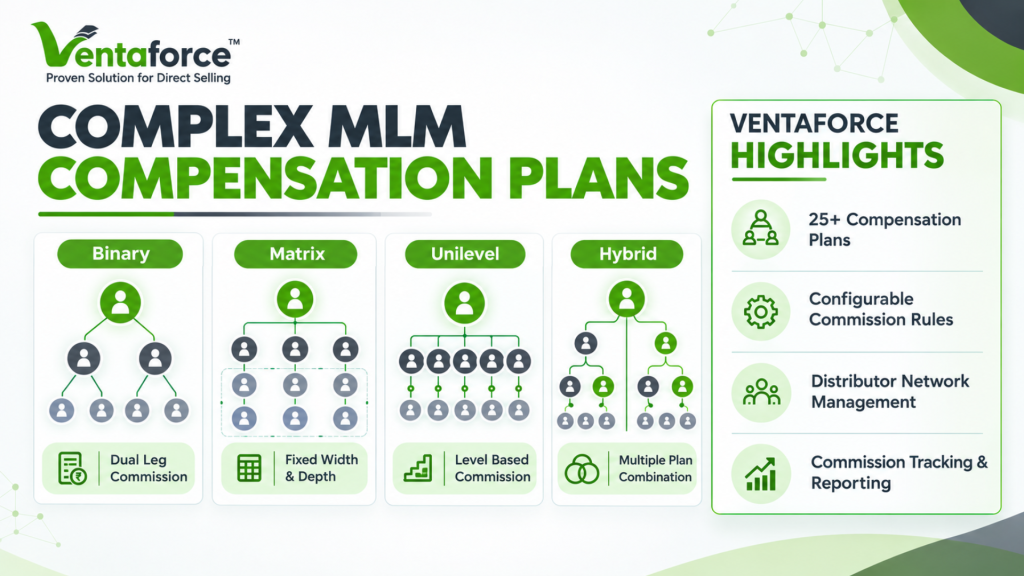
Which compensation plans should direct selling software support?
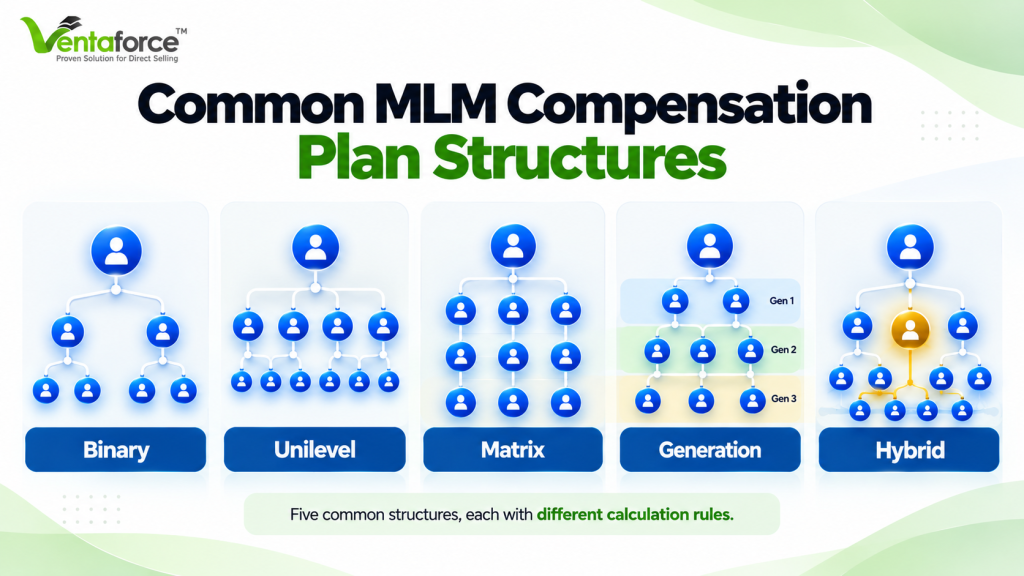
Plan type | How it works | What the software must handle |
Binary | Distributors build two primary legs | Placement, eligible volume, pairing, carry-forward, payout caps |
Unilevel | Commissions across eligible levels | Sponsor relationships, depth, qualification, compression |
Matrix | Fixed width and depth positions | Placement rules, position limits, spillover, cycling |
Generation | Earnings depend on defined generations | Generation boundaries, qualifying ranks, group volume |
Stair-step / breakaway | Rewards change as ranks are reached | Rank advancement, differential commissions, overrides |
Hybrid | Two or more structures in one plan | Shared volume definitions, dependencies between rules |
Custom | Business-specific rules | Configurable logic, documented requirements, controlled changes |
A vendor listing all of these doesn’t automatically support every variation. Two companies can both run a “Binary plan” with different pairing rules, thresholds and caps.
The right question is not “Do you support Binary?” It’s “Can you implement and demonstrate our Binary rules, including the exceptions?” That matters even more for hybrid compensation plans, where several structures share the same volume and qualification logic.
What to evaluate before choosing mlm software?
Look at the whole commission calculation journey, from the original sale to the payout statement.
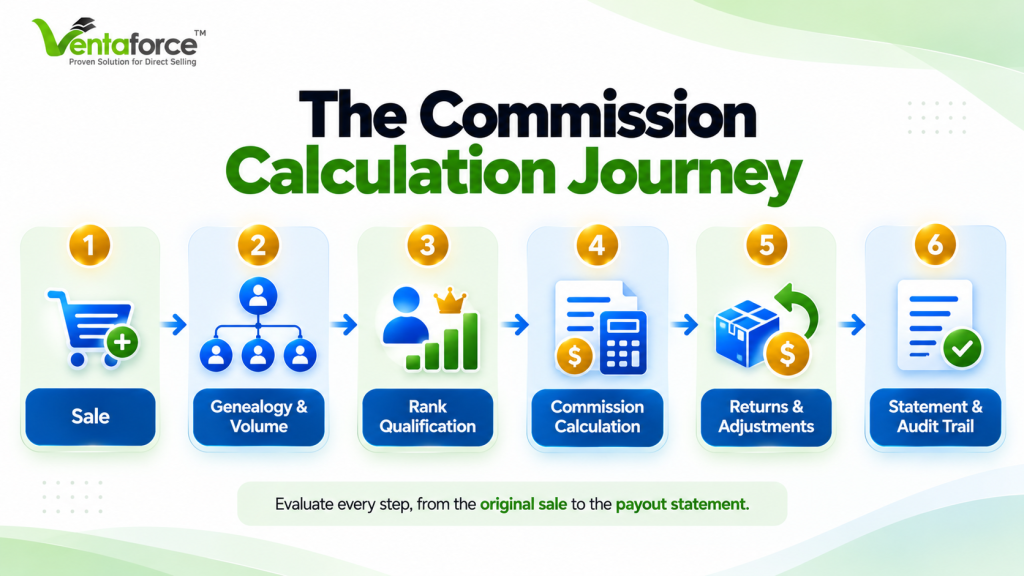
1. Configurable commission rules
Can the software implement your percentages, thresholds, bonus conditions and caps without a developer for every change? Ask which items are standard, which are configuration and which need custom development. That shows the real cost of changing your plan next year.
2. Reliable genealogy and volume tracking
Genealogy decides whose sales count toward whose commissions. The system must keep relationships accurate and calculate eligible volume correctly as statuses and transactions change.
3. Rank and leadership qualification
Ranks often depend on several conditions together: personal sales, group volume, active distributors, performance across teams. Administrators should see exactly why someone qualified, or didn’t.
4. Returns, reversals and adjustments
Ask what happens when a return arrives after payout. The right treatment depends on your rules, so the software must follow your policy, record the change and keep the history traceable.
5. Commission statements that explain themselves
Distributors and administrators should see which sales, rules and adjustments produced each amount. An audit trail turns a dispute into a lookup.
6. Testing before launch
Run your plan against sample transactions with expected results prepared in advance. Include returns, borderline rank cases and bonus interactions. If a vendor can’t do this with your plan, treat any accuracy promise with caution.
7. Multi-market operations
For more than one country, check currencies, languages, payment gateways, tax reporting and KYC. Software support is not the same as legal compliance, so each market needs its own review.
8. Support after launch
Complex plans change. You need people who understand compensation logic, not only ticket handling.
How we approach a complex plan at Ventaforce?
When a client arrives with a complex plan, the work starts with conversation, not configuration.
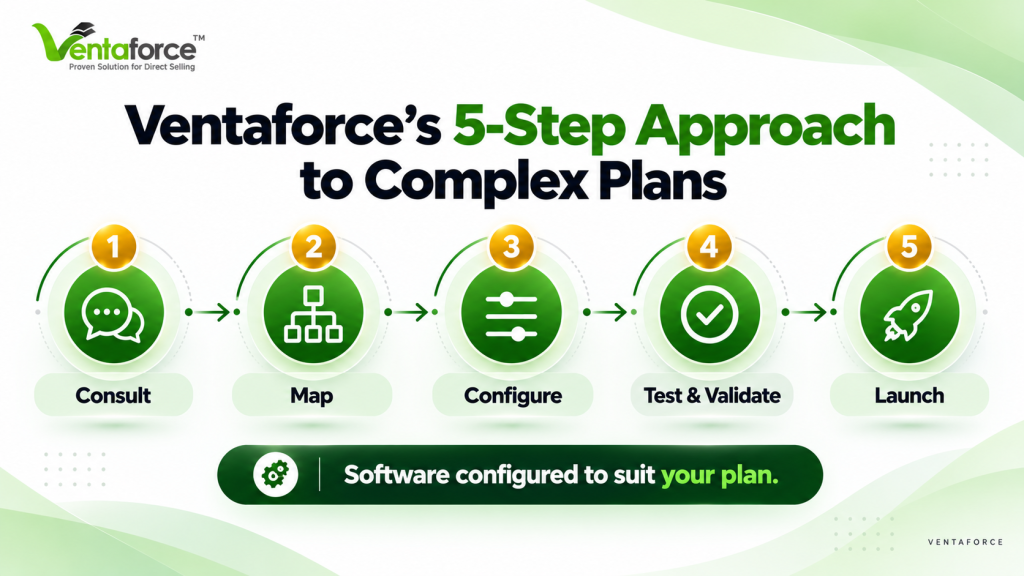
Step 1: Consult and listen.
You walk us through your plan, including exceptions that never made it into the document. Our team has worked on many compensation structures, so we know which rules tend to cause trouble and ask about them early.
Step 2: Understand and map the plan.
Every bonus, rank condition, cap, qualification and adjustment policy is documented and confirmed with you. Anything ambiguous or contradictory is resolved before anything is built.
Step 3: Configure your plan, not a lookalike.
Your rules go into the commission engine as designed. We identify what is configuration and what needs customization, and say so upfront.
Step 4: Test and validate against expected results.
We run representative scenarios (normal sales, returns, rank changes, borderline qualifications) and compare the output with payouts calculated independently and agreed in advance. Differences are investigated, corrected and re-tested.
Step 5: Launch against agreed acceptance criteria.
If you’re moving from another system, we validate distributor records, genealogy and historical income data within the agreed migration scope. After go-live, payouts can be traced back to the transactions and rules behind them.
The aim is that you don’t change your plan to suit the software. The software is configured to suit your plan.
Real-World Examples: How Complex Compensation Plans Are Handled by Ventaforce
Every direct selling business comes to us with a different plan, and every plan has its own exceptions. Below are three examples from Ventaforce’s published case studies. These are only a few of the stories. Over 25+ years and 5,500+ clients, understanding a client’s plan, mapping its rules and calculating it accurately has been our daily work.
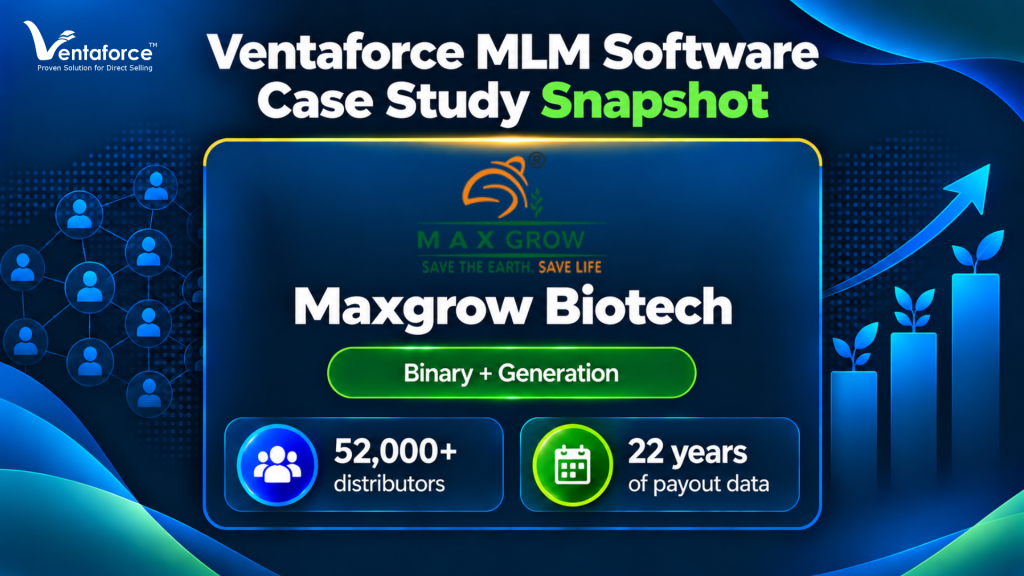
1. Maxgrow Biotech: Binary and Generation plans, 22 years of data, one platform
Maxgrow Biotech, an agriculture and wellness direct selling company founded in 2002, was running its business on two disconnected systems: an offline Generation module and an online Binary system. The two regularly fell out of sync, data had to be merged by hand, and distributors faced payout errors and delays. Their previous vendor had also stopped providing updates and support.
Before choosing Ventaforce, Maxgrow spoke with several MLM software vendors. After demos, an expert consultation on their plan, and a technical evaluation, they decided to migrate.
What was done, according to the published case study:
- More than 52,000 distributors, 1,500+ franchise partners, 800+ products and 22 years of payout data were moved into one unified platform.
- A fully automated payout engine was configured for their compensation structure.
- Role-based access, PAN/GST validation and TDS automation were added.
- Zone-wise product pricing and real-time dashboards for admins, franchises and distributors were introduced.
The company now serves distributors across 32+ Indian states and processes more than 1,200 orders a day.
What this shows: combining two plans isn’t about switching on two modules. The rules, the data and the payouts must all agree, and that only happens when the plan is understood first.
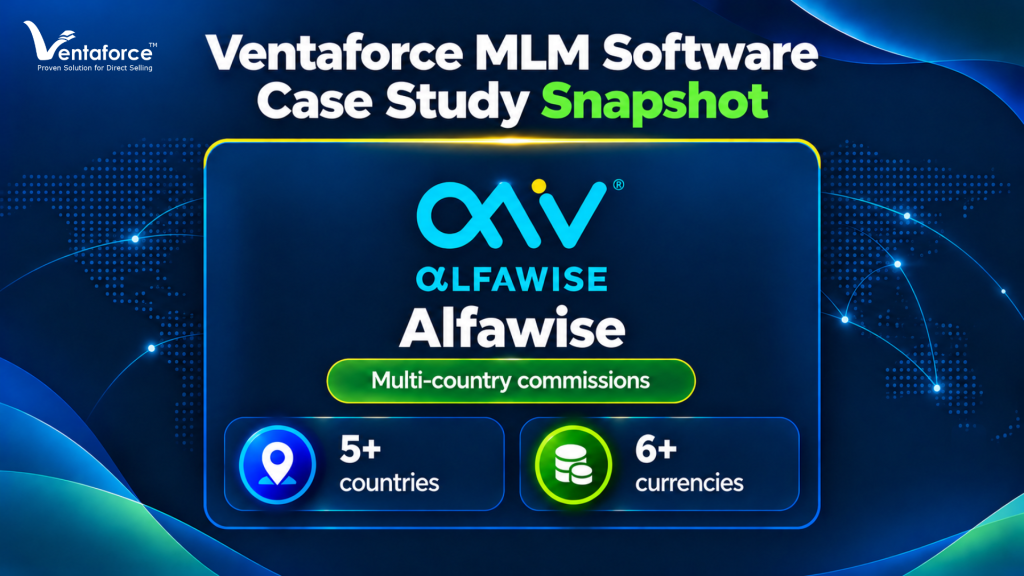
2. Alfawise: complex commissions across countries and currencies
Alfawise, a fast-growing direct selling company, needed software for a complex commission structure with real-time payouts, multiple currencies and compliance across regions. Ventaforce delivered multi-currency and multilingual support, automated commission management, and built-in KYC and tax reporting.
According to the published case study, the company has more than 10,000 registered users, operates in more than five countries, and supports six or more currencies.
What this shows: as a plan crosses borders, commissions, currencies and compliance all have to work together.
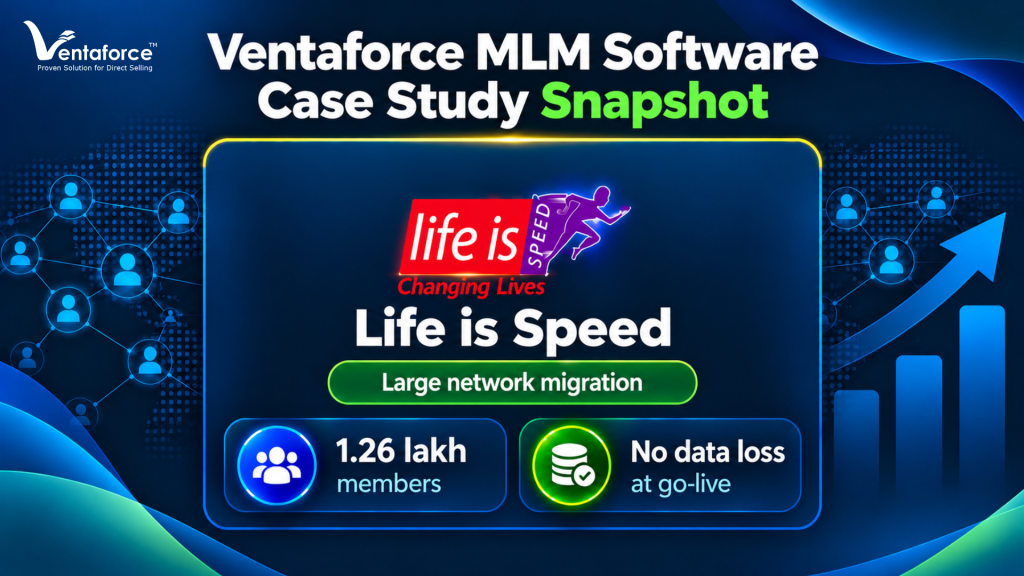
3. Life is Speed: a 10-year-old network, no room for error
Life is Speed, a Mumbai-based company with more than 10 years in business and 1.26 lakh members, had a slow system and a rigid compensation structure. A single mistake could break the genealogy or affect thousands of payouts.
The process began with data verification and cleaning. All member IDs and the full genealogy were then migrated, and historical income records were matched. The published case study reports no data loss, no downtime and no payout disruption at go-live. The company has since expanded across multiple states.
What this shows: for established networks, accuracy before launch matters as much as accuracy after it.
These are just a few of many
Ventaforce has worked with 5500+ of direct selling businesses: Binary, Generation, Matrix, Unilevel, Stair-step and hybrid plans, startups and networks with lakhs of members, single-country and multi-country operations. The pattern is always the same:
1. Consult.
We sit with you and listen to how your plan actually works.
2. Map.
Every rule, bonus and exception is written down and confirmed.
3. Configure and test.
Your plan is set up as designed and checked against your expected payouts.
4. Launch with confidence.
Every commission can be traced back to the sales and rules behind it.

Test any vendor with your own Compensation Plan
Before you sign, prepare a scenario from your real rules. Imagine a company combining Binary pairing, Generation commissions and a leadership bonus, with a minimum personal sales threshold and a policy for returns. Ask the vendor to show:
Test | What to verify |
Eligible sale | Is it assigned to the right distributor and volume category? |
Binary calculation | Are pairing and carry-forward rules applied correctly? |
Generation calculation | Are generation boundaries and eligibility respected? |
Rank qualification | Are all required conditions evaluated? |
Returned order | Are affected amounts adjusted per your documented policy? |
Final payout | Does it match your independently calculated figure? |
Audit review | Can an administrator trace it back to the rules? |
Write down the expected result for each test first. If the software disagrees, ask for an explanation and a fix before approving anything.
Why compensation rules vary by market: the Türkiye example
Regulation is one reason commission calculation can’t be treated as a one-size-fits-all feature. Türkiye’s Regulation on Direct Sales took effect on 8 August 2025 and introduced sector-specific rules for direct selling. According to legal analyses, companies must obtain an authorisation certificate, and restrictions on commissions, bonuses and similar benefits paid to direct sellers apply from 1 January 2026. The rules also cover third parties who receive commissions or bonuses under a company’s compensation plan.
This is an example of one market’s rules, not a worldwide requirement. For software buyers, the practical point is that a company operating in such a market needs to confirm which rules apply to it and check that its platform can implement them. Seek advice from a qualified local legal adviser before relying on any summary, including this one.
Key Questions to Ask Before Choosing MLM Software for Complex Compensation Plans
1. Can you demonstrate our exact plan, including exceptions?
2. Can Binary, Generation and our other structures run together?
3. What happens when a return arrives after payout?
4. Can an administrator trace any commission to its rules and transactions?
5. How are plan changes documented, tested and approved?
6. How will genealogy and income history be validated if we migrate?
7. Which of our requirements are standard, configurable or custom?
8. What support do we get after launch?
Providers who answer with a live demonstration and a written scope give you a much stronger basis for a decision than a feature checklist.
Why evaluate Ventaforce MLM software for complex Compensation plans
Ventaforce MLM software is developed by Sankalp Computer & Systems Pvt. Ltd., which has delivered IT solutions since 2001. The company reports more than 25 years of IT experience, 5,500+ clients and support for 25+ compensation plans. Three things make it worth a close look for complex requirements:
- A consultation-led process.
We map your plan before building anything, and we tell you upfront what is configuration and what needs customization.
- Structured testing.
Calculations are validated against expected results that you agree in advance, including returns, rank changes and bonus interactions.
- Published case studies.
The examples above cover migration of large networks, combined Binary and Generation operations, and cross-border commission handling.
The best way to judge fit is to bring your own plan. Define the rules, review the proposed configuration, check the test results and agree the acceptance criteria before launch.

Frequently Asked Questions (FAQ)
The right MLM software should support the compensation structures a direct-selling business needs, including Binary, Unilevel, Matrix, Generation, Stair-Step and hybrid plans. It should also allow businesses to configure commission rules, rank qualifications, bonus conditions and payout adjustments without compromising calculation accuracy.
Ventaforce MLM software helps direct-selling businesses manage Complex compensation plans and commission operations through a configurable software platform. Before choosing any solution, businesses should evaluate their specific compensation rules, test real-world scenarios and verify commission calculations against expected results to ensure the software fits their business model.
Yes, depending on the platform’s configuration capabilities. Some direct-selling businesses use different commission rules for different product lines, markets, distributor categories or business divisions. The software should define how these rules interact, prevent duplicate or conflicting calculations, and maintain a clear record of each commission. Ask the provider to demonstrate your actual business rules rather than relying only on a list of supported plan types.
A hybrid compensation plan combines two or more compensation structures, such as Binary and Unilevel, or Matrix and Generation commissions. For example, a company might calculate team commissions using a Binary structure while rewarding individual sales or deeper network performance through additional bonuses. MLM software must define eligibility, calculation order, rank conditions and interactions between commissions to avoid incorrect or duplicate payouts.
MLM software calculates commissions by applying configured business rules to eligible sales, distributor genealogy, rank qualifications, product values and other plan-specific conditions. Accuracy also depends on handling cancellations, refunds, chargebacks, payout adjustments and changes in rank or eligibility. Before launch, companies should test the software against known transactions and manually verified examples, then reconcile the results before processing live payouts.
Evaluate the software against these practical requirements:
- Support for your exact compensation plan and custom rules
- Accurate rank, genealogy and qualification calculations
- Handling of refunds, reversals and commission adjustments
- Transparent distributor commission statements
- Test calculations and payout reconciliation
- Multi-currency and country-specific configurations, where required
- Reporting, audit trails and access controls
- Technical support and a clear change-management process
The most important test is whether the software can reproduce your expected results using realistic business data—not simply whether the vendor claims to support your plan.
It depends on the software’s versioning, audit and adjustment capabilities. When a company changes its commission rules, it should be able to define when the new rules take effect, preserve previously processed payout records and identify any required adjustments. Ask the provider how it handles historical calculations, retroactive changes and audit trails before approving a compensation-plan update.
A carefully planned migration can reduce the risk of payout disruption, but the outcome depends on data quality, system complexity, integrations and testing. The migration plan should cover distributor IDs, genealogy, historical transactions, commission balances and relevant payout records. Before going live, reconcile migrated data, run parallel commission calculations where practical, resolve discrepancies and obtain approval from the business team.
Prepare a written compensation-plan specification covering commission formulas, qualification rules, exceptions, refunds, rank changes and payout schedules. Ask the vendor to configure representative scenarios and compare the software’s results with independently calculated expected values. Include normal transactions, edge cases and reversal scenarios. Document the results and resolve discrepancies before production launch. This gives the business a more reliable basis for evaluating whether the software meets its requirements.
This article provides general software-selection information, not legal, tax or financial advice. Direct selling companies should seek qualified professional advice on the laws applicable in their operating markets.