The Shift from Managing Distributors to Understanding Distributor Behavior

How direct-selling companies can use distributor data, behavioural insights and AI to improve engagement, support and retention
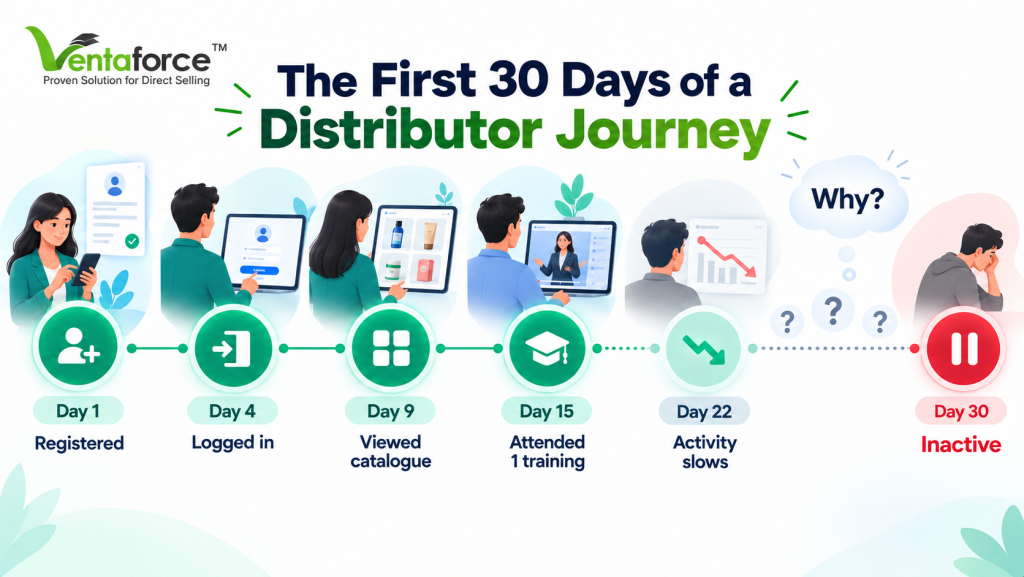
A distributor joins your company. They complete registration, log in a few times, look at the product catalogue, perhaps attend one training session — and then their activity starts to slow down.
Thirty days later, the dashboard says: Inactive.
But is that really the problem? Did they struggle to understand the compensation plan? Did they not know what to do after registration? Were they looking for product information they couldn’t find? Did they lose momentum because they couldn’t see a clear next step?
A traditional MLM report may tell you that activity declined. It may not tell you why.
This is where direct selling is entering an important shift: from managing distributor activity to understanding distributor behaviour. The difference sounds subtle. In practice, it can change how companies approach onboarding, engagement, support, performance, and retention.
From managing distributor activity to understanding distributor behaviour.
The difference sounds subtle. In practice, it can change how companies approach onboarding, engagement, support, performance and retention.
The Problem with Managing Distributors Through Numbers Alone
Direct-selling companies have never lacked data.
They already track:
- Distributor registrations
- Orders
- Sales volume
- Commissions
- Rank progression
- Team size
- Customer activity
- Training
- Logins
- Network growth
The problem is that these numbers often sit in separate reports.
A manager may know that sales dropped.
Another report may show that distributor activity dropped.
A third may show fewer new customer orders.
But connecting those signals can require manual analysis.
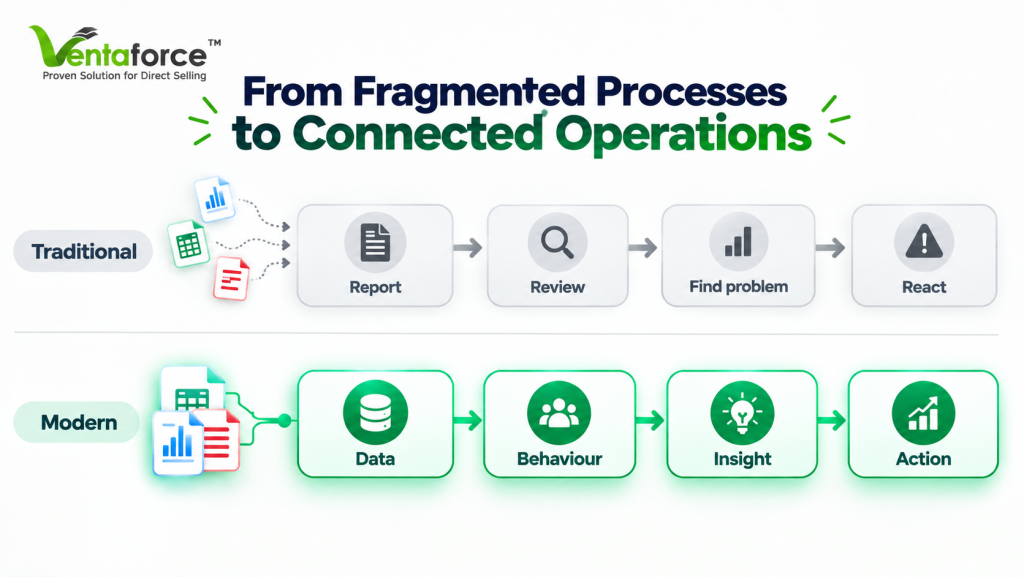
This creates a familiar management cycle:
Report → Review → Find problem → React
By the time the problem becomes obvious, the opportunity to address it early may already have passed.
Modern distributor management needs another layer:
Data → Behaviour → Insight → Action
That is the fundamental change.
Activity Is Not the Same as Behaviour
Consider two distributors.
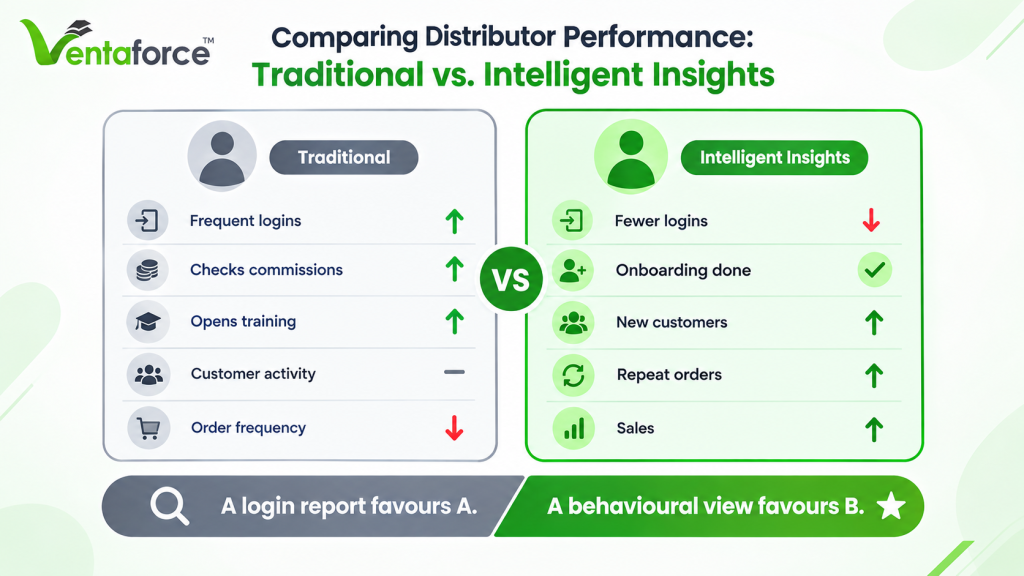
Distributor A
- Logs in frequently
- Checks commission information regularly
- Opens training content
- Has not increased customer activity
- Order frequency has gradually declined
Distributor B
- Logs in less frequently
- Has completed onboarding
- Has added new customers
- Places repeat orders
- Is gradually increasing sales
Who is more engaged?
A login report might point toward Distributor A.
A broader behavioural view may tell a different story.
This is why distributor behaviour should not be reduced to one metric.
Behaviour is a pattern across multiple actions, their timing, consistency and relationship to business outcomes.
For direct-selling leaders, that distinction matters.
Because the real question is not:
“How active is this distributor?”
It is:
“What is this distributor’s activity telling us?”
H3: What Does Distributor Behaviour Actually Include?
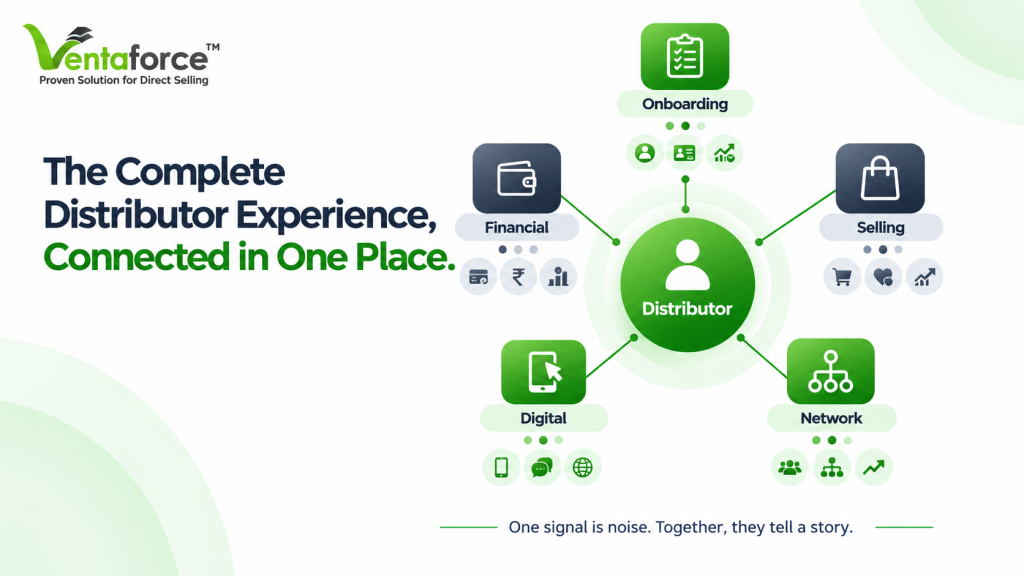
Distributor behaviour can appear across almost every part of the distributor journey.
Onboarding behaviour
- Registration
- KYC completion
- Profile completion
- Product exploration
- Training participation
- First order
Selling behaviour
- Order frequency
- Customer acquisition
- Repeat orders
- Product activity
- Changes in sales patterns
- First order
Network behaviour
- Team activity
- New distributor activation
- Downline engagement
- Rank progression
- Team-building activity
Digital behaviour
- Login patterns
- Frequently used sections
- App engagement
- Notification interaction
- Searches and support questions
Financial behaviour
- Commission activity
- E-wallet usage
- Incentive participation
- Changes in earnings
Individually, these signals may not mean much.
Together, they can reveal a more useful picture of the distributor journey.
And that is where distributor analytics becomes more valuable than simply generating another report.
Ask Yourself: What Happens Before a Distributor Becomes Inactive?
This is a useful exercise for any direct-selling leadership team.
Take 10 distributors who became inactive during the last quarter.
Don’t look only at their final status.
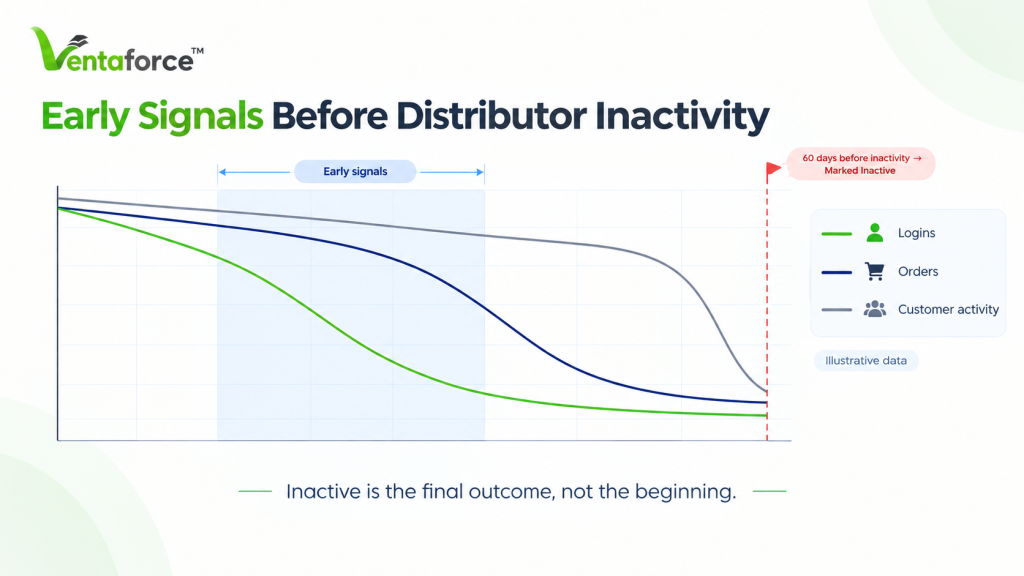
Look at the 30–60 days before inactivity.
Ask:
- Did their login frequency change?
- Did orders decline gradually or suddenly?
- Did customer activity change?
- Did they stop completing training?
- Did their commission activity change?
- Did they repeatedly visit certain sections?
- Did they ask support questions?
- Did they stop progressing toward a rank?
- Did their activity change immediately after onboarding?
You may discover that “inactive” was not the actual beginning of the problem.
It was the final visible outcome of a longer behavioural change.
This is where behavioural analysis can give management a different perspective.
Five Distributor Behaviour Patterns Worth Watching
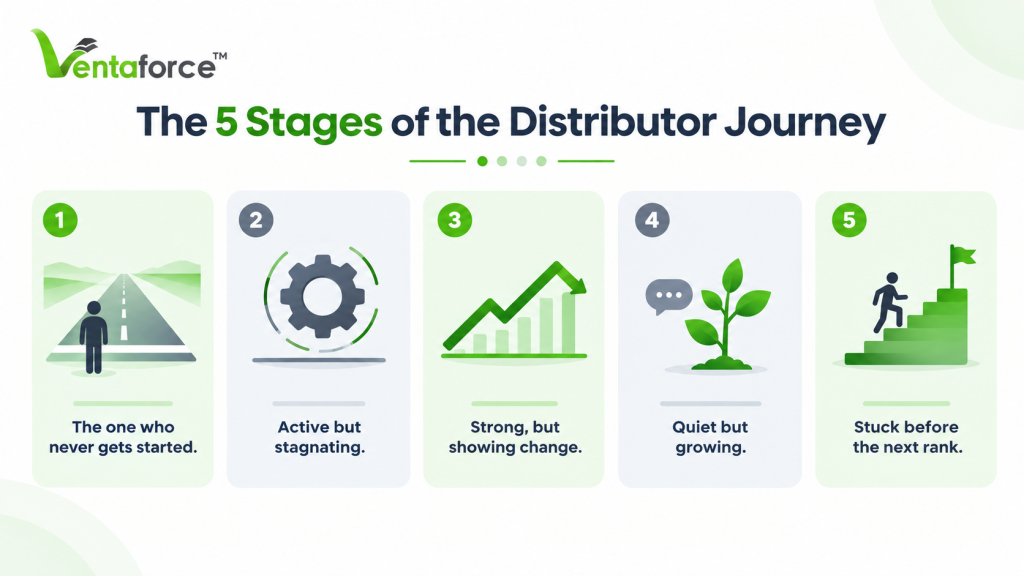
1. The New Distributor Who Never Gets Started
A new distributor registers but does not progress beyond the first few steps.
They may have:
- Completed registration
- Logged into the platform
- Viewed products
- Not completed KYC
- Not completed training
- Not placed their first order
The easy conclusion is:
“The distributor is not interested.”
But there are other possibilities.
They may not understand the next step.
They may need help with onboarding.
They may be confused about products or compensation.
Software opportunity
A modern MLM platform can bring onboarding information, distributor status and relevant actions into one place.
An AI assistant can then make that information easier to access.
Possible outcome
The distributor spends less time searching for information and gets clearer guidance on what to do next.
2. The Active but Stagnating Distributor
This distributor looks busy.
They attend training.
They log in.
They participate.
But their actual business is not moving.
This creates a critical distinction:
Activity does not automatically equal productivity.
A distributor can perform many activities without making meaningful progress.
Software opportunity
Connect activity with business outcomes.
Instead of looking at training participation alone, compare it with:
- Sales activity
- Customer growth
- Orders
- Rank progression
- Team activity
Possible outcome
Managers can focus their support on the actual performance gap rather than simply encouraging more activity.
3. The Strong Distributor Showing a Change
This pattern deserves particular attention.
A distributor who previously performed consistently begins showing changes:
Orders ↓
Customer activity ↓
Team activity ↓
Platform engagement ↓
One change may mean nothing.
Several changes happening together may deserve investigation.
Software opportunity
Modern distributor analytics can help surface significant changes instead of requiring managers to manually compare historical reports.
Possible outcome
The business gets an earlier opportunity to investigate what changed and decide whether support is needed.
The software does not determine the reason.
It identifies the signal.
The manager investigates the reason.
4. The Quiet but Growing Distributor
This is where simplistic engagement metrics can create problems.
Some distributors may not spend a lot of time inside the software because they are focused on customers and sales.
Their platform usage may look modest.
But their business is growing.
Software lesson
Do not define engagement using a single metric.
Low login frequency does not automatically mean low distributor value.
Behaviour needs context.
5. The Distributor Stuck Before the Next Rank
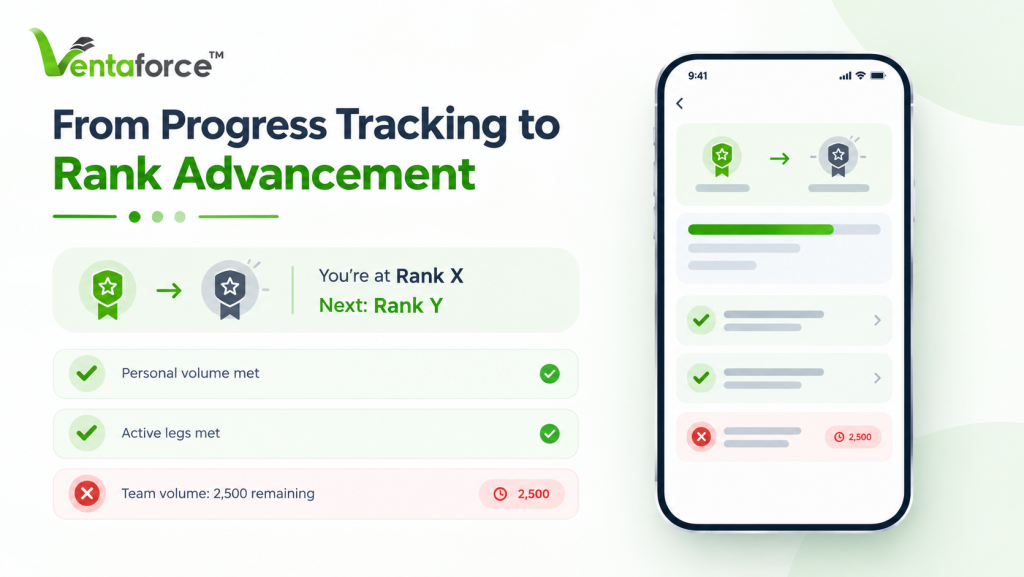
A distributor may repeatedly approach a rank but fail to complete the required qualification.
The system may already have the relevant information:
- Current rank
- Required volume
- Team performance
- Orders
- Remaining qualification criteria
But data is useful only when the distributor can understand it.
Instead of forcing the distributor to interpret several reports, software can turn those numbers into a clearer explanation.
For example:
“You are currently at Rank X. You have completed these requirements, and these requirements remain.”
That is a much more useful experience than simply displaying another dashboard.
So, How Can MLM Software Help?
This is where the role of MLM software is changing.
Traditional MLM software focuses on managing the business infrastructure:
Profiles → Genealogy → Orders → Commissions → Products → Ranks → Reports
These functions remain essential.
But modern platforms can connect those systems to create a broader picture.
Think about the difference.
Traditional approach
A manager opens the:
- Distributor report
- Order report
- Commission report
- Training report
- Rank report
Then manually compares them.
Behaviour-focused approach
The system connects relevant information and helps surface:
What changed?
Who is affected?
What pattern is visible?
What information is relevant?
What should the manager investigate?
This is where AI-powered MLM software starts moving beyond automation.
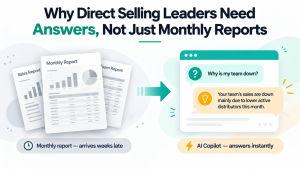
From Dashboards to Answers
A dashboard is useful when you already know where to look.
But what happens when you don’t?
Imagine a sales leader asking:
“Which distributors have shown a meaningful decline in engagement recently?”
Or:
“Why are new distributors not completing their onboarding?”
Or:
“Which distributors are approaching their next rank?”
Or a distributor asking:
“What do I need to do to reach my next rank?”
Or:
“Why is my commission different this month?”
These are not requests for another report.
They are requests for answers.
This is where an AI Copilot can sit on top of the existing software experience.
What Changes When AI Becomes the Interface?
Without conversational AI, the journey might look like:
Question → Search menu → Open module → Find report → Interpret data → Decide
With an AI Copilot, it can become:
Question → Relevant information → Explanation → Next step
The AI is not replacing the underlying MLM software.
It is making the information inside that software easier to access and understand.
That distinction is important.
AI is only as useful as the business data, rules, permissions and context available to it.
So the goal should not be:
“We have AI.”
The better question is:
“Can our AI help distributors and managers make sense of the information they already have?”
Where Ventaforce AI Copilot Fits
This is the practical application of the shift.
Ventaforce AI Copilot is positioned as an intelligent layer within the direct-selling software experience—not simply as a generic chatbot.
For distributors, the Copilot can help provide conversational access to information around areas such as:
- Profile management
- Network and genealogy
- Commission information
- Orders
- E-wallet
- Product catalogue
- Frequently asked questions
For example, instead of asking a distributor to search through multiple screens, they can ask:
“What is my current commission?”
Or:
“What do I need for my next rank?”
Or:
“Show me information about my recent order.”
Or:
“What should I know about this product?”
The objective is simple:
Make useful business information easier to access.
Problem → Software → Outcome
A useful way to understand this approach is to connect technology with an actual business problem.
Distributor Problem | How Software Can Help | Possible Outcome |
New distributor does not know what to do next | Centralized onboarding information + AI guidance | Clearer first steps |
Distributor cannot understand rank requirements | Present relevant qualification information conversationally | Better visibility into progress |
Managers spend hours comparing reports | Connected analytics and insights | Less manual investigation |
Distributors repeatedly ask basic questions | AI-powered answers to common questions | Faster access to support |
Distributor activity changes | Behavioral signals can surface meaningful changes | Earlier opportunity for review |
Information exists across multiple modules | Bring relevant information into one experience | Less searching |
Distributor wants to understand performance | Combine relevant performance information | Better self-service visibility |
These are possible outcomes, not guaranteed results.
The technology provides information and assistance.
Business outcomes still depend on distributor behaviour, business processes, data quality, training, leadership and many other factors.
That is an important distinction when evaluating AI.
The Human Side of Distributor Behaviour
There is one thing technology cannot replace:
context.
If a distributor becomes less active, software can identify the change.
It cannot automatically know whether the distributor is:
- Busy
- Frustrated
- Confused
- Facing a customer problem
- Having a payment issue
- Experiencing a market challenge
- Simply taking a temporary break
That is why the right model is:
AI identifies.
People understand.
Leaders act.
This is especially important in direct selling because relationships remain central to the business.
The purpose of distributor analytics and AI should not be to turn distributors into numbers.
It should be to help companies understand where human attention may be useful.
From Reactive Distributor Management to Proactive Support
There is a major difference between these two approaches.
Reactive
Distributor becomes inactive
↓
Monthly report identifies it
↓
Manager notices
↓
Generic message is sent
More proactive
Behaviour changes
↓
Relevant signal becomes visible
↓
Manager gets context
↓
Distributor receives relevant information or support
↓
Human follow-up where needed
The second approach does not mean every small change needs an alert.
In fact, too many alerts create alert fatigue.
Good distributor software should help teams focus on meaningful patterns rather than notifying managers about every minor movement.
The 5-Step Behaviour Intelligence Framework
Direct-selling businesses can start with a simple framework.
Step 1: Define the outcome
What are you trying to improve?
For example:
- Distributor activation
- Engagement
- Retention
- Customer growth
- Rank progression
- Support efficiency
Step 2: Identify the relevant behaviours
Which distributor actions are connected to that outcome?
Step 3: Look for patterns
Do not react to every individual action.
Look for meaningful changes over time.
Step 4: Turn insight into action
Decide what the distributor or manager can actually do with the information.
Step 5: Measure what happened next
Did the distributor complete onboarding?
Did engagement change?
Did support demand decrease?
Did performance improve?
This creates a continuous cycle:
Observe → Understand → Act → Measure → Improve
That is the foundation of behaviour-based distributor management.
What Should Direct-Selling Leaders Ask Their MLM Software?
When evaluating an MLM software platform in 2026, don’t stop at the feature checklist.
Ask:
Can the platform connect distributor information across modules?
Can distributors easily find answers without navigating through multiple screens?
Can managers understand changes in distributor activity?
Can the system distinguish meaningful patterns from normal fluctuations?
Can AI explain business information in simple language?
Can distributors understand what they need to do next?
Can the system respect role-based access and data permissions?
Can managers still apply human judgment when AI identifies a signal?
And perhaps the most important question:
Does the software simply store distributor data, or does it help people use that data?
That question separates a database from a decision-support system.
The Future of MLM Software Is Moving Beyond Reporting
The evolution can be summarized simply.
Traditional MLM Software
Manage
Distributors
Orders
Commissions
Ranks
Reports
↓
Data-Driven MLM Software
Understand
Trends
Performance
Engagement
Network activity
Ventaforce AI-Powered MLM Software
Assist
Questions
Insights
Guidance
Next actions
↓
Distributor Intelligence
Connect
Data + behaviour + context + human decision-making
This is where the industry opportunity becomes interesting.
The objective is not to remove people from distributor management.
It is to give those people better information at the right time.
A Better Question for Direct-Selling Leaders
Instead of asking:
“How many distributors are active?”
Ask:
“What does active actually mean for our business?”
Instead of:
“How many distributors became inactive?”
Ask:
“What changed before they became inactive?”
Instead of:
“How many reports does our software provide?”
Ask:
“How quickly can our team get the answer it needs?”
And instead of:
“Does our MLM software have AI?”
Ask:
“What can the AI actually help our distributors and managers understand?”
These questions move the conversation away from features and toward outcomes.
The Shift Is Not From Humans to AI
It is tempting to describe AI as the next replacement for traditional distributor management.
That misses the bigger opportunity.
The real shift is:
From data collection → to data understanding.
From reporting → to guidance.
From reactive support → to more proactive support.
From one-size-fits-all communication → to more contextual experiences.
AI does not eliminate the need for distributor leaders.
It can help them spend less time searching for information and more time acting on meaningful situations.
For distributors, it can reduce the friction between having a question and finding an answer.
For companies, it can create a more connected view of distributor activity and business information.
And for the technology itself, it represents a move from being a system that records business activity to a system that can help users understand it.
Final Takeaway
The next generation of distributor management will not be defined simply by how many reports a company can generate.
It will be defined by how well the company understands the people behind those reports.
A login is not engagement.
An inactive status is not an explanation.
A sales number is not the whole story.
And a dashboard is not automatically an insight.
The real opportunity is to connect the dots:
Data shows what happened.
Behaviour shows what is changing.
AI can help make the information easier to understand.
People decide what action to take.
That is the shift from managing distributors to understanding distributor behaviour.
And as MLM software becomes more intelligent, the question for direct-selling leaders is becoming less about:
“How much data do we have?”
and more about:
“How quickly can we turn that data into something useful for our distributors and our business?”
Frequently Asked Questions (FAQ)
Distributor behaviour refers to patterns in how distributors interact with products, customers, orders, training, commissions, teams and digital platforms. Looking at these patterns can provide more context than measuring individual activities alone.
Understanding behaviour can help companies identify where distributors may be getting stuck, changing their activity patterns or needing additional information. It can support better onboarding, engagement and distributor management.
MLM software can bring together information such as distributor profiles, genealogy, orders, commissions, rank progression and activity. This connected information can help managers identify patterns and areas requiring attention.
AI can make business information easier to access through natural-language questions, summarize relevant information and provide contextual guidance based on available data and permissions.
AI can identify patterns that may be associated with declining engagement, but these are signals rather than certainties. Human review remains important before taking action.
Activity is an individual action, such as logging in or placing an order. Behaviour looks at patterns across multiple activities, including frequency, timing, consistency and relationship to business outcomes.
An AI Copilot can provide conversational access to relevant business information, helping distributors find answers about areas such as commissions, orders, products, network information and frequently asked questions more easily.
Companies should evaluate more than whether a platform has an AI label. They should consider data integration, answer quality, security, permissions, contextual guidance, usability, transparency and whether the AI actually solves meaningful distributor or management problems.