How Does MLM Software Work? A Complete Guide for Direct Selling Businesses
A direct selling business can start with a simple spreadsheet.
A few distributors join. Orders are manageable. Commissions can be checked manually. Reports are created at the end of the month.
Then the network grows.
100 distributors become 1,000.
1,000 become 10,000.
Different products, ranks, bonuses, teams, countries and payout rules start entering the picture.
Suddenly, the question isn’t:
“Can we calculate commissions?”
The real question becomes:
“Can we manage thousands of relationships, transactions and compensation rules accurately at the same time?”
This is where MLM software becomes important.
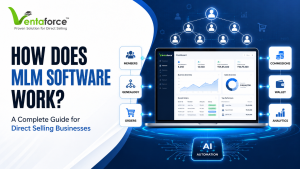
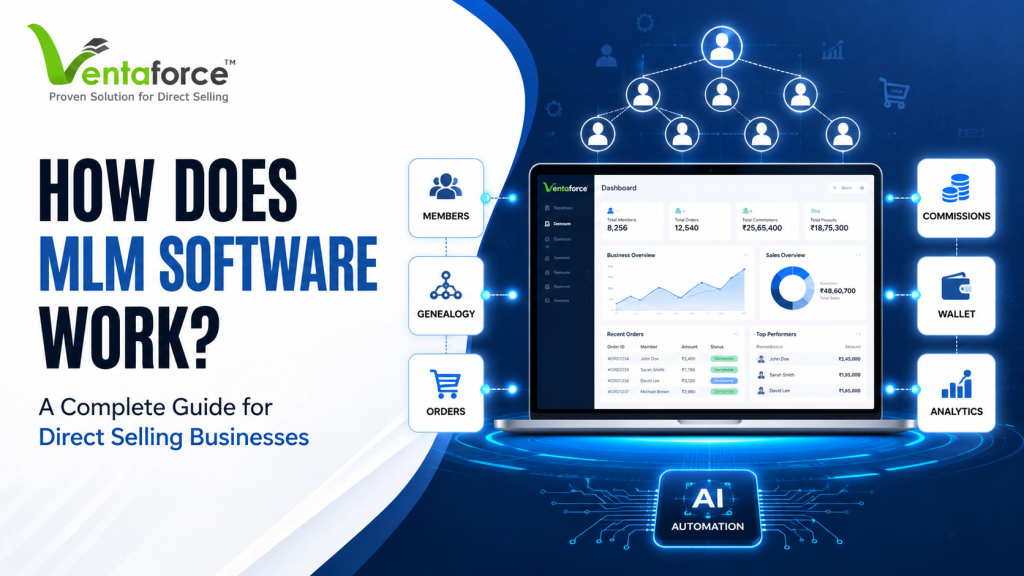
But MLM software is much more than a commission calculator. It connects distributor management, genealogy, orders, compensation, wallets, payouts, reporting and business data into one system.
In this guide, we’ll look at how MLM software actually works behind the scenes, how one order can trigger multiple calculations, how different compensation plans are handled, what happens when a network scales, and what businesses should look for before choosing a platform.
Quick Answer: How Does MLM Software Work?
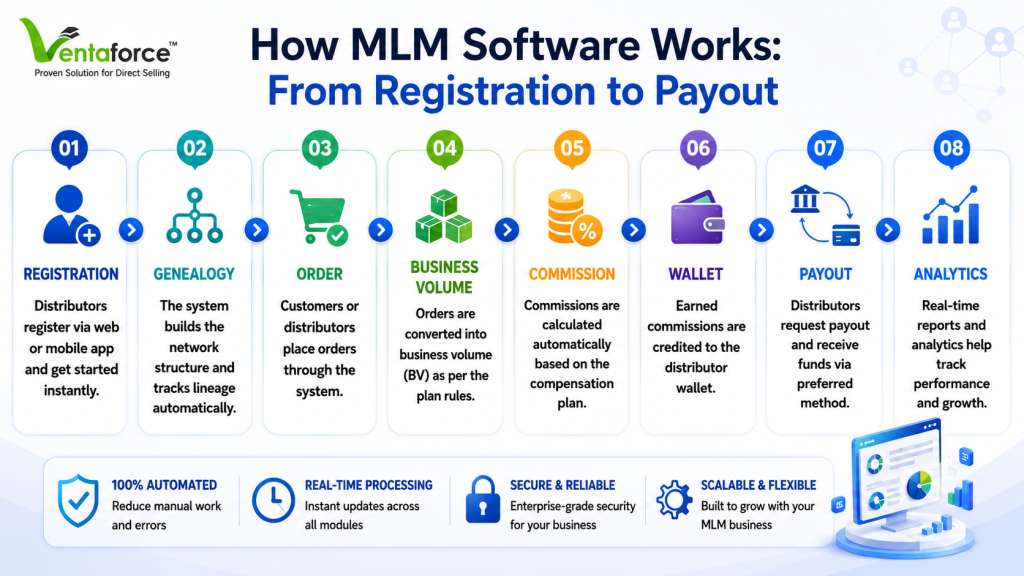
MLM software is a digital system that automates the core operations of a direct selling business. It manages distributors and their network relationships, processes orders, calculates commissions according to predefined compensation rules, updates wallets, manages payouts and generates business reports.
In simple terms:
Member Registration → Genealogy → Order → Business Volume → Commission Calculation → Wallet → Payout → Reporting
The complexity is hidden behind this simple workflow.
Let’s understand what happens at every stage.
What Is MLM Software?
MLM software is specialized business software built for multi-level marketing, network marketing and direct selling companies.
A conventional CRM can manage customers.
An e-commerce platform can manage products and orders.
An accounting system can manage financial transactions.
But a direct selling company has another layer:
the network.
The system needs to understand:
- Who sponsored a distributor?
- Where is that distributor positioned?
- Who is in their downline?
- What sales volume did they generate?
- Which bonuses are they eligible for?
- What rank have they achieved?
- How much commission should they receive?
- Has the commission already been paid?
- What happens if the order is refunded?
That’s why specialized software is often required as a direct selling organization becomes more complex.
Why Does a Direct Selling Business Need MLM Software?
Consider a simple example.
Distributor A sponsors B.
B sponsors C.
C sponsors D.
D purchases products worth ₹10,000.
Depending on the compensation plan, that transaction may affect more than D.
It could contribute to:
- D's personal volume
- C's group volume
- B's group volume
- A's leadership qualification
- Rank progression
- Matching bonuses
- Level-based commissions
- Binary volume
- Other plan-specific incentives
One order has now created several business events.
Imagine processing thousands of similar transactions every day.
This is where manual systems become difficult to maintain.
The purpose of MLM software is to connect these events automatically.
The Complete MLM Software Workflow
At a high level, the process looks like this:
Member Registration
↓
Sponsor & Placement Created
↓
Product Purchase / Order
↓
Business Volume Generated
↓
Compensation Rules Checked
↓
Commission Calculated
↓
Wallet Updated
↓
Withdrawal Requested
↓
Payout Processed
↓
Reports & Analytics Updated
But what actually happens between these steps?
Let’s take one transaction and follow it through the system.
Step 1: Distributor Registration
Everything begins when a distributor or customer joins the organization.
The system may capture:
- Name
- Contact details
- Address
- Sponsor ID
- Placement information
- KYC documents
- Tax details
- Joining package
- Login credentials
- Payment information
Once registration is completed, the platform creates a unique member profile.
But creating the profile isn’t enough.
The system must also determine where the new member belongs in the network.
That takes us to genealogy.
Step 2: Sponsor and Genealogy Management
Genealogy is one of the most important components of direct selling software.
Think of it as the digital structure of the network.
It can show:
Upline
↓
Sponsor
↓
Member
↓
Downline
However, there’s an important distinction between sponsorship and placement.
Sponsor
The person who directly introduced or recruited the new member.
Placement
The position where the member is actually placed in the network.
In some compensation plans these are the same.
In others, they can be different.
A good system needs to understand both relationships because compensation calculations may depend on them.
As new distributors join, the genealogy is updated automatically.
That means administrators don’t have to manually redraw or maintain the network tree.
Step 3: Product or Order Processing
Now the distributor places an order.
The software records information such as:
- Product
- Quantity
- Selling price
- Discount
- Tax
- Customer/distributor
- Payment status
- Order status
- Business volume
- Transaction date
At this point, something important happens.
A normal e-commerce system may consider the transaction complete.
MLM software asks another question:
What does this transaction mean for the compensation plan?
That is where business volume enters the picture.
Step 4: Business Volume Is Generated
Not every compensation plan calculates commissions directly from the selling price.
Instead, the product may have an associated value such as:
- PV — Personal Volume
- BV — Business Volume
- GV — Group Volume
- CV — Commissionable Volume
- Points
For example:
Product price: ₹5,000
Commissionable volume: 3,000 points
The compensation engine may use the 3,000 points rather than the ₹5,000 selling price.
The exact calculation depends entirely on the company’s compensation plan.
This is why compensation-plan configuration is such an important part of MLM software.
Step 5: The Commission Engine Does the Complex Work
This is arguably the heart of the system.
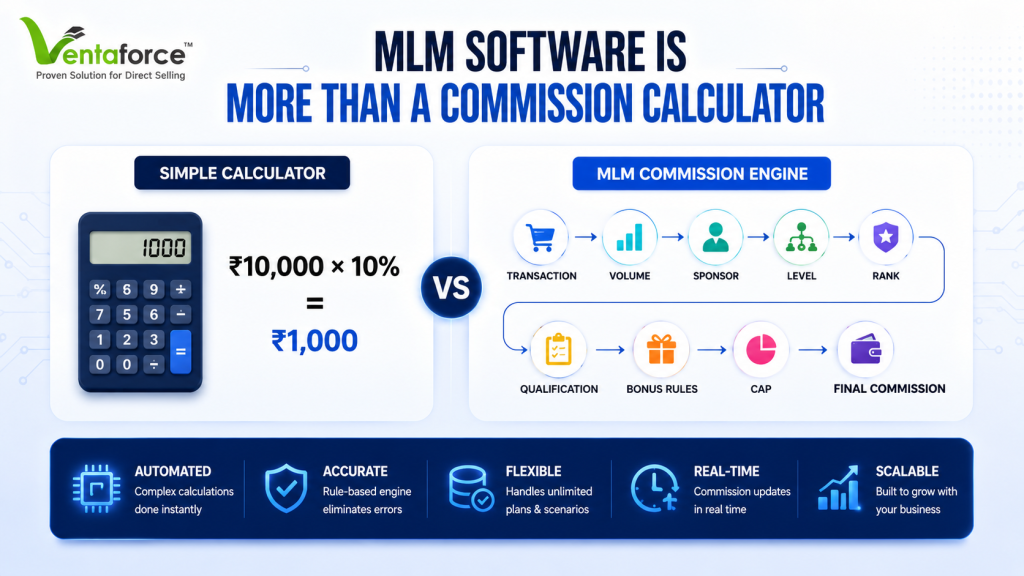
A commission engine is not simply a percentage calculator.
It is a business-rule engine.
Before calculating a commission, the software may need to determine:
1. Who generated the sale?
2. Who is their sponsor?
3. Where are they positioned?
4. What volume was generated?
5. Is the distributor active?
6. Has the distributor met the required qualification?
7. What rank do they hold?
8. Which bonus applies?
9. How many levels are eligible?
10. Is there a payout cap?
11. Is carry-forward applicable?
12. Are deductions required?
13. Has this transaction already been processed?
Only after these rules are evaluated can the system determine the final commission.
A Simple Example of MLM Commission Calculation
Let’s simplify it.
Suppose a compensation plan provides:
- Level 1: 10%
- Level 2: 5%
- Level 3: 3%
A transaction generates ₹10,000 of eligible commissionable volume.
If all three levels qualify:
Level 1: ₹1,000
Level 2: ₹500
Level 3: ₹300
But a real compensation plan could be much more complicated.
It may include:
- Rank requirements
- Minimum personal volume
- Matching bonuses
- Binary pairing
- Maximum payout limits
- Carry-forward volume
- Leadership bonuses
- Tax deductions
- Refund adjustments
- Commission cycles
This is why a serious compensation engine needs to be configurable and auditable.
Calculator vs Commission Engine: What's the Difference?
This is a useful way to think about it.
A calculator answers:
What is 10% of ₹10,000?
A commission engine answers:
Who is entitled to the 10%, under which conditions, based on which transaction, at which level, during which commission period, after applying qualification rules and limits?
The second problem is significantly more complex.
That’s what specialized MLM software is designed to handle.
Step 6: Wallet and Ledger Management
After the commission is calculated, the amount needs to be recorded.
This is where the distributor wallet becomes important.
A wallet may contain transactions such as:
- Commission credited
- Bonus credited
- Purchase deducted
- Tax deducted
- Withdrawal requested
- Withdrawal approved
- Adjustment
- Transfer
- Refund
For example:
Transaction | Amount |
Commission | ₹4,500 |
Bonus | ₹1,200 |
Purchase | -₹1,000 |
Deduction | -₹450 |
Available Balance | ₹4,250 |
The important part isn’t simply displaying ₹4,250.
The system should also show how that amount was created.
That transaction history provides transparency for both distributors and finance teams.
Step 7: Withdrawal and Payout Processing
A wallet balance does not necessarily mean the money has already reached the distributor’s bank account.
There can be several stages:
Commission Calculated
↓
Wallet Credited
↓
Withdrawal Requested
↓
Request Verified
↓
Admin Approved
↓
Payment Processed
↓
Transaction Completed
A structured payout workflow helps finance teams track pending, approved, rejected and completed transactions.
It also reduces the need to maintain separate spreadsheets for withdrawals.
Step 8: Reports and Business Analytics
Now the same operational data becomes useful for management.
Instead of asking only:
“How many distributors do we have?”
management can ask:
- Which regions are growing?
- Which products are selling fastest?
- Which teams are generating the most volume?
- How many distributors became active this month?
- How many became inactive?
- Which ranks are growing?
- What is the total commission liability?
- How much has been paid?
- What are the pending withdrawals?
- Which products have the highest repeat purchases?
This is where the software becomes more than an administrative tool.
It becomes a business intelligence layer.
What Does a Distributor See?
The administrator may see hundreds of settings and reports.
A distributor shouldn’t have to.
A well-designed member dashboard generally focuses on the information that matters to that individual.
My Business
- Personal sales
- Team sales
- Business volume
- Rank
- Rank progress
My Network
- Sponsor
- Genealogy
- Downline
- Team members
My Earnings
- Commissions
- Bonuses
- Wallet
- Withdrawals
- Transaction history
My Orders
- Orders
- Invoices
- Payment status
- Delivery information
The objective is simple:
Hide complexity. Show clarity.
Administrator vs Distributor: Why the Difference Matters
The two users have completely different requirements.
Administrator
Needs:
- Network-wide visibility
- Compensation configuration
- Member management
- Product management
- KYC management
- Payout controls
- Reports
- Tax settings
- Security controls
- Audit trails
Distributor
Needs:
- Personal dashboard
- Genealogy
- Orders
- Earnings
- Wallet
- Rank information
- Profile
- Notifications
Role-based access ensures users see what they need without exposing unnecessary information.
How Does MLM Software Support Different Compensation Plans?
Not every direct selling company operates the same way.
This is why you should never choose a platform simply because it supports “MLM.”
The important question is:
Can it accurately support your compensation structure?
Common models include:
Binary MLM Plan
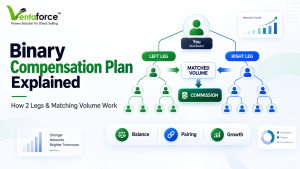
Usually consists of two legs.
The software may track:
- Left volume
- Right volume
- Pairing
- Matching volume
- Carry-forward
- Spillover
- Cycle rules
Unilevel MLM Plan
Distributors can sponsor multiple people directly.
The system needs to track multiple levels of the organization.
Matrix MLM Plan
The network follows predefined width and depth rules.
The platform must manage placement according to the matrix structure.
Generation MLM Plan
Commissions may depend on generations, ranks and leadership qualifications.
Board MLM Plan
Members move through predefined positions based on specific rules.
Hybrid MLM Plan
Some companies combine multiple structures.
The more customized the plan, the more important the underlying commission engine becomes.
Why Compensation-Plan Flexibility Matters
Imagine a company changes one rule.
Before: A leadership bonus requires three qualified levels.
After: The company changes the requirement to five levels.
What happens next?
If the software is heavily hard-coded, even a small change can require development work.
A configurable system can allow business rules to be modified more efficiently.
Important configuration areas can include:
- Bonus percentages
- Qualification requirements
- Levels
- Rank rules
- Volume requirements
- Carry-forward
- Commission cycles
A growing company shouldn’t have to rebuild its entire technology platform every time its business model evolves.
MLM Software Is Really a Relationship + Transaction System
Here’s an important point that is often missed in discussions about MLM technology.
At its core, MLM software connects four things:
1. People
Members, customers, leaders and administrators.
2. Relationships
Sponsors, placements, uplines and downlines.
3. Transactions
Orders, payments, commissions, refunds, withdrawals and adjustments.
4. Rules
The conditions that determine what happens after each transaction.
Once these four elements are connected, automation becomes possible.
That’s the real architecture behind the software.
What Happens When an MLM Network Grows?
This is where the technology challenge changes.
Managing 500 members is very different from managing 50,000.
At a smaller scale, manual processes may still appear manageable.
At a larger scale, you have:
- More transactions
- More genealogy relationships
- More commission calculations
- More wallet activity
- More payout requests
- More reports
- More concurrent users
And peak periods can make the problem even bigger.
For example, imagine thousands of distributors checking their dashboards around the same time a weekly or monthly commission cycle is processed.
The question is no longer:
“Can the software store 100,000 members?”
A better question is:
“Can it process large numbers of transactions and calculations reliably when the network is busiest?”
That is a much more meaningful test of scalability.
Why Data Accuracy Becomes Critical at Scale
Suppose one commission calculation is incorrect.
At a small scale, finance may identify and correct it quickly.
But imagine the same problem affects 20,000 transactions.
Now you have:
- Incorrect wallets
- Distributor complaints
- Reconciliation problems
- Manual adjustments
- Support workload
That’s why serious systems need:
- Transaction histories
- Audit trails
- Permission controls
- Validation rules
- Reconciliation mechanisms
- Backup and recovery processes
Scalability without accuracy isn’t useful.
MLM Software and Compliance: An Important Distinction
Technology can support compliance.
It cannot guarantee that a company’s entire business model is legally compliant.
Software can help manage:
- KYC
- Transaction records
- Audit trails
- Approval workflows
- Tax-related information
- Distributor information
- Compensation calculations
- Access controls
But the legality of a direct selling business depends on its actual business model, compensation structure and practices.
For example, in the United States, the Federal Trade Commission has emphasized that there isn’t a simple percentage test for determining whether an MLM is a pyramid scheme. The overall structure and operation of the business matter.
So the right way to think about it is:
Software can support compliance processes. It does not replace legal advice or regulatory review.
What Should an MLM Business Actually Measure?
A network’s size alone doesn’t tell you whether the business is healthy.
A better analytics strategy looks at several dimensions.
Network Health
- Active distributors
- New distributors
- Retention
- Reactivation
- Rank movement
Sales Health
- Retail sales
- Distributor orders
- Repeat purchases
- Product-wise sales
- Regional sales
Financial Health
- Commission liability
- Payouts
- Refunds
- Wallet balances
- Average order value
Operational Health
- Pending KYC
- Pending withdrawals
- Failed payments
- Order issues
- Support requests
This gives management a more complete view of the business.
Automation Doesn't Always Mean Growth
This is an important point.
It is easy for software companies to say:
“Automate your business and grow 10X.”
Real business outcomes are more complicated.
Software doesn’t automatically create customers or guarantee revenue growth.
Its direct value is usually operational.
For example, a company might measure:
- Reduction in manual commission-processing time
- Faster member onboarding
- Faster reporting
- Reduced reconciliation work
- Faster withdrawal processing
- Fewer repetitive support requests
- Better visibility into network activity
The best way to measure impact is with a before-and-after baseline.
KPI | Before Automation | After Automation |
Member processing time | Measure | Measure |
Commission processing time | Measure | Measure |
Manual reconciliation hours | Measure | Measure |
Withdrawal processing time | Measure | Measure |
Reporting turnaround | Measure | Measure |
Basic information support requests | Measure | Measure |
This is much more meaningful than promising an arbitrary percentage increase in revenue.
Where Is Your Business Losing Time?
Try this quick self-check.
Are you still…
Calculating commissions in Excel?
Your compensation process may need automation.
Manually updating genealogy?
Your network structure may be difficult to scale.
Answering repeated wallet questions?
Your member dashboard may need improvement.
Reconciling payouts manually?
Your financial workflow may need better integration.
Preparing reports at the end of every month?
Your analytics layer may be too dependent on manual work.
Correcting commission errors?
Your compensation rules and transaction controls deserve closer attention.
Sometimes the problem isn’t that your business needs “more software.”
The problem is that one critical process has become too complex to manage manually.
Top 12 Features to Look for in MLM Software
Rather than choosing a platform because it has the longest feature list, evaluate whether it handles the functions your business actually needs.
# | Feature | Why It Matters |
1 | Distributor Management | Centralizes member information |
2 | Genealogy Management | Maintains network relationships |
3 | Commission Engine | Automates compensation rules |
4 | Multiple Compensation Plans | Supports different business models |
5 | E-Wallet | Tracks earnings and transactions |
6 | Payout Management | Structures withdrawal processing |
7 | KYC Management | Supports identity verification workflows |
8 | Product & Order Management | Connects sales with network activity |
9 | Rank Management | Tracks qualification and progression |
10 | Reports & Analytics | Helps management understand performance |
11 | Mobile Access | Gives distributors access anywhere |
12 | Security & Audit Controls | Protects sensitive information |
The important word here is integration.
Having 12 separate features isn’t particularly useful if they don’t communicate with one another.
MLM Software vs Spreadsheet: What's the Real Difference?
A spreadsheet can certainly calculate percentages.
It can even maintain a basic member list.
So why move to specialized software?
Because the challenge isn’t arithmetic.
It’s interconnected operations.
Manual / Spreadsheet Approach | MLM Software |
Manual member updates | Centralized member management |
Static network records | Dynamic genealogy |
Spreadsheet formulas | Compensation engine |
Separate financial records | Integrated wallet |
Manual reports | Automated dashboards |
Manual payout tracking | Structured payout workflow |
Limited access control | Role-based permissions |
Difficult history tracking | Transaction and audit records |
The question therefore isn’t:
“Can Excel calculate commissions?”
Of course it can.
The better question is:
“Can Excel reliably manage thousands of members, relationships, transactions and changing compensation rules at the same time?”
That’s where the difference becomes clear.
When Should a Company Invest in MLM Software?
There isn’t a magic number such as 1,000 or 10,000 distributors.
The right time depends on complexity.
Consider implementing specialized software when:
- Commission calculations are becoming difficult.
- Spreadsheets are being used across multiple departments.
- Distributors need real-time information.
- Payout processing takes too long.
- Network placement requires manual work.
- Management waits for reports.
- Different systems contain conflicting information.
- The compensation plan is becoming more complex.
- Your company is entering multiple markets.
- The number of daily transactions is increasing.
In other words:
You don’t necessarily need MLM software because your network is large.
You may need it because your business processes have become too complex to manage manually.
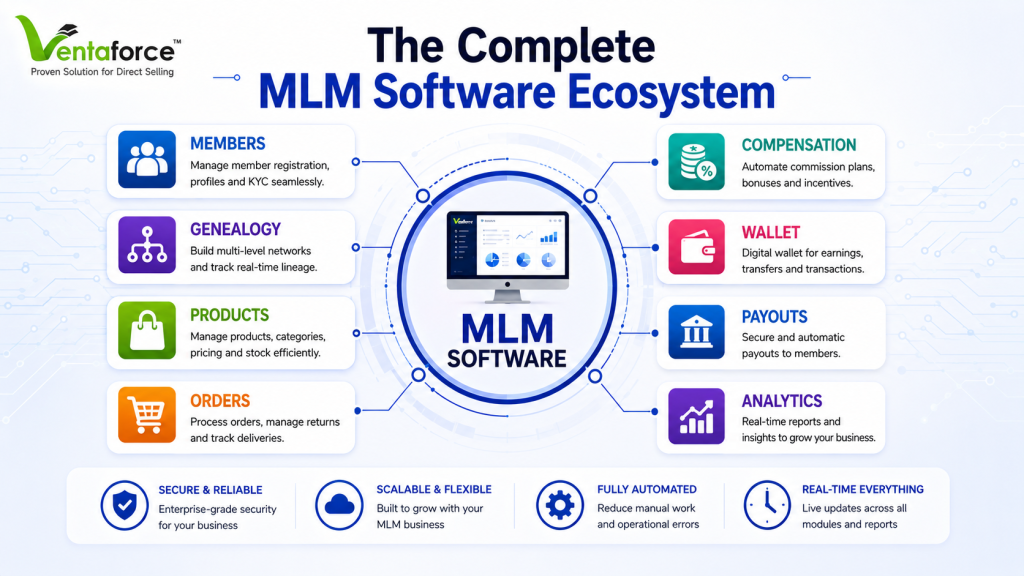
What Does a Complete Direct Selling Software Ecosystem Look Like?
A mature platform can connect the entire business:
Website / Mobile App
↓
Registration & KYC
↓
Member Management
↓
Genealogy
↓
Products & Orders
↓
Business Volume
↓
Compensation Engine
↓
Wallet & Ledger
↓
Payouts
↓
Analytics & Reporting
↓
Management Decisions
Instead of different teams working from disconnected spreadsheets and systems, information flows through one connected ecosystem.
Where Does AI Fit Into MLM Software?
AI is becoming increasingly relevant to business software, but there is an important principle to remember:
AI is only as useful as the data underneath it.
If genealogy data is inaccurate, commission records are inconsistent or transactions are incomplete, adding AI won’t fix the foundation.
The evolution is better understood as:
Manual
↓
Digital
↓
Automated
↓
Data-Driven
↓
Intelligent
AI can potentially help identify:
- Unusual transaction patterns
- Changes in distributor activity
- Sales trends
- Potential inactivity
- Rank progression patterns
- Commission anomalies
- Frequently asked distributor questions
For example, an Ventaforce AI Copilot could answer:
“Which of my team members are closest to the next rank?”
Instead of a distributor searching through multiple reports.
This is one area where newer platforms, including AI-enabled solutions such as Ventaforce, are moving beyond traditional automation toward more intelligent business assistance.
The technology should complement the core system—not replace it.
A Simple MLM Software Readiness Test
How ready is your business for automation?
Answer Yes or No:
1. Do you calculate commissions manually?
2. Do distributors frequently ask about their wallet or earnings?
3. Is genealogy difficult to maintain?
4. Do payout processes require several manual steps?
5. Does management depend on manually prepared reports?
6. Are you planning to expand into new regions or countries?
7. Are you introducing new products or compensation rules?
Your Result
0–2 Yes:
Your current processes may still be manageable, but monitor complexity as you grow.
3–5 Yes:
You are likely entering the stage where automation can significantly reduce operational workload.
6–7 Yes:
Your business may benefit from a centralized platform designed to manage network, transactions and compensation at scale.
This isn’t a scientific benchmark.
It’s simply a useful way to identify operational pressure points.
15 Questions to Ask Before Choosing MLM Software
Don’t start a vendor conversation with:
“How many features do you have?”
Start here.
Compensation
1. Can the platform support our exact compensation plan?
2. Can compensation rules be configured?
3. How are commission adjustments handled?
4. How are refunds and chargebacks treated?
Network
5. How does the platform handle large genealogy structures?
6. Can sponsor and placement relationships be separated?
7. How quickly are network changes reflected?
Finance
8. Does the system maintain a complete wallet ledger?
9. How are withdrawals approved?
10. Can taxes and deductions be tracked?
Operations
11. How does KYC work?
12. Can orders and commissions be connected?
13. What reporting capabilities are available?
Security
14. How are sensitive member and financial records protected?
15. Is there an audit trail for important administrative actions?
These questions will tell you much more about a platform than a long feature checklist.
The Future of MLM Software
The future isn’t simply about adding more features.
It’s about making complex businesses easier to understand and operate.
The evolution of direct selling technology is moving toward:
Automation → Integration → Analytics → Intelligence
The software of the future won’t simply tell a company:
“You generated ₹50 lakh in sales.”
It will increasingly help answer:
“Where did the growth come from?”
“What changed this month?”
“Which teams need attention?”
“Where are operational problems occurring?”
“What should management investigate next?”
That shift—from recording information to understanding information—is likely to become one of the most important developments in direct selling technology.
Final Thoughts
A direct selling network may grow one distributor at a time.
But every new distributor creates new relationships, transactions, calculations, records and business rules.
That’s why MLM software isn’t simply a tool for calculating commissions.
It is the infrastructure that connects:
People + Relationships + Products + Transactions + Compensation + Financial Records + Business Intelligence
The right platform should make this complexity easier to manage without forcing the business to compromise its compensation model or operational requirements.
So when evaluating MLM software, don’t ask only:
“How many features does it have?”
Ask:
“Can it accurately represent how our business works today—and continue to support us as the business becomes more complex?”
That is the question that matters.
And whether you’re running a small network, an established direct selling company or a rapidly expanding international organization, the best technology decision starts with understanding your processes, compensation rules, data, compliance requirements and growth plans.
The software should then support that business—not the other way around.
One Final Question
If your distributor network doubled tomorrow:
Would your current systems handle it—or would your team simply have twice as much manual work?
That question may tell you more about your technology readiness than any software feature list.
Frequently Asked Questions (FAQ)
MLM software is a specialized platform that helps direct selling and network marketing companies manage distributors, genealogy, orders, compensation, wallets, payouts and business reporting from a centralized system.
It connects distributor registration, genealogy, product transactions, business volume, compensation rules, commission calculation, wallets, payouts and reporting into one automated workflow.
The software uses a compensation engine to evaluate transactions against predefined rules such as volume, levels, ranks, qualifications, percentages, caps and other conditions.
Genealogy is the digital representation of a distributor network. It shows relationships such as sponsors, placements, uplines and downlines.
Many platforms support multiple structures, including Binary, Unilevel, Matrix, Generation, Board and customized or hybrid compensation plans.
CRM software primarily manages customer relationships and sales interactions. MLM software additionally manages distributor networks, genealogy, compensation, ranks, commissions and payouts.
Yes. Depending on the platform, product and order management can be connected with distributor accounts, business volume and compensation calculations.
An e-wallet records financial transactions associated with a distributor, including commissions, bonuses, deductions, transfers and withdrawals.
Many platforms can automate or streamline withdrawal requests, approvals, deductions, payment processing and payout records.
Depending on the platform, international direct selling operations may require features such as multiple currencies, languages, taxation, regional rules and country-specific payout processes.
No. Software can support compliance processes and record keeping, but legal compliance depends on the company’s business model, compensation structure, marketing practices and applicable regulations.
There is no universal member threshold. A company should consider it when manual calculations, spreadsheets, genealogy management, reporting or payout processes become difficult to manage accurately and efficiently.