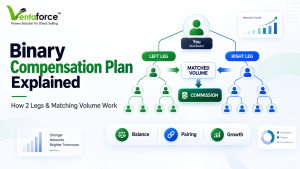
What Is a Binary Compensation Plan? Complete Guide With Examples (2026)
If you’ve ever sat in a direct selling meeting and heard someone say “just build two legs and let the spillover do the work,” you’ve bumped into the binary compensation plan — one of the most popular (and most misunderstood) payout structures in the MLM and direct selling world.
This guide breaks it down the way an actual MLM consultant would explain it to a founder over coffee — no jargon dump, no recycled Wikipedia definition. By the end, you’ll know exactly how binary plans work, how commissions are calculated, where they can go wrong, and whether they’re the right fit for your business.
What Is a Binary Compensation Plan?
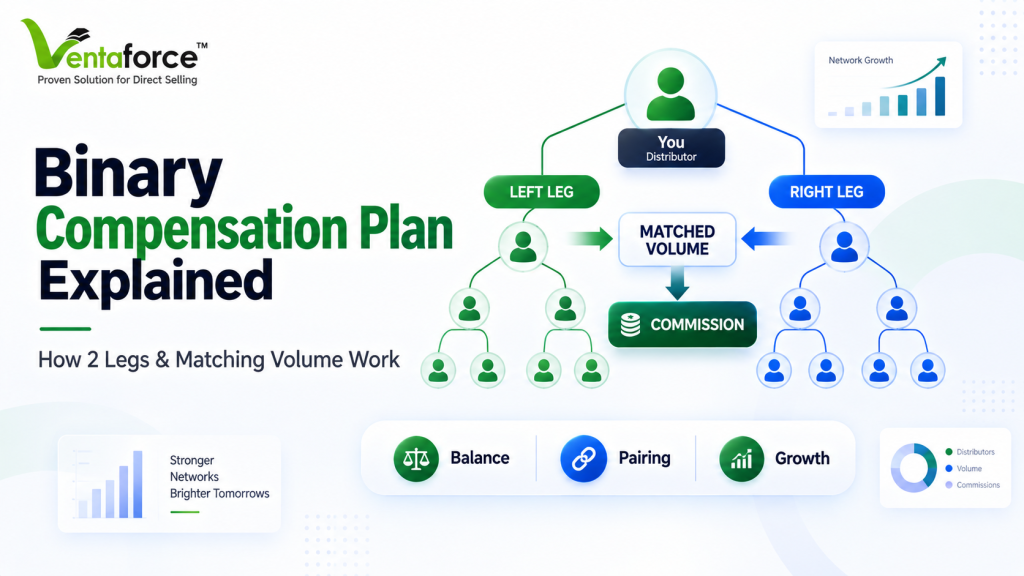
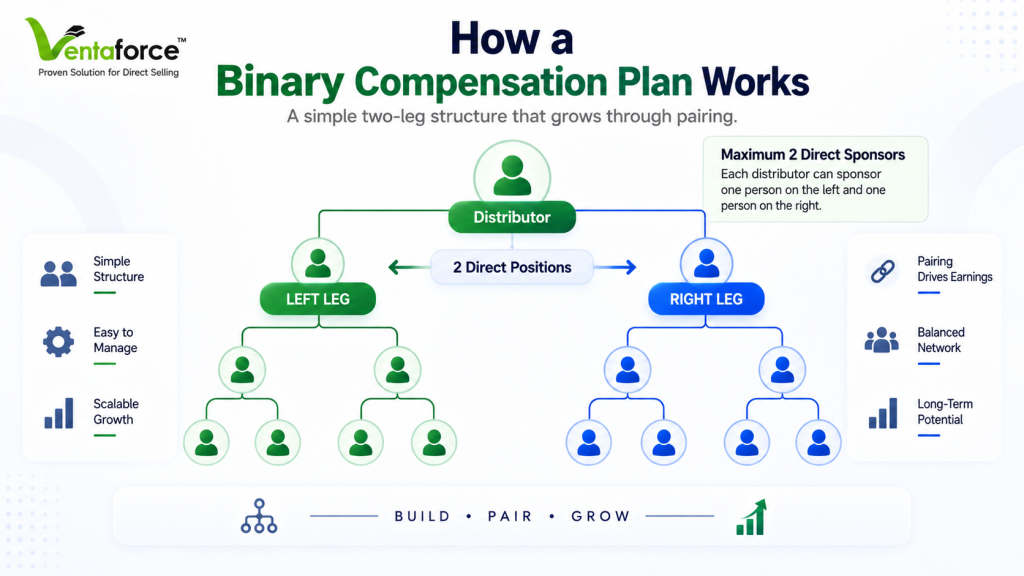
A binary compensation plan is a network marketing structure where every distributor can sponsor a maximum of two people directly — one on the left and one on the right. Each of those two can also sponsor two more, and so on, creating a tree that branches out in pairs.
Think of it like a family tree that’s forced to have exactly two children per person. That’s the whole trick of the “binary” name — it’s built on the number two.
The company pays commission when the volume (sales) on the left side matches the volume on the right side. This is called pairing or matching, and it’s the heartbeat of every binary plan.
How Does a Binary Plan Actually Work? (Step-by-Step)
Let’s say you join a company and become a distributor.
1. You sponsor two people
one goes into your left leg, one into your right leg.
2. Anyone you recruit after that doesn’t sit directly under you — they get placed further down the tree, usually under your existing left or right leg. This is called spillover.
3. Both legs generate sales volume (called Business Volume or BV) as your team sells products or brings in new members.
4. The company looks at whichever leg has less volume — that’s your weaker leg.
5. You get paid a percentage on the volume that matches between both legs. Extra volume on the stronger side usually carries forward to the next cycle (this is called flush or carry forward, depending on the company).
Simple Example
Imagine your plan pays 10% on matched volume, calculated weekly.
Leg | Volume This Week |
Left Leg | $10,000 |
Right Leg | $6,000 |
- Matching volume = $6,000 (the smaller side)
- Commission = 10% of $6,000 = $600
- The leftover $4,000 on the left leg usually carries over to next week (subject to company rules and caps)
This is why binary plans reward balance, not just raw recruiting. A distributor with $50,000 on one leg and $500 on the other only gets paid on $500 worth of matching.
Why Direct Sellers Love (and Sometimes Hate) Binary Plans
The Upside for Distributors
- Team spillover benefit
New recruits placed by your upline or company can land in your downline, helping you earn even without personally sponsoring them.
- Faster earning potential early on
Because pairing happens frequently (often daily or weekly), new distributors can see commissions sooner than in plans that require deep unilevel structures.
- Simple to explain
“Build two teams, get paid when they match” is far easier to pitch than complex multi-leg or matrix plans.
The Catch
- Weak leg dependency
Your income is capped by your weakest leg, no matter how strong the other side is.
- Volume flush risk
Unused volume beyond company caps can be lost if not matched in time.
- Spillover complacency
Some distributors sit back expecting spillover instead of actively recruiting — which usually backfires because spillover isn’t guaranteed or controllable.
Expert Tip: A binary plan rewards team balancing, not just recruiting. Train your distributors to always ask, “Which leg needs volume this week?” before pushing new sign-ups into either side. Smart leg management often earns more than aggressive recruiting.
Busting the Biggest Binary Plan Myth: "Spillover Means I Don't Have to Work"
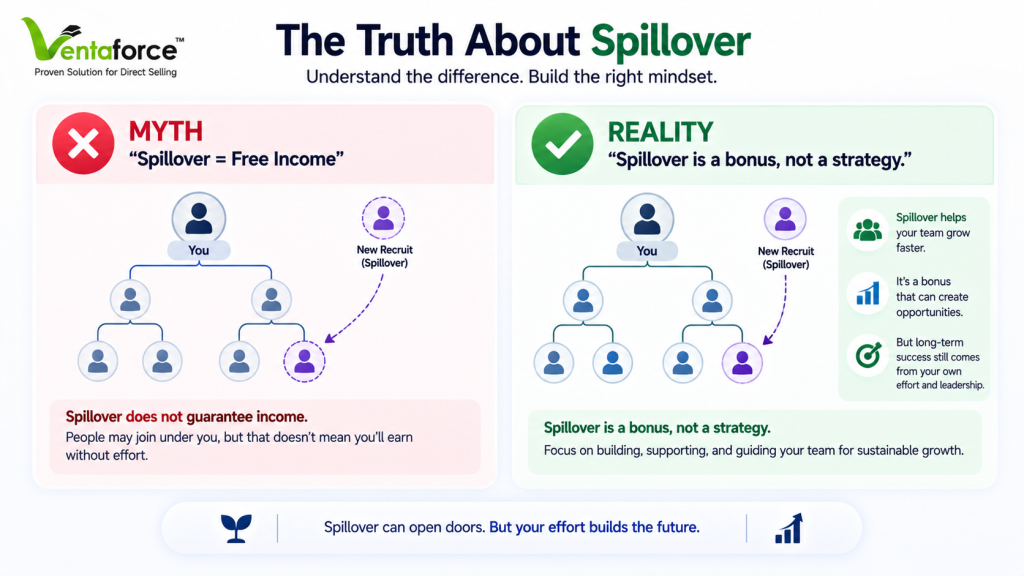
This single misunderstanding causes more distributor drop-off than any compensation math ever will. New recruits hear “spillover” and picture free income landing in their lap. It doesn’t work that way.
Spillover only happens when your upline (or the people above them) has more recruits than they can place directly, so the overflow lands under you. It’s a bonus, not a strategy. Distributors who sit back waiting for spillover almost always end up with one dead leg and no matching commission, because spillover is unpredictable and never guaranteed to balance both sides evenly.
The distributors who actually earn well treat spillover as a nice surprise on top of consistent personal sponsoring — not a substitute for it.
"My upline put weak recruits on my leg — is that even allowed?"
This is the other objection that comes up constantly, usually from someone who feels the system is rigged against them. Here’s the honest answer: yes, it’s allowed, and it’s not personal.
Placement in a binary plan generally follows one of two rules, set by the company, not by any individual upline:
- Fixed placement
new recruits go strictly into whichever leg is next in line, in order, with no manual choice involved.
- Discretionary placement
an upline (or the company’s placement algorithm) can choose which leg a new recruit lands in, often to help balance a struggling downline.
If your upline placed someone inactive on your leg, it’s usually not sabotage — it’s more often a company default rule you haven’t learned yet, or an attempt to fill your weaker side. Before assuming bad intent, ask your upline or support team two things: what’s our placement policy, and can I request placement in a specific leg for my own recruits. Most binary plan software actually lets you choose left or right when you personally sponsor someone — many new distributors just don’t realize that control exists.
Expert Tip: If placement genuinely feels unfair, don’t fight it after the fact — get your company’s written placement policy on day one, before you start recruiting. It’s far easier to plan your strategy around known rules than to dispute a placement after volume has already been counted.
Your First 30 Days on a Binary Plan (Action Steps for New Distributors)
If you just joined a binary plan and the theory above makes sense but you’re not sure what to do, start here:
1. Sponsor your first two people fast.
One goes left, one goes right. Don’t wait for the “perfect” recruit — an imperfect one in each leg beats a perfect one in only one leg.
2. Track both legs weekly, not just total team size
Ask: which leg is behind? Put your next recruiting push there.
3. Don't stack all your personal recruits on one side just because it's growing faster
It feels productive but caps your commission at the weaker leg regardless.
4. Learn your company's flush/carry-forward window on day one
Missing a matching cycle because you didn’t know volume expires is the single most common rookie mistake.
5. Set a weekly "leg check-in"
Five minutes reviewing left vs right volume — so imbalance never sneaks up on you.
Expert Tip: The fastest binary earners aren’t the biggest recruiters — they’re the best balancers. A distributor with 500 people split 250/250 consistently out-earns one with 800 people split 700/100.
Binary Plan vs Other Compensation Plans (Quick Comparison)
Plan Type | Structure | Best For |
Binary Plan | 2 legs per person, paid on matching volume | Fast-growing teams, simple explanation to new joiners |
Unilevel Plan | Unlimited direct recruits, paid by level depth | Businesses wanting flat, easy-to-track structures |
Matrix Plan | Fixed width and depth (e.g., 3×7, 5×5) | Companies wanting controlled, capped growth |
Generation Plan | Paid across “generations” of leaders | Established MLMs with strong leadership tiers |
If you’re a startup evaluating which plan to launch with, the binary plan is popular because it’s fast to explain in a sales pitch and creates quick early momentum through spillover — but it needs strong MLM software to track pairing, caps, and flushing accurately, or payouts can spiral out of control.
If you’re an established business already running a binary plan and things feel “off” — commissions too high, weak-leg abuse, or distributors gaming spillover placement — the fix is usually not to abandon the plan, but to tighten your caps, flush rules, and placement logic (see below).
Key Terms Every Binary Plan Owner Should Know
- BV (Business Volume)
The point value assigned to a product sale, used for commission calculation instead of raw currency.
- Pairing/Matching
The act of matching equal volume from both legs to trigger a payout.
- Flush Out
Unmatched volume that expires if not paired within the cycle (daily/weekly/monthly, depending on the company).
- Capping
A maximum commission limit per distributor per cycle, used to control payout liability.
- Spillover
Extra recruits placed under an existing distributor by upline or auto-placement systems.
- Weak Leg / Power Leg
The leg with less volume (weak) vs. more volume (power/strong).
A Real-World Style Example (With Numbers)
Let’s walk through Priya, a distributor at a wellness products company running a binary plan with:
- 10% matching commission
- Daily pairing cycle
- Cap of $1,000/day per distributor
Day 1
- Left leg volume: $8,000
- Right leg volume: $3,000
- Matched volume: $3,000 → Commission: $300
- Carry forward: $5,000 (left leg)
Day 2
- New left leg volume: $2,000 (total available: $7,000 with carry forward)
- New right leg volume: $6,000
- Matched volume: $6,000 → Commission: $600
Day 3
- Left leg volume: $9,000 (total available: $10,000)
- Right leg volume: $1,000
- Matched volume: $1,000 → Commission should be $1,000, but capped at $1,000/day, so no change here — but if commission had crossed $1,000, it would be capped.
Notice how Priya’s income depends entirely on keeping both legs fed consistently — not just one side exploding with sales.
Expert Tip: Most successful binary earners set a personal rule — “for every 2 recruits I bring in, one goes left, one goes right” — to avoid one leg ballooning while the other starves.
Common Mistakes Startups Make With Binary Plans
1. No capping strategy
Leads to runaway commission liabilities that can bankrupt a young company.
2. Unclear flush/carry-forward rules
Distributors get confused and frustrated when volume disappears.
3. Manual tracking
Binary plans are volume- and time-sensitive; spreadsheets break down fast. Dedicated MLM binary plan software is almost mandatory once you cross a few hundred distributors.
4. Copy-pasting another company's plan
Payout percentages and caps should be modeled against your product margins, not just copied from a competitor.

Common Mistakes Startups Make With Binary Plans
Choose a binary plan if:
- You want a simple, easy-to-pitch structure for new distributors
- You expect rapid team growth and want spillover to help retain early recruits
- You're comfortable investing in proper compensation-plan software from day one
Consider an alternative if:
- You want commissions tied more directly to personal recruiting effort (unilevel may fit better)
- You want tighter control over payout structure with fixed width/depth (matrix plan)
- You're building a plan around long-term leadership development (generation plan)
Final Takeaway
A binary compensation plan isn’t magic — it’s math. Two legs, matched volume, and a payout formula. What separates a thriving binary-plan company from a struggling one is discipline in capping, clear flush rules, and solid tracking software — not the plan structure itself.
Whether you’re a startup picking your first compensation plan or an established business trying to finally understand the binary structure your company already runs on, the core idea stays the same: balance your legs, understand your caps, and always know where your volume is going.

Frequently Asked Questions (FAQ)
Most companies run daily or weekly pairing cycles, though some use monthly cycles depending on product type and cash flow.
You can only sponsor two people directly. Anyone beyond that is placed elsewhere in the tree through spillover — you still benefit from their volume, just not as a direct downline.
Depending on company policy, it either flushes (expires) or carries forward to the next cycle, up to a set limit.
No. A binary plan is a compensation structure used by legitimate direct selling and MLM companies to distribute commissions based on product sales volume. Legality depends on whether the business is genuinely selling products/services to end customers — not on the shape of the compensation tree itself.