Over the last 24+ years of working with MLM and direct selling businesses, we’ve seen a common pattern.
Most founders don’t start their businesses thinking about software.
They start with a vision.
- A vision of building a strong distributor network.
- A vision of creating life-changing products.
- A vision of expanding into new markets and helping thousands of people build successful businesses.
In the beginning, everything revolves around growth.
More distributors.
More customers.
More sales.
More markets.
And that’s exactly how it should be.
After all, growth is what every MLM company is working toward.
In fact, when we speak with founders and executives, the conversations are often very similar.
- "We want to enter new countries."
- "We want to reach 100,000 distributors."
- "We want to launch globally."
- "We want to become a leading direct selling company."
The ambition is real.
The opportunity is often real too.
But here’s something we’ve observed repeatedly.
The companies that talk about 10X growth are not always the companies that achieve it.
What’s even more surprising is that many of them have everything they need on the surface.
Strong products, Experienced leadership, A motivated distributor network, A clear business strategy.
Yet somewhere along the journey, growth starts becoming harder.
Expansion takes longer than expected.
Operational challenges begin appearing.
Teams spend more time managing processes than driving innovation.
Leaders struggle to get the information they need.
And suddenly, a business that was built for growth starts feeling difficult to scale.
Not because the market disappeared.
Not because distributors stopped joining.
Not because the opportunity became less attractive.
But because the infrastructure supporting the business was never designed for the level of growth the company was trying to achieve.
And one of the biggest parts of that infrastructure is MLM software.
The challenge is that software limitations rarely show up when a business is small.
They appear when thousands of distributors expect instant access to information, reports, and earnings. By the time many businesses recognize the problem, growth has already started slowing down.
That’s why one of the most important questions every MLM founder should ask isn’t :
“How do we grow faster?”
It’s:
“Can our current systems support the growth we’re planning?”
Because in today’s direct selling industry, having a big vision is only part of the equation.
The businesses that achieve sustainable growth are usually the ones that prepare their infrastructure before growth arrives.
Why Do Some MLM Companies Grow Faster Than Others ?
This is one of the most interesting questions we’ve encountered over the years.
If you ask ten people, you’ll probably hear ten different answers.
- Some will say it's because of better products.
- Others will point to stronger leadership.
- Some believe success comes from having the right compensation plan, while others credit marketing, timing, or market demand.
- And to some extent, they're all right.
These factors certainly play an important role in growth.
However, after working closely with MLM businesses at different stages of growth, we’ve noticed something that often gets overlooked.
The companies that consistently scale faster aren’t always the ones with the best products.
They’re not always the ones with the most aggressive marketing budgets.
And they’re not always the ones with the largest distributor networks.
What sets many of them apart is their ability to support growth when it arrives.
That might sound obvious, but it’s a distinction many businesses miss.
Most companies spend a significant amount of time thinking about how to create growth.
They focus on attracting more distributors, increasing sales, launching new products, and entering new markets.
Very few spend the same amount of time thinking about what happens after growth begins.
- What happens when distributor registrations suddenly double?
- What happens when a successful leader builds a team of thousands?
- What happens when demand comes from multiple countries at the same time?
- What happens when your compensation plan becomes more sophisticated as the business evolves?
Growth creates opportunities, but it also creates pressure.
And pressure has a way of exposing weaknesses that were never visible before.
Over the years, we’ve seen businesses with incredible momentum struggle simply because their operational systems weren’t prepared for the success they had worked so hard to achieve.
Meanwhile, other companies continued scaling smoothly because they had invested in the right foundation early.
- They didn't wait until operational challenges appeared.
- They prepared for them in advance.
- They understood that growth isn't just about generating momentum.
It’s about sustaining momentum.
Think of it like building a bridge.
Most people focus on how far the bridge can reach.
Very few think about how much weight it will eventually need to carry.
An MLM business works in much the same way.
Attracting growth is important.
But supporting that growth is what determines whether the business can continue scaling year after year.
The companies that grow fastest often have one thing in common:
- They build for the business they want to become, not just the business they are today.
- They invest in scalability before scalability becomes urgent.
- They think beyond current numbers and current markets.
- And most importantly, they recognize that sustainable growth requires more than ambition.
It requires infrastructure, systems, and technology capable of supporting a much larger vision.
The Stage Where Most MLM Businesses Feel Comfortable
In the early stages, nearly every software platform appears sufficient.
The distributor network is manageable.
Commissions are relatively simple.
Support tickets are limited.
Reports generate quickly.
Everything feels under control.
At this stage, founders naturally focus on sales and recruitment.
Software becomes background infrastructure.
Nobody talks about it.
Nobody worries about it.
Because nothing appears broken.
The problem is that software limitations rarely reveal themselves during stability.
They reveal themselves during growth.
What Happens When an MLM Business Starts Scaling ?
Every founder dreams of reaching the stage where growth starts accelerating.
Distributor registrations are increasing.
- Sales are growing consistently.
- Leaders are building larger teams.
- New markets are showing interest in the opportunity.
From the outside, everything looks like success.
But this is also the stage where many businesses discover that growth creates a new set of challenges.
What worked when managing 5,000 distributors may not work when managing 50,000.
Commission structures become more complex. Transaction volumes increase. Support requests grow. Leadership teams need deeper insights and faster access to business data.
In other words, the business becomes more sophisticated.
And that’s where software starts playing a much bigger role.
Over the years, we’ve observed that growth rarely breaks a business overnight. Instead, it exposes limitations that were hidden during the early stages.
The question is no longer, “Can the software run the business?”
The real question becomes:
“Can the software support the business we’re becoming ?”
What Happens When an MLM Business Starts Scaling ?
One of the biggest misconceptions in the MLM industry is that growth solves problems.
In reality, growth often reveals them.
We’ve seen companies operate comfortably for years with a few thousand distributors. Commissions are processed on time, reports are easy to manage, and the system appears to work perfectly.
Then growth happens.
A product goes viral.
A leader builds a massive team.
A new country opens up.
Distributor registrations start increasing faster than expected.
And suddenly, the business feels different.
Not because something went wrong.
But because growth changes everything.
The processes that worked for 5,000 distributors may struggle at 50,000.
The reports that once provided enough information no longer give leadership the visibility they need.
The system that handled a few thousand transactions now has to manage hundreds of thousands.
This is the stage where many founders realize they are no longer running the same company they started.
The business has evolved.
The demands have evolved.
The expectations have evolved.
The question is whether the software has evolved too.
Because from what we’ve observed, businesses rarely outgrow their ambition.
They outgrow the systems that were supposed to support it.
“Businesses rarely outgrow their ambition. They outgrow the systems that were supposed to support it.”
Why Multi-Country Expansion Exposes Software Limitations ?
One of the most common goals among MLM companies is international expansion.
The opportunity is obvious.
- New customers.
- New distributors.
- New revenue streams.
- Larger markets.
However, entering another country introduces far more complexity than many businesses anticipate.
Now the business must manage different currencies.
- Different tax structures.
- Different regulations.
- Different languages.
- Different payment methods.
- Different compliance requirements.
A software platform designed primarily for local operations often struggles to support global operations efficiently.
This is one of the reasons some companies expand successfully while others encounter operational bottlenecks despite strong demand.
Does Multilingual MLM Software Really Matter ?
Many founders initially view multilingual support as a convenience feature.
But from what we’ve observed, it directly affects growth.
Consider a distributor joining from a new market.
They’re excited.
They’re motivated.
They’re ready to build.
But when they access the platform, the dashboards, reports, notifications, and business tools are not available in their preferred language.
Immediately, engagement becomes harder.
People build businesses faster when systems feel familiar.
Multilingual support isn’t simply about translation.
It’s about accessibility.
And accessibility influences adoption.
The Question Most Founders Don't Ask
Most MLM founders ask:
“How can we grow faster?”
A more important question might be:
“If growth happens tomorrow, can our systems support it?”
Because growth itself is rarely the problem.
The inability to support growth is the problem.
There is a major difference.
One creates opportunity.
The other creates bottlenecks.
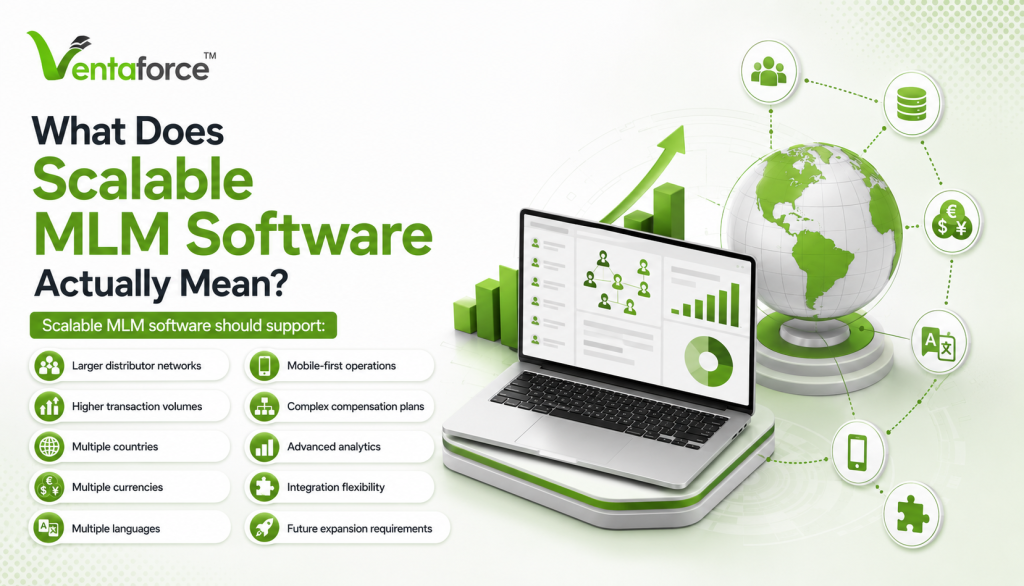
What Does Scalable MLM Software Actually Mean ?
Many people assume scalability means handling more users.
The reality is much broader.
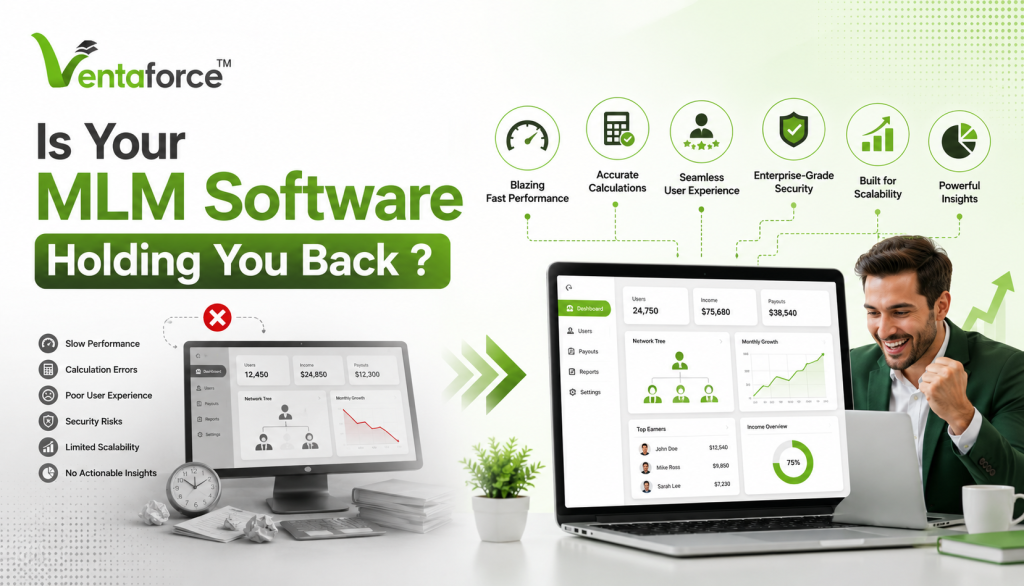
Scalable MLM software should support :
- Larger distributor networks
- Higher transaction volumes .
- Multiple countries
- Multiple currencies
- Multiple languages
- Mobile-first operations
- Complex compensation plans
- Advanced analytics
- Integration flexibility
- Future expansion requirements
The goal isn’t simply to support today’s business.
The goal is to support the business you intend to become.
The Real Cost of Outgrowing Your Software
The cost isn’t just technical.
It’s strategic.
When software becomes a limitation, businesses often experience slower decision-making, increased operational overhead, reduced distributor satisfaction, and delayed expansion initiatives.
These costs rarely appear on a financial statement.
Yet they affect growth every day.
That’s why the most successful MLM businesses treat software differently.
They don’t view it as a tool.
They view it as infrastructure.
Just as a building depends on its foundation, growth depends on the systems supporting it.
Final Thoughts
Over the last 24+ years, we’ve seen MLM companies launch new products, enter new markets, and build distributor networks that span countries and continents.
And one thing has become very clear.
Most businesses don’t struggle because they lack ambition.
They struggle because the systems supporting that ambition were never built for the scale they eventually reached.
The reality is that growth changes everything.
The business you’re running today will not be the same business you’re running three or five years from now.
Your distributor network will grow.
Your operations will become more complex.
Your reporting requirements will increase.
Your leaders will expect greater visibility.
Your customers and distributors will demand better digital experiences.
The question is whether your software will be ready for that future.
Because when growth starts accelerating, it’s often too late to discover that your systems can’t keep up.
From our experience, the most successful MLM companies don’t wait for operational challenges to appear before they start thinking about scalability.
They prepare early.
They invest in the right foundation.
They build systems that support not only where the business is today, but where they want it to be tomorrow.
So before planning your next market expansion, your next product launch, or your next growth target, ask yourself one simple question:
If my MLM business grows 10X over the next few years, will my current software help drive that growth—or become the reason it slows down?
The answer to that question may reveal more about your future growth potential than any sales forecast ever could.
Thinking about 10X growth? Start with the foundation.
Explore how Ventaforce MLM Software helps businesses Grow 10x and scale across countries, currencies, and distributor networks with confidence.
- Key Takeaways
✔ Growth often exposes software limitations that remain hidden during the early stages of business.
✔ Scalable MLM software supports larger networks, higher transaction volumes, and international expansion.
✔ Distributor experience directly influences engagement, retention, and long-term growth.
✔ Multi-country growth requires support for multiple currencies, languages, compliance requirements, and payment systems.
✔ Businesses that prepare for scalability early are better positioned to achieve sustainable 10X growth.
Frequently Asked Questions (FAQ)
MLM companies that grow consistently usually focus on more than recruitment and sales. They invest in scalable systems, automation, distributor experience, and operational efficiency. While products and leadership matter, sustainable growth often depends on how well the business can support increasing distributor networks and transaction volumes.
Yes. As an MLM business grows, software limitations can create operational challenges such as delayed reporting, manual commission processing, poor distributor experiences, and difficulties managing multiple markets. These bottlenecks can slow down expansion and reduce overall efficiency.
One of the biggest challenges is scalability. Many MLM companies start with software that works well for a smaller network but struggle when distributor numbers, transactions, and operational complexity increase. Growth often exposes limitations that were not visible during the early stages.
Some common signs include increasing manual work, dependence on spreadsheets, delayed commission calculations, limited reporting capabilities, rising support requests, and difficulty expanding into new countries. If operations become more difficult as the business grows, the software may be part of the problem.
Rapid growth increases complexity across every department. More distributors, more transactions, more commissions, and more support requests create additional operational demands. Businesses that lack scalable infrastructure often struggle to manage this complexity efficiently.
Yes. Distributors interact with the software daily to check commissions, monitor team performance, and manage their business activities. If the platform is difficult to use, lacks mobile accessibility, or provides a poor user experience, engagement and retention can decline over time.
Automation plays a critical role in scalability. Automated commission processing, reporting, distributor onboarding, and order management reduce manual work and help businesses handle larger networks without significantly increasing operational costs.
Many companies focus on market opportunities but underestimate operational requirements. International expansion often requires support for multiple currencies, languages, tax structures, compliance requirements, and payment methods. Without the right software infrastructure, scaling globally becomes difficult.
Yes. Multilingual platforms help distributors understand the system more easily, improve adoption rates, reduce confusion, and create a better overall experience. This becomes especially important when expanding into multiple countries.
Before pursuing aggressive growth targets, founders should evaluate whether their technology, operations, reporting systems, compensation management, and distributor experience can support a significantly larger business. Sustainable growth requires infrastructure that can scale alongside the organization.
In most cases, upgrading before major growth initiatives is the smarter approach. Businesses that prepare their systems early are typically better positioned to handle increased demand, larger distributor networks, and expansion into new markets.
Preparing for 10X growth requires more than recruitment and sales strategies. Companies need scalable software, automated operations, strong reporting capabilities, global-ready infrastructure, and systems capable of supporting larger distributor networks, higher transaction volumes, and multi-country expansion.