I have spent more than 25 years in the direct selling industry. In that time I have worked with over 5,500 clients, and I have personally seen more than 300 companies migrate from one MLM software to another. When I say I have seen what works and what breaks, this is where it comes from.
So what technology should a large MLM company use? My honest answer is simple. Choose direct selling software where the compensation plan can be changed without writing code. Make sure it handles a very large downline quickly, and that the commission run keeps working when your network doubles. Mobile, e-commerce and compliance should already be part of the product.
Most of the migrations I have handled started the same way. A company grew, the old system started to struggle, and one bad payout cycle made the owner finally say, “We need to move.” The warning signs were almost always there months earlier.
Why the right MLM software matters more as you grow
A small network can survive on spreadsheets and a basic tool. A large one cannot. Once you have hundreds of thousands of distributors, a single wrong commission rule can mean thousands of support tickets in a week.
In my experience, a late or wrong payout hurts more than almost any other problem. Distributors forgive a slow website. They do not forgive a missing commission. That is why large companies treat direct selling software as core infrastructure, the way a bank treats its ledger.
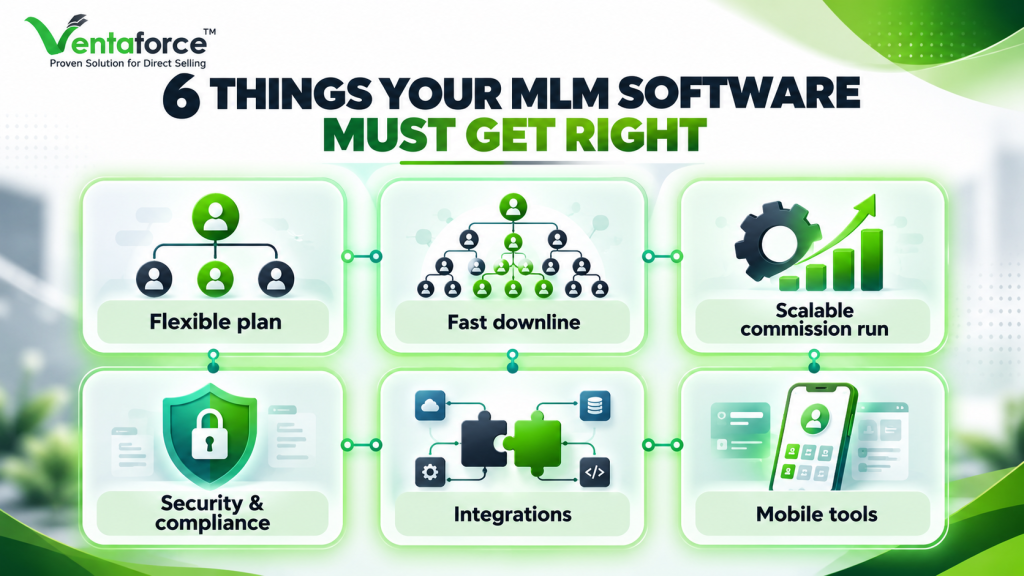
1. Look for flexible MLM compensation plan software
Your plan will not stay the same. Ranks change, bonuses are added, and a new market needs a different structure. A year from now, your MLM compensation plan may look quite different from today.
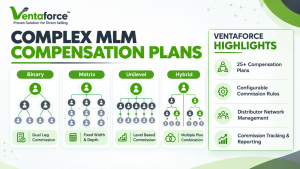
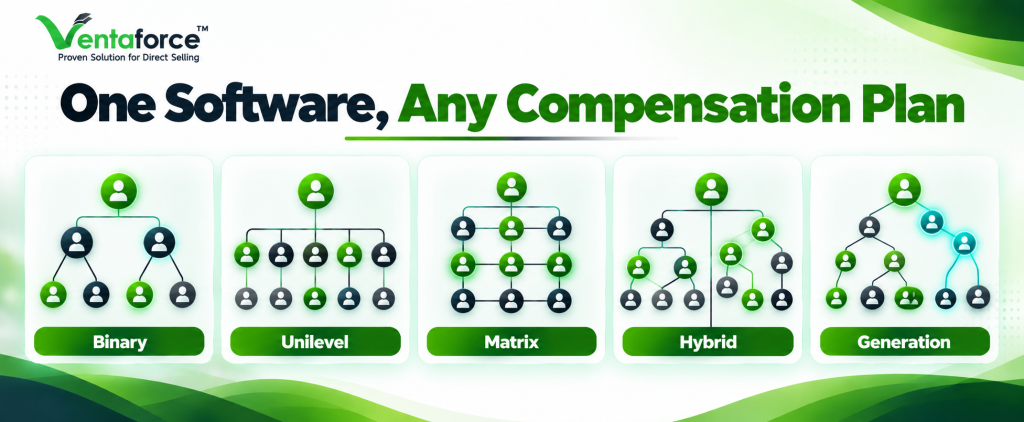
That is why your MLM software company must be capable of changing your plan whenever your business needs it. Whatever your ranks, bonuses and rules are, the software should be able to run them. Binary, unilevel, matrix, hybrid or something fully custom: your plan comes first, and the software follows it.
Many companies forget the second part. When you change your plan after a year, your software company should be there to do it with you. A plan change touches ranks, qualification rules, payouts and reports, so it needs to be handled properly and tested before it goes live. You want a partner who sits with you and makes the change correctly, not a vendor who disappears after go-live.
2. Make sure the system understands your downline
Almost every bonus question is really a question about the tree. Who is under this person? How deep? Which leg is stronger?
Weak systems answer these by walking the tree again and again, and they slow down as you grow. Strong network marketing software stores the structure so the whole downline can be read quickly.
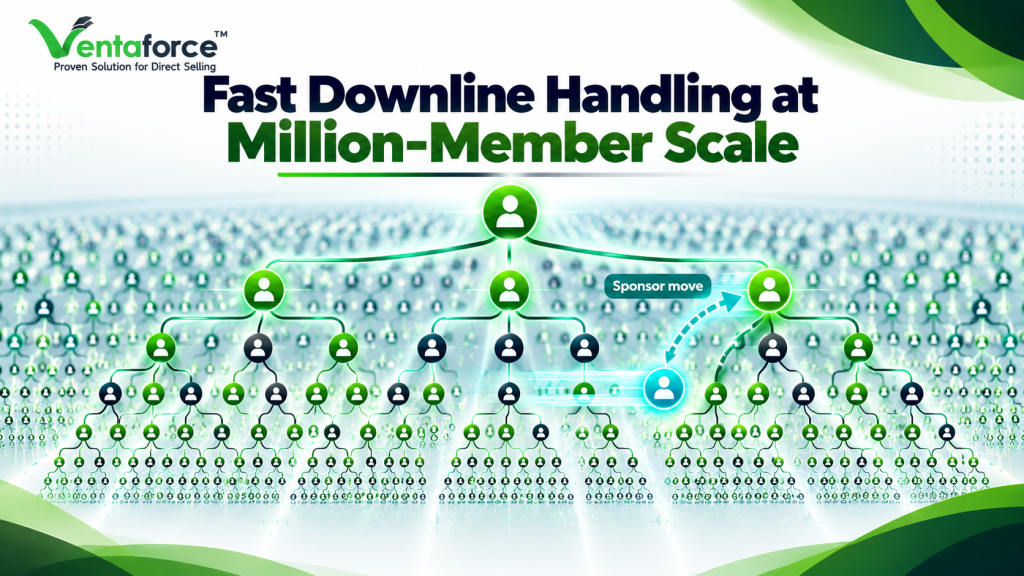
When you evaluate a vendor, ask a hard question: what happens when a distributor is moved to a new sponsor on a tree with a million members? In my experience, the answer tells you more than any feature list.
3. Plan for the commission run, not just the website
The commission run is the heaviest job in your business. It reads orders, ranks, volumes and wallets, and it must be right every time. The work grows with the number of active members and the number of levels you pay. Running it daily instead of monthly multiplies the load again.
A rough way to think about it:
- Smaller runs (up to a couple of million commission lines) can run well on a properly tuned database.
- Mid-size runs need background workers and a copy of the database for reading, so payouts do not slow down the shop.
- Very large runs need the work split across many machines, with volumes updated as orders come in instead of recalculated at the end.
These numbers are only a guide, because every plan is different. What I have seen many times is a company that tested its software with a small data set, then hit trouble in the first real month. Always ask how the MLM commission software behaves at ten times your current size.
4. Treat security and compliance as part of the product
Your system holds personal data, bank details and money. It also has to follow data protection and tax rules in every country where you sell. Look for two-factor sign-in, role-based access, encrypted data and consent records you can export on request.
Ventaforce lists GDPR, CCPA and tax compliance among its features, along with layered security controls and two-factor authentication. Whichever MLM software provider you consider, ask for a live demo of these features, not a brochure.
5. MLM Software should be integration ready
No company runs on one system alone. You will want to connect payment gateways, shipping partners, accounting tools, a CRM, SMS and email services, and your own website or app. Your software should be ready for these connections, with an API and standard integrations, so you can add them as your business grows without rebuilding anything.
6. Give distributors the tools they actually use
Most of your field works from a phone. If your back office only feels good on a laptop, your growth is quietly capped.
The basics for a modern MLM software setup:
- A mobile app for distributors
- A personal replicated website for each distributor
- Support for many currencies and languages
- Automatic email, SMS and WhatsApp updates
- Wallets and several payment methods
- A support assistant for common questions
Selling matters too. Orders, stock, shipping and payment gateways should talk directly to the commission engine. That removes the nightly spreadsheet someone on your team uses to match them up.
7. Pick an architecture that fits your stage
What Does Software Architecture Mean?
Think of MLM software as a company office. Different departments handle different jobs: one manages distributors, another calculates commissions, another handles orders and payments, and another prepares reports.
Software architecture means how these different parts of the software are organised and how they work together.
There are three common approaches to organising these functions.
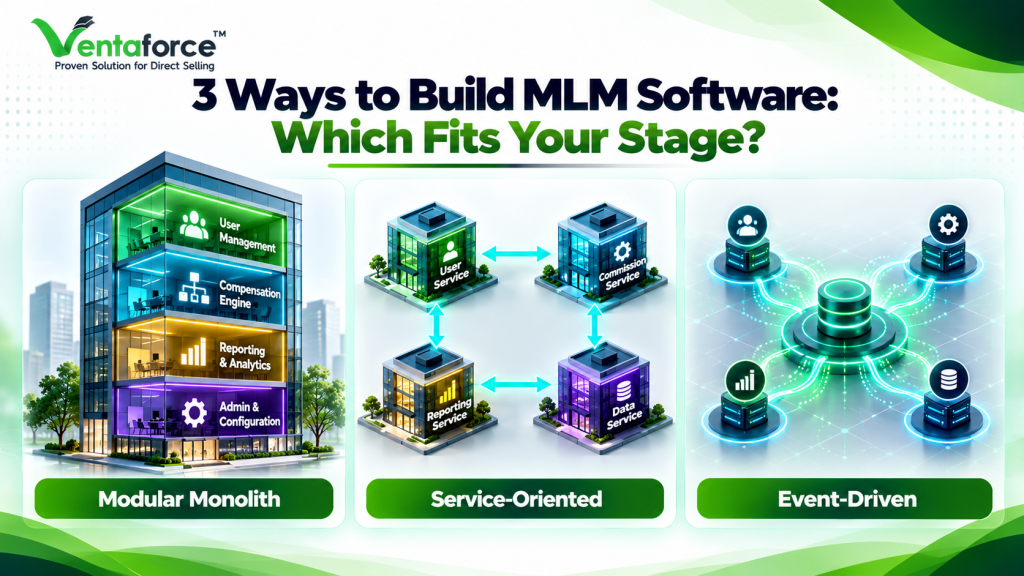
1. Modular Monolith — One System With Separate Parts
Imagine one office building with different departments. Each department has its own responsibilities, but everyone works within the same building.
Similarly, one software application manages distributors, orders, commissions, and reports, with each function organised into a separate module.
Example:
When a distributor places an order, the system records the sale and calculates the relevant sales volume.
- Good for: Businesses that want an organised system without unnecessary technical complexity.
- Possible challenge: Heavy tasks, such as commission calculations, may slow down other functions if the system is not designed to handle the workload properly.
2. Service-Oriented — Different Services Working Together
Imagine different departments operating independently but communicating with each other to complete their work.
In this approach, separate software services handle functions such as orders, commissions, and payments.
Example:
The order service records a sale and sends the relevant information to the commission service for processing.
- Good for: Businesses that need to manage different software functions independently.
- Possible challenge: The services must stay in sync. If an order is recorded but its commission update fails, the system needs a reliable way to detect and resolve the issue.
3. Event-Driven — The System Responds to Business Activities
Imagine that whenever something important happens, the system sends a message to trigger the next tasks.
Example: When a distributor places an order:
- The system records the order.
- It generates an event indicating that the order has been placed.
- The relevant functions receive that event.
- Inventory updates, commission processing, and notifications can happen as separate tasks.
These tasks do not necessarily need to finish at the same time.
- Good for: Businesses that process many transactions and need different tasks to run independently.
- Possible challenge: The system needs to track failed messages, delays, and duplicate processing to ensure business data remains accurate.
An event-driven system does not automatically mean commissions are calculated instantly. That depends on how the software is designed.
What Is the Difference?
Approach | In simple words | Main consideration |
Modular monolith | One application with separate modules | Simpler to manage, but heavy workloads need careful handling |
Service-oriented | Different services work together | Functions can be managed independently, but coordination is more complex |
Event-driven | The system reacts to messages about business activities | Supports independent processing, but requires careful monitoring |
Which Approach Should a Large MLM Company Choose?
There is no single best approach for every business. A large distributor network does not automatically require complex architecture.
For example, an MLM company processing commissions monthly may have different requirements from one handling frequent transactions and earnings updates throughout the day. The right approach depends on the compensation plan, transaction volume, business needs, and reliability requirements.
The goal is to choose MLM software that can handle your current operations and expected growth without adding unnecessary complexity.
Ventaforce combines modular, service-oriented, and event-driven approaches to support business operations, process transactions efficiently, and scale as your MLM network grows.
What 300+ migrations have taught me
If you are planning to move to a new platform, these are the lessons I would pass on from my own projects:
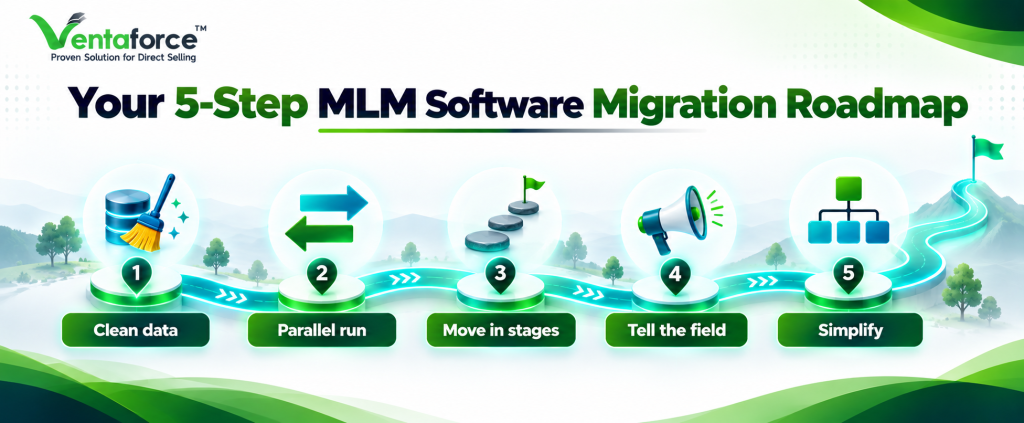
- Clean your data before you move it. Duplicate members, broken sponsor links and old wallet balances are the usual cause of delays. Fixing them early saves weeks.
- Run both systems side by side for one payout cycle. Compare every commission line. It feels slow, but it catches problems while they are still cheap to fix.
- Move in stages when you can. Start with a smaller market or product line, learn, then move the rest.
- Tell your field early. Distributors accept change when they know what to expect and when their first payout arrives on time.
- Do not copy your old problems. A migration is a chance to simplify plan rules that nobody understands anymore.
Quick Checklist: What to Check Before Buying MLM Software
Count how many of these your current platform handles without custom development:
1. Calculates commissions automatically with clear payout reports
2. Supports multiple currencies and languages
3. Includes GDPR, CCPA, GST and tax compliance tools
4. Offers two-factor sign-in and strong access controls
5. Has a distributor mobile app
6. Gives each distributor a replicated website
7. Connects e-commerce, stock and shipping to commissions
8. Offers an API and standard payment gateways
9. Provides business reports without exporting to spreadsheets
0 to 3: Time to look at a new platform. 4 to 7: The basics work, but the gaps will cost you. 8 to 10: You are in good shape, so focus on scale testing and how fast you can launch a new plan.
Where Ventaforce MLM Software Fits
For more than 25 years, we have worked closely with direct-selling businesses and observed the challenges they face as their networks grow. Every business has different requirements, from managing complex compensation plans and accurate commission calculations to distributor engagement, inventory, and international expansion. These real-world challenges have shaped how we continue to strengthen and improve Ventaforce MLM Software.
Built by Sankalp Computer & Systems, Ventaforce supports direct-selling businesses from startups to large enterprises with features including automated commission calculations, replicated websites, multi-currency support, mobile apps, e-commerce, inventory management, and compliance-related capabilities.
With experience serving 5,500+ clients, we understand that choosing MLM software is not just about comparing features. It is about finding a system that works with your compensation plan, supports your business operations, and can grow with your network.
Whatever challenges your direct-selling business faces, Ventaforce helps you find a technology solution built around your business needs.
Bring your actual compensation plan and your busiest payout scenario to a Ventaforce demo. See how the software handles your requirements before making a decision.
Ready to explore a solution for your business?
Frequently Asked Questions (FAQ)
MLM software is a system that runs the daily work of a multi-level marketing business. It records distributors and their downline, takes orders, calculates commissions and bonuses, handles payouts, and gives distributors a back office to track their own business. It is also called network marketing software or direct selling software.
In practice, they mean the same thing. “Direct selling software” is the broader, more neutral term for any company that sells through independent representatives. “MLM software” usually means the same tools with a focus on multi-level compensation plans. Most vendors use both terms for one product.
Start with a flexible compensation plan engine, fast downline handling, automatic commission calculation and a reliable payout process. Then check for multi-currency and multi-language support, a mobile app, replicated websites, e-commerce with inventory and shipping, compliance tools, two-factor security and an API.
Good software can handle binary, unilevel, matrix, hybrid, generation, stair-step and custom plans. The real question is how easily your team can change a plan later. Ask the vendor to set up your actual plan during the demo.
It reads each qualifying order, finds the distributors who earn from it using the genealogy tree, applies your plan’s rules for levels, ranks, caps and bonus pools, and writes the result as commission lines. Good systems record which rule produced each line, so disputes are easy to resolve.
Ask for proof at your size, not the vendor’s average customer. ask how the commission run is split across workers, and ask how a sponsor move on a large tree is handled.
Most companies choose cloud because it is faster to launch, easier to scale and simpler to update. On-premise can make sense with strict data rules or a strong in-house IT team. Either way, ask about backups, uptime and who owns security.
For most companies, yes. Distributors check earnings, share their website, add members and place orders from their phones. A mobile app also makes onboarding easier and keeps your field engaged.
It depends on the vendor, so ask. Look for two-factor authentication, role-based access, encrypted data, activity logs and regular security updates. Confirm support for rules such as GDPR and CCPA where they apply to you.
Yes. Better platforms include e-commerce, inventory and shipping, and connect to payment gateways. An API lets you link accounting tools, a CRM or logistics partners.
It depends on how custom your plan is, how clean your data is and how many integrations you have. In my experience, data cleanup is what most often changes the timeline, not the software itself. Ask the vendor for a timeline based on your plan and your data.
Yes, if it is planned well. A good vendor will help you export your genealogy, orders, wallets and history, check it against your old system, and run both side by side for at least one payout cycle before you switch fully.
The ones I see most are moving dirty data, skipping the side-by-side payout check, switching everything at once, and not telling the field in advance. Each is easy to avoid with early planning.
MLM software pricing depends on your business requirements, compensation plan, customization, number of distributors, and hosting needs.
With Ventaforce MLM Software, plans start at just ₹8,250 per month when billed annually, helping businesses get started with a powerful MLM software solution at an affordable price. The right plan depends on your business needs and requirements.
Shortlist vendors with real experience in direct selling, ask for customers of your sizeRead independent reviews and check what support looks like after launch. The right partner will suggest improvements, not just install software.