Global Direct Selling Outlook 2026: Trends, Markets, and Opportunities Shaping the Industry

Introduction: The Direct Selling Industry Is Entering a New Growth Cycle
The global direct selling industry is undergoing one of the most significant transformations in its history.
Valued at approximately $167 billion globally, direct selling has evolved far beyond traditional home meetings and person-to-person product demonstrations. Today’s leading direct selling companies operate within a highly connected ecosystem powered by mobile commerce, artificial intelligence, social selling, and digital distributor networks.
While mature markets such as the United States continue to generate substantial revenues, much of the industry’s future growth is emerging from regions where digital adoption, entrepreneurship, and community-driven commerce are accelerating simultaneously.
For direct selling companies, network marketing leaders, and MLM software providers, understanding where growth is occurring—and why—is becoming a strategic necessity rather than a competitive advantage.
The question in 2026 is no longer whether direct selling will grow.
The question is which markets, technologies, and business models will define the next decade of expansion.
- Key Takeaways
✔ Asia-Pacific remains the largest growth hub for the direct selling industry, led by India, Indonesia, and Southeast Asia.
✔ India is emerging as a high-potential market due to digital adoption, social commerce, and growing entrepreneurship.
✔ Mexico and Brazil are transforming direct selling through social commerce, creator-led selling, and mobile-first consumer behavior.
✔ Africa is a long-term growth frontier, supported by rising smartphone adoption and a young entrepreneurial population.
✔ The USA continues to lead through innovation, with AI, personalization, and digital transformation driving growth.
✔ Technology is becoming a key differentiator, making MLM software, direct selling software, and automation essential for scalability.
✔ The future of direct selling is digital-first, combining social commerce, AI-powered enablement, and relationship-driven selling.
Bottom Line: The next generation of successful direct selling companies will be those that combine trust, technology, and market-specific strategies to capitalize on emerging growth opportunities.
Thinking About Starting a Direct Selling Business in 2026? Read This First.
If you’re evaluating whether now is the right time to launch a direct selling company, the market signals are encouraging.
Many entrepreneurs assume direct selling growth has slowed because eCommerce dominates headlines.
The reality is very different.
Consumers today are overwhelmed with advertisements, endless product choices, and algorithm-driven recommendations.
As a result, trust has become one of the most valuable assets in modern commerce.
This is exactly where the direct selling industry continues to thrive.
Modern direct selling businesses combine:
- Personal recommendations
- Community-driven commerce
- Social selling
- Mobile technology
- AI-powered customer engagement
Rather than competing with eCommerce, direct selling is evolving alongside it.
The biggest opportunity isn’t simply selling products.
It’s building trusted communities around products.
For entrepreneurs entering the direct selling industry today, this creates opportunities that barely existed a decade ago.
Where Should You Launch Your Direct Selling Company?
One of the biggest mistakes founders make is assuming every market offers equal growth potential.
Growth is becoming increasingly concentrated in specific regions where economic, demographic, and technological trends align.
Let’s explore the markets shaping the future of the direct selling industry.
Growth Hotspot #1: Asia-Pacific's Entrepreneurial Boom Is Redefining Direct Selling
Asia-Pacific remains the largest contributor to global direct selling revenue and continues to shape the future direction of the industry.
According to industry statistics published by the World Federation of Direct Selling Associations (WFDSA), Asia-Pacific consistently accounts for the largest share of global direct selling sales, outperforming North America, Europe, and Latin America. This dominance is not simply the result of population size—it reflects deeper economic and technological shifts that are transforming how consumers buy products and how distributors build businesses.
Countries such as India, Indonesia, Vietnam, Thailand, Malaysia, and the Philippines are experiencing rapid growth driven by rising internet penetration, expanding middle-class populations, and increasing entrepreneurial participation.
According to global industry reports, Asia-Pacific accounts for the largest share of worldwide direct selling activity, making it one of the most strategically important regions for expansion.
Why Asia-Pacific Continues to Outperform
Several structural factors explain the region’s sustained growth:
- Smartphone-first consumer behavior
- High social media engagement
- Growing preference for flexible income opportunities
- Strong wellness and personal care demand
- Expanding digital payment ecosystems
Unlike many mature economies, consumers across emerging Asian markets often leapfrog traditional retail models and move directly into mobile commerce.
This environment aligns naturally with modern direct selling business models.
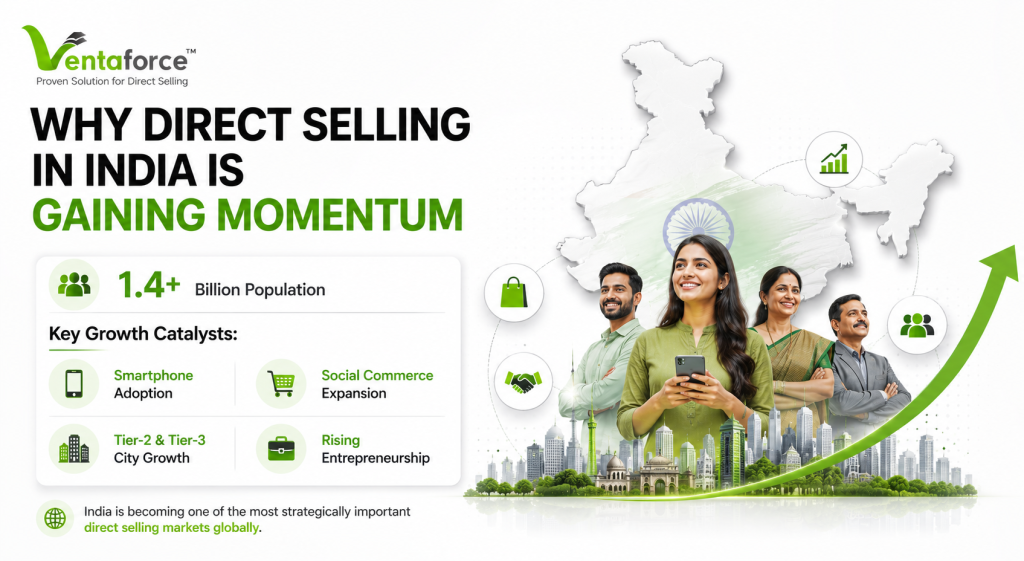
Direct Selling in India: A Market Every Industry Leader Is Watching
Among all emerging markets, direct selling in India deserves special attention.
India combines several powerful growth drivers:
- A population exceeding 1.4 billion
- Expanding digital infrastructure
- Rapid growth of Tier-2 and Tier-3 cities
- Rising entrepreneurial aspirations
- Increasing social commerce adoption
The Indian direct selling market is evolving beyond metropolitan centers.
Cities once considered secondary markets are now becoming major hubs for distributor recruitment and customer acquisition.
For direct selling companies entering India, localization, mobile-first engagement, and simplified onboarding experiences will be critical success factors.
Strategic Implications for Direct Selling Companies
Organizations expanding into Asia-Pacific should focus on:
- Mobile-first distributor experiences
- Localized compensation plans
- Multilingual support systems
- AI-powered onboarding
- Social commerce integrations
Companies relying on legacy infrastructure may struggle to compete against digitally native organizations operating with modern MLM software and direct selling software platforms.
Growth Hotspot #2: Latin America Is Becoming the Global Capital of Social Selling
According to the World Federation of Direct Selling Associations (WFDSA), Latin America remains one of the world’s most influential direct selling regions, accounting for a significant share of global direct selling sales and hosting some of the industry’s largest markets, including Brazil, Mexico, Colombia, and Peru. The region has long embraced relationship-based commerce, making it a natural environment for direct selling companies seeking sustainable growth.
What makes Latin America particularly compelling in 2026 is the convergence of social commerce and entrepreneurship. Research from McKinsey indicates that Latin American consumers are among the world’s most digitally engaged, with social platforms increasingly influencing purchasing decisions across beauty, wellness, and lifestyle categories. As consumers spend more time discovering products through creators, communities, and peer recommendations, direct selling companies are finding new opportunities to scale distributor networks through digital channels.
At the same time, Statista and regional eCommerce studies show that mobile commerce adoption continues to accelerate across major markets such as Brazil and Mexico. With millions of consumers using smartphones as their primary gateway to online shopping, distributors can now reach customers through social media, messaging apps, and digital storefronts without relying solely on traditional face-to-face selling.
These shifts are creating a powerful growth environment where direct selling, social selling, and creator-led commerce increasingly overlap, enabling distributors to build audiences, communities, and customer relationships at scale.
Why Latin America Continues to Attract Direct Selling Companies
Several structural factors explain the region’s momentum:
- High social media engagement rates
- Strong culture of relationship-based purchasing
- Rapid growth in mobile commerce
- Expanding wellness and beauty sectors
- Increasing interest in flexible income opportunities
- Growing creator economy and influencer-driven commerce
Unlike many mature markets where consumers are saturated with advertising, purchasing decisions in Latin America are still heavily influenced by trusted recommendations from family members, friends, community leaders, and content creators.
This cultural dynamic aligns naturally with the core strengths of the direct selling industry and helps explain why direct selling in Mexico, Brazil, Colombia, and Peru continues to attract both established companies and emerging brands.
Direct Selling in Mexico: Why Global Companies Are Paying Attention
- Strong social media usage
- Large consumer population
- Growing wellness demand
- Expanding digital payment adoption
- High community engagement
What makes direct selling in Mexico especially attractive is the strong culture of trust-based purchasing.
Consumers frequently rely on recommendations from family members, friends, and local communities.
What makes direct selling in Mexico especially attractive is the strong culture of trust-based purchasing. Consumers frequently rely on recommendations from family members, friends, local communities, and increasingly, social media creators when making buying decisions.
This trend is becoming even more important as social commerce accelerates across the country. According to recent market research, Mexico’s social commerce market generated more than $12.5 billion in revenue in 2025 and is projected to grow at a 37.6% CAGR through 2033, making it one of the fastest-growing social commerce markets globally.
Source: https://www.grandviewresearch.com/horizon/outlook/social-commerce-market/mexico
The shift toward social selling is already visible in consumer behavior. Research shows that over 42% of Mexican consumers use social media platforms for online purchases, while social networks are increasingly influencing product discovery and purchasing decisions.
Source: https://forbes.com.mx/el-social-commerce-adquiere-fuerza-en-mexico/
For direct selling companies, this creates a unique advantage.
Mexico has quietly become one of the most attractive direct selling markets in Latin America.
The country combines:
Strategic Implication
Companies entering Mexico should prioritize:
- Social commerce tools
- Mobile-first distributor experiences
- Digital storefronts
- Influencer-friendly recruitment models
The future distributor in Mexico may look more like a content creator than a traditional salesperson.
Direct Selling in Brazil: The Social Commerce Powerhouse
- Influencer culture
- Mobile commerce
- Social engagement
- Community-driven purchasing
Many distributors are building audiences first and organizations second.
Brazil is not only one of Latin America’s largest direct selling markets but also one of its fastest-evolving digital commerce ecosystems. According to Grand View Research, Brazil’s direct selling market generated approximately USD 11.6 billion in revenue in 2025 and is projected to reach USD 19 billion by 2033, growing at a CAGR of 6.5%. The report also highlights that cosmetics and personal care account for more than 55% of direct selling sales, reflecting the country’s strong beauty and wellness culture.
Source: https://www.grandviewresearch.com/horizon/outlook/direct-selling-market/brazil
Brazil remains one of the world’s most influential direct selling markets.
Beauty, wellness, and lifestyle products continue to perform exceptionally well.
What makes Brazil particularly important is the convergence of:
Strategic Implication
Organizations should invest in:
- Social selling capabilities
- Content creation tools
- Creator-focused distributor support
The companies that help distributors become trusted digital voices will gain a significant competitive advantage.
Growth Hotspot #3: Africa Is Emerging as the Direct Selling Industry's Long-Term Frontier
What makes Africa particularly compelling is the combination of a young population and accelerating digital adoption. According to the GSM Association (GSMA), Sub-Saharan Africa is expected to reach nearly 700 million mobile subscribers by 2030, with smartphone adoption projected to increase from approximately 51% in 2023 to 61% by 2030. This expansion is creating millions of new digital consumers who can access eCommerce, social commerce, mobile payments, and direct selling opportunities directly from their smartphones.
While Africa currently represents a smaller share of global direct selling revenue, many industry analysts view it as one of the most promising long-term growth opportunities.
The continent’s demographic and technological trends mirror some of the same conditions that fueled rapid expansion across Asia in previous decades.
Key Growth Drivers
Several forces are contributing to Africa’s growing importance:
1. Rapid Population Growth
Africa’s young population creates a large future workforce and consumer base.
2. Mobile Connectivity Expansion
Smartphone adoption and mobile internet access continue to improve across key markets.
3. Entrepreneurial Demand
Many consumers are actively seeking alternative income opportunities and flexible business models.
4. Increasing Financial Inclusion
Mobile payment platforms are reducing barriers to participation in digital commerce.
Countries such as Nigeria, Kenya, Ghana, and South Africa are becoming important strategic markets for forward-looking direct selling companies.
Strategic Implications for Direct Selling Companies
Success in Africa will depend on:
- Mobile-first infrastructure
- Low-bandwidth digital experiences
- Local payment integrations
- Simplified distributor journeys
- Scalable direct selling software
Companies that establish early market presence may gain substantial long-term advantages as these economies continue to mature.
Direct Selling in the USA: Innovation Rather Than Expansion
According to the Direct Selling Association (DSA), U.S. direct selling retail sales exceeded $36 billion, making the country one of the largest direct selling markets globally. However, industry leaders are increasingly investing in technology to improve distributor productivity, customer experiences, and operational efficiency rather than relying solely on market expansion.
Research from McKinsey & Company shows that personalization can drive revenue growth of 5% to 15% while significantly improving customer engagement and retention. As consumer expectations continue to rise, leading direct selling companies are leveraging AI, advanced analytics, and automation to deliver more personalized experiences across the customer journey.
While emerging markets attract significant attention, the United States remains one of the world’s most important direct selling markets.
However, growth dynamics differ significantly from developing economies.
In the U.S., future growth is likely to come from innovation rather than market expansion.
Key trends include:
- AI-powered customer engagement
- Advanced distributor analytics
- Personalized shopping experiences
- Subscription-based product models
- Enhanced compliance technology
For direct selling companies operating in the U.S., technological sophistication is becoming a major competitive differentiator.

The Technology Gap Creating Winners and Losers
Across every growth hotspot, one pattern is becoming increasingly clear.
Technology is separating industry leaders from laggards.
✔ Modern direct selling companies are investing heavily in MLM software .
These technologies help organizations scale efficiently while improving distributor productivity and customer experiences.
Companies relying on outdated systems face increasing challenges in recruitment, retention, compliance, and global expansion.
Several forces are contributing to Africa’s growing importance:
The Future of Direct Selling: Five Trends That Will Shape the Next Decade
The direct selling industry is entering a technology-driven era.
Several trends are expected to shape future growth.
1. AI-Powered Distributor Enablement
Artificial intelligence will improve prospecting, onboarding, training, and customer engagement.
2. Social Commerce Will Become the Primary Sales Channel
The distinction between social media and commerce will continue to disappear.
3. Mobile-First Experiences Will Become Mandatory
Distributors increasingly expect to manage their businesses entirely through smartphones.
4. Compliance Automation Will Become Essential
As regulations evolve globally, automated compliance systems will play a larger role.
5. Data-Driven Decision Making Will Drive Competitive Advantage
Organizations leveraging analytics and predictive insights will outperform competitors operating on intuition alone.
What This Means for Direct Selling Companies in 2026?
The next generation of industry leaders will not necessarily be the largest organizations today.
They will be the companies that successfully combine:
- Strong product portfolios
- Digital innovation
- Global scalability
- Distributor empowerment
- Advanced MLM software infrastructure
- Exceptional customer experiences
Growth opportunities exist across Asia-Pacific, Latin America, Africa, India, and the United States.
However, capturing those opportunities requires more than geographic expansion.
It requires technology-enabled execution.
Conclusion
The global direct selling industry is entering a period of geographic transformation and technological acceleration.
- Asia-Pacific is driving entrepreneurial growth.
- Latin America is pioneering social selling.
- Africa is emerging as a future growth frontier.
- The United States continues to lead innovation and operational sophistication.
Across all regions, one reality remains clear:
The future belongs to direct selling companies that combine human relationships with modern technology.
As AI, social commerce, and advanced direct selling software continue to evolve, organizations that invest in scalable MLM software platforms, mobile-first experiences, and distributor enablement tools will be best positioned to thrive in the years ahead.
Ready to Build the Next Generation of Your Direct Selling Business?
The direct selling industry is evolving faster than ever. From India’s digital expansion and Latin America’s social commerce boom to Africa’s emerging opportunities and AI-driven innovation in the USA, the companies that thrive will be those that combine strategic market expansion with the right technology foundation.
Whether you’re launching a new direct selling company, expanding into new markets, or modernizing your operations, success depends on having the MLM Software tools to scale efficiently.
Ventaforce helps direct selling companies simplify operations, automate commissions, empower distributors, and accelerate global growth with powerful MLM software built for the future.
Explore how Ventaforce can help you build, manage, and scale a future-ready direct selling business.
Frequently Asked Questions (FAQ)
Yes. While growth varies by region, the global direct selling industry continues to expand through digital transformation, social commerce, mobile-first business models, and increasing demand for flexible income opportunities.
Some of the most promising markets in 2026 include India, Mexico, Brazil, Indonesia, Vietnam, the Philippines, Nigeria, Kenya, and the United States. These markets combine strong digital adoption, entrepreneurial activity, and growing consumer demand.
Direct selling in India is benefiting from rising internet penetration, expanding social commerce, growing entrepreneurship, and increased adoption in Tier-2 and Tier-3 cities. These factors make India one of the fastest-growing markets for direct selling companies.
Social commerce allows distributors to sell products through platforms like Instagram, Facebook, TikTok, and WhatsApp. This enables distributors to build communities, engage customers, and generate sales without relying solely on traditional face-to-face selling.
Health and wellness, nutrition, beauty, personal care, skincare, lifestyle, and home-care products continue to be among the strongest-performing categories in the direct selling industry.
Modern MLM software helps direct selling companies manage distributor networks, automate commission calculations, track sales performance, improve compliance, and support global expansion through scalable technology.
Africa is increasingly viewed as a long-term growth opportunity due to its young population, expanding smartphone adoption, growing mobile payment infrastructure, and rising entrepreneurial participation.
The future of direct selling will be driven by AI-powered automation, social commerce, mobile-first experiences, personalized customer engagement, and advanced direct selling software platforms that help companies scale efficiently.
Some of the biggest challenges include distributor retention, regulatory compliance, changing consumer expectations, digital transformation, and increasing competition in social commerce channels.
Successful global expansion requires localized strategies, mobile-first distributor experiences, multilingual support, compliance management, and robust direct selling software or MLM software that can support multiple markets and compensation plans.
Yes. While eCommerce focuses on online transactions, direct selling relies on personal recommendations, relationship-building, and distributor networks. Today, many successful companies combine direct selling with eCommerce and social commerce strategies.
Entrepreneurs should evaluate market demand, product selection, compensation plans, compliance requirements, target regions, and technology infrastructure. Choosing the right MLM software and direct selling software is often a critical factor in long-term success.