What Direct Selling Businesses Should Understand Before MLM Software Migration
Direct selling businesses usually don’t think about changing MLM software until operations start becoming difficult.
At first, the issues seem manageable :
- Reports take longer
- Commissions need manual checking
- Support tickets increase
- Distributors complain occasionally
- The system slows during peak activity
But over time, small operational issues start affecting business confidence.
This is usually the stage where businesses begin exploring :
- Switching MLM software
- MLM software migration
- Large-scale MLM data migration
However, many businesses underestimate what migration actually involves.
Changing MLM software is not similar to changing a billing tool or replacing a website.
For direct selling companies, the software manages :
- Genealogy structures
- Distributor relationships
- Commissions
- Payouts
- Ranks
- Wallets
- Operational workflows
That’s why migration decisions should be approached carefully and strategically.
This guide explains:
- When businesses should consider switching MLM software
- What operational risks to evaluate
- Common migration mistakes
- Practical checkpoints before selecting a new MLM software provider
First, What Does “Switching MLM Software” Actually Mean ?
Many business owners hear the term MLM software migration frequently but are not always sure what the process actually includes.
In simple terms :
MLM software migration means transferring your existing business operations and distributor ecosystem from one platform to another without disrupting operational continuity.
This usually involves moving:
- Distributor records
- Genealogy structures
- Commission history
- Wallets
- Payout data
- Rank records
- Reports
- Product data
- Integrations
But the complexity comes from how interconnected MLM systems are.
For example :
- One incorrect genealogy mapping may affect payout calculations
- One commission mismatch may create distributor disputes
- One missing wallet entry may reduce trust immediately
- Practical checkpoints before selecting a new MLM software provider
That’s why experienced migration planning matters more than businesses initially expect.
Who Should Consider Switching MLM Software ?
- Growing MLM businesses struggling with manual operations
- Direct selling companies expanding internationally
- Businesses facing payout inconsistencies
- Companies managing large genealogy structures
- Organizations planning mobile-first distributor operations
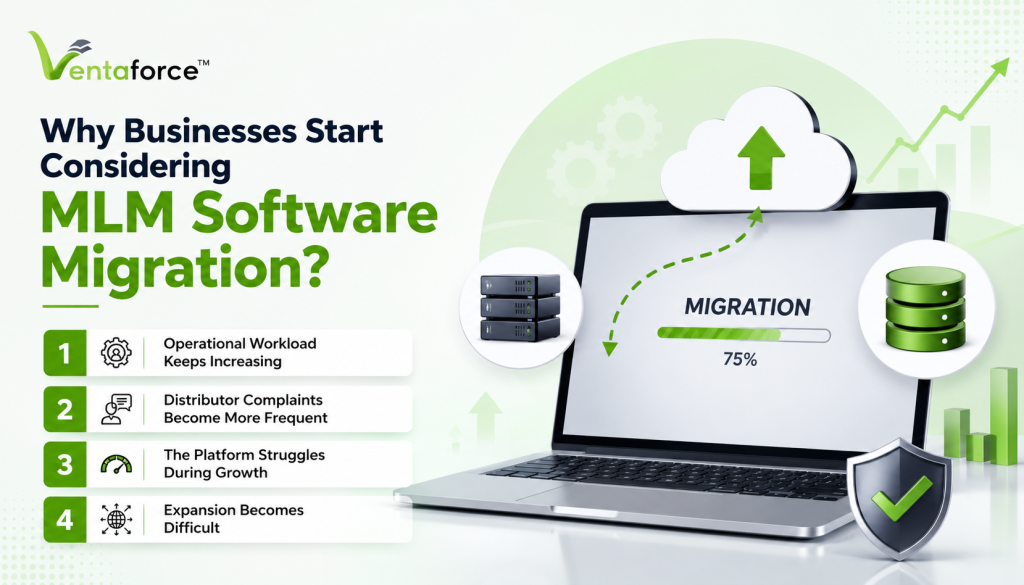
Who Should Consider Switching MLM Software ?
Most businesses do not suddenly decide to replace their MLM platform.
Usually, migration discussions begin after operational pressure starts increasing.
As per observations across growing direct selling businesses, migration conversations commonly begin when companies notice:
1. Operational Workload Keeps Increasing
One common sign businesses start outgrowing software is when operational teams become dependent on :
- Manual calculations
- Excel-based reports
- Payout adjustments
- or repeated support intervention.
At that stage, software starts creating workload instead of reducing it.
2. Distributor Complaints Become More Frequent
Direct sellers interact with the platform daily.
So businesses often notice software limitations through recurring distributor complaints around :
- Commission delays
- Wallet mismatches
- Slow dashboards
- Login issues.
- or inconsistent reports
Over time, these issues affect distributor confidence.
3. The Platform Struggles During Growth
Some systems perform adequately at smaller scale but struggle as distributor networks grow.
Performance issues often become visible during :
- Commission runs
- High traffic periods
- Product Launches
- or international expansion
This becomes especially noticeable in businesses managing large genealogy structures.
4. Expansion Becomes Difficult
Older MLM systems may not support :
- Multiple currencies
- Multilingual operations
- Taxation flexibility
- International payment gateways
- or advanced integrations
As businesses scale into new markets, operational limitations become harder to ignore.
Before Comparing Providers, Ask This Internal Question
One common mistake businesses make:
Comparing software demos before understanding internal operational problems.
Before switching MLM software providers, businesses should first identify :
- what operationally is not working today
- what future scalability is required
- and what workflows are creating friction internally.
For example :
- Is reporting too slow ?
- Are payouts difficult to validate ?
- Is compensation logic becoming difficult to manage ?
- Are operations too manual ?
- Is the software unstable during traffic spikes ?
- Is mobile usability poor ?
- Are integrations limited ?
Without understanding the actual problem, businesses sometimes migrate into another system with similar limitations.
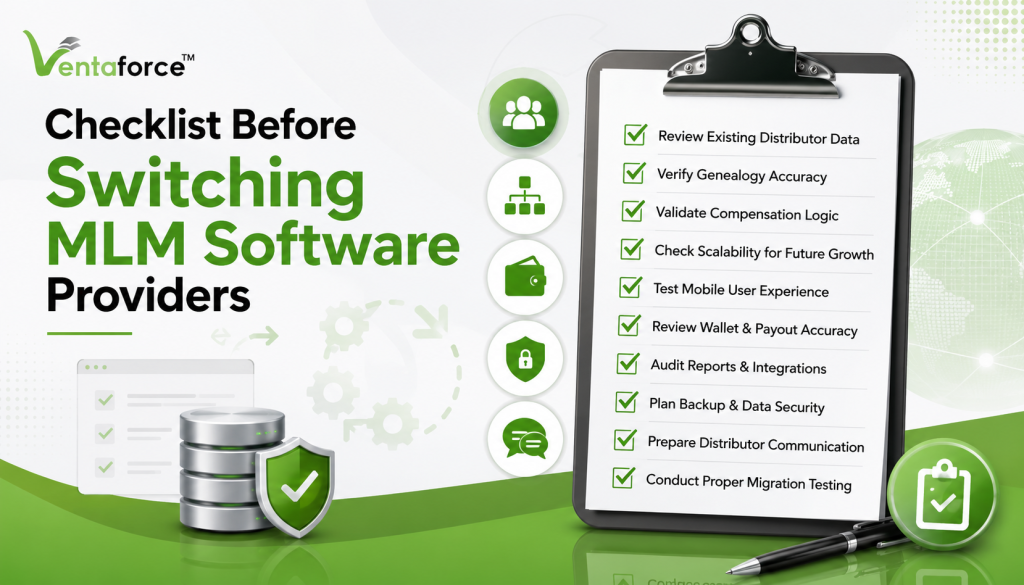
Checklist Before Switching MLM Software Providers
Important Considerations for Emerging MLM Businesses, Scaling Networks, and Enterprise Direct Selling Companies.
1. Review Existing Data Carefully Before Migration
One of the biggest mistakes businesses make is assuming all existing data is clean and migration-ready.
Older MLM systems often contain years of :
- Duplicate records
- Inactive distributors
- Incomplete genealogy structures
- Outdated reports
- and inconsistent payout history
One common issue businesses face during migration is incomplete or inconsistent distributor data.
As per migration observations across growing MLM businesses, reviewing genealogy integrity and payout history early helps reduce operational risk later.
Businesses should review :
- Sponsor relationships
- Genealogy mapping
- wallets
- Commission
- Ranks
- Payout history
- and inactive accounts before migration begins
At Ventaforce, migration planning usually starts with a detailed operational data audit to identify critical business records before transfer begins.
2. Verify Compensation Logic Carefully
This is one of the most sensitive parts of MLM software migration.
Many software providers say they support :
- Binary Plans
- Matrix Plan
- Unilevel Plan
But compensation structures often contain custom business logic built over years.
Businesses should carefully validate :
- Carry forward calculations
- Matching bonuses
- Rank qualifications
- Leadership pools
- Capping rules
- Wallet deductions
- and payout conditions
Even small compensation mismatches can affect thousands of distributor payouts.
Based on migration observations from direct selling businesses, compensation validation is usually more important than feature comparisons.
3. Don’t Focus Only on Features — Focus on Operational Scalability
Many software demos look impressive initially.
But businesses should evaluate :
- Whether the system handles growth properly
- Whether reports remain fast under traffic
- Whether mobile performance remains stable
- and whether automation improves operations long term
One important operational question businesses should ask:
“Will this platform still support us after our next growth stage?”
Because repeated software migration becomes expensive operationally and financially.
4. Understand How Migration Will Actually Be Managed
Many businesses think migration simply means moving data from one database to another.
In reality, experienced MLM data migration usually includes :
- Genealogy validation
- Compensation Verification
- Backup Planning
- Staged testing
- Rollback Preparation
- and operational monitoring
Businesses should clearly understand :
- What data gets migrated
- What testing stages exist
- How payout accuracy is verified
- and what downtime should realistically be expected.
Transparent planning often reflects migration maturity.
5. Distributor Communication Matters More Than Most Businesses Expect
One important lesson businesses often learn during migration:
Even technically successful migration can feel unsuccessful if distributors feel confused.
Before launch, businesses should prepare:
- Migration announcements
- FAQ Pages
- Onboarding instructions
- Support escalation plans
- and login guidance
Clear communication significantly reduces operational confusion during transition.
6. Mobile Experience Should Be Evaluated Practically
Today, many distributors run their business almost entirely through smartphones.
Before selecting a platform, businesses should test :
- Dashboard Responsiveness
- Wallet visibility
- Order Workflow
- Notification System
- Report readability
- and mobile performance during heavy usage
Poor mobile usability directly affects distributor engagement.
7. Testing Should Never Be Treated as a Formality
One practical migration reality:
Most operational problems appear during testing — not after launch.
That’s why testing matters significantly.
Businesses should validate :
- Genealogy structures
- Commission
- Ranks
- Wallets
- Reports
- Integrations
- and payout calculations before deployment
As per operational migration experience, businesses that rush testing usually face avoidable post-launch complications.
Common Mistakes Businesses Make During MLM Software Migration
Include
- Rushing Migration
- Skipping genealogy validation
- Focusing only on pricing
- Ignoring distributor communication
- Poor testing
- Unclear compensation mapping
A Simple Comparison Many Direct Sellers Relate To
One business owner once described switching MLM software like this:
“It feels like shifting an entire running business into a new building without stopping operations.”
Operationally, that comparison makes sense.
Because businesses are not only changing dashboards.
They are transferring :
- Distributor relationships
- Financial workflows
- Genealogy structures
- Operational processes
- and years of business history
That’s why rushed migration usually creates unnecessary stress.
Carefully planned migration usually creates operational stability.
What Businesses Usually Fear Most During MLM Data Migration?
In most migration discussions, one concern appears repeatedly:
“What if distributor data gets affected?”
This concern is understandable because MLM systems contain sensitive operational data tied directly to :
- Commissions
- Genealogy
- Wallets
- and payout continuity
As per migration observations across growing direct selling businesses, confidence usually improves once businesses understand :
- Backup processes
- Validation stages
- Rollback strategies
- Testing environments
- and operational verification methods
Migration risk generally increases when businesses :
- Rush implementation
- Underestimate compensation complexity
- or skip testing stages
What Successful MLM Software Migrations Usually Have in Common ?
Across successful migration projects, several patterns appear consistently.
Businesses that transition smoothly usually :
- Audit operational data early
- Validate compensation logic carefully
- Involve operational teams during testing
- Communicate clearly with distributors
- and allocate realistic migration timelines
Migration success usually depends more on operational planning than software marketing claims.
A Practical Example From Migration Experience
In one migration project handled by Ventaforce, a growing direct selling business faced operational limitations caused by rapid network expansion.
The challenge was not only software replacement.
The real concern was whether :
- Genealogy structures
- Historical commissions
- Wallets
- and distributor records
could transition safely without affecting payout continuity.
The migration involved :
- More than 2.75 lakh distributor records
- Large genealogy structures
- Historical payout data
- and operational reports
The project required careful validation because payout continuity directly affected distributor confidence.
After staged testing and operational verification, the business transitioned successfully while maintaining operational continuity.
Quick Tips for Direct Sellers Before Switching MLM Software
Based on years of operational observations across growing direct selling businesses, here are some practical recommendations direct sellers
should keep in mind before planning MLM software migration.
- Don’t wait for software problems to become operational crises
If commissions, reports, or distributor support issues are increasing regularly, it’s usually better to evaluate scalability early instead of waiting for system dependency to grow.
- Always verify genealogy accuracy before migration
In direct selling, genealogy structures affect payouts, ranks, and sponsor relationships. Even small mapping inconsistencies can create large operational problems later.
- Test compensation logic using real payout scenarios
Never rely only on demo explanations. Validate binary calculations, matching bonuses, carry forwards, rank logic, and wallet deductions using actual business cases.
- Focus on distributor experience — not only admin features
A platform may look advanced from the backend, but distributor usability matters more long term. Evaluate mobile access, wallet visibility, report clarity, and dashboard speed carefully.
- Clean outdated data before migration begins
Older systems often contain duplicate records, inactive distributors, and inconsistent payout history. Data cleanup usually reduces migration complexity significantly.
- Don’t rush testing to launch faster
Many migration issues appear during testing — not after deployment. Allocate proper time to validate commissions, wallets, genealogy structures, and reports before going live.
- Communicate with distributors early during migration
Even technically successful migration can create confusion if distributors are uninformed. Clear communication usually reduces support pressure and operational misunderstandings.
- Evaluate future scalability — not just current needs
Choose software based on where the business is going, not only where it is today. Scalability becomes critical as distributor networks and transaction volumes grow.
- Include operational teams during migration planning
Finance, support, compliance, and payout teams often identify practical workflow risks that technical teams may overlook during migration preparation.
- Treat migration as a business transition, not just a software upgrade
Successful MLM software migration usually improves operational efficiency, reporting visibility, payout confidence, and long-term scalability when planned properly.
Our Expert Observation
Based on migration observations from growing direct selling businesses, the most successful MLM software transitions usually happen when companies:
- Plan early
- Validate compensation logic carefully
- Involve operational teams
- and prioritize distributor experience throughout the migration process.
Final Thoughts
Switching MLM software is rarely just a technical decision.
For direct selling businesses, it directly affects :
- Distributor trust
- Operational continuity
- Payout Reliability
- Scalability
- and long-term business stability.
Businesses that approach migration strategically usually focus on :
- Operational planning
- Compensation validation
- Testing
- Distributor communication
- and scalability evaluation
Because successful MLM software migration is not only about moving data.
It is about building a stronger operational foundation for future growth.
Planning to Switch MLM Software Without Affecting Distributor Operations?
Ventaforce has supported MLM software migration projects involving :
- Large distributor databases
- Complex genealogy structures
- and enterprise-scale direct selling operations
Frequently Asked Questions (FAQ)
MLM software migration is the process of transferring distributor records, genealogy structures, commissions, wallets, payout history, and operational workflows from one MLM platform to another without disrupting business operations.
Businesses usually consider switching MLM software when they experience:
- slow system performance,
- increasing manual operations,
- payout inconsistencies,
- distributor complaints,
- scalability limitations,
- or operational difficulties during growth.
Common signs include:
- slow dashboards,
- manual commission corrections,
- poor mobile usability,
- payout delays,
- limited integrations,
- reporting issues,
- and system instability during high traffic periods.
MLM data migration may include:
- distributor records,
- genealogy trees,
- commissions,
- wallets,
- payout history,
- ranks,
- reports,
- and transaction records.
Genealogy structures directly affect:
- commissions,
- sponsor relationships,
- rank calculations,
- and payout continuity.
Incorrect genealogy mapping can create major operational issues after migration.
Yes. Structured migration planning, genealogy validation, staged testing, and backup preparation help businesses migrate large distributor databases safely while maintaining operational continuity.
Common migration risks include:
- genealogy mismatches,
- commission calculation errors,
- incomplete data transfer,
- poor testing,
- payout inconsistencies,
and insufficient distributor communication.
Testing is one of the most critical migration stages because it helps identify:
- payout mismatches,
- genealogy issues,
- wallet inconsistencies,
- and reporting errors before launch.
Businesses usually reduce migration risk by:
- auditing existing data,
- validating genealogy structures,
- testing compensation plans,
- preparing backups,
- and involving operational teams during migration planning.
Successful MLM software migration usually depends on:
- early planning,
- genealogy accuracy,
- compensation validation,
- operational testing,
- realistic timelines,
- and clear distributor communication throughout the migration process.