What Top MLM Leaders Do Differently Than Average Distributors ?

Network marketing is often described as “simple.”
In reality, it is simple in concept but complex in execution.
Millions of people around the world join MLM and direct selling companies every year. They are given the same products, the same compensation plan, and often the same training materials. Yet the outcomes are dramatically different. A very small percentage build global organizations, long-term residual income, and leadership influence. The majority struggle, stagnate, or exit the industry entirely.
This article breaks down—at a deep, operational level—what top MLM leaders do differently than average distributors, and why those differences compound over time into massive separation in results.
In today’s environment, no compensation plan, recruitment strategy, or MLM software platform can compensate for a weak product. Sustainable growth is driven by one core factor: products that deliver real, repeatable value to real customers.
This guide explains what MLM business products are, identifies the strongest product categories worldwide, and outlines how entrepreneurs can select compliant, profitable, and scalable products for long-term success.
Understanding the Global MLM Landscape
Direct selling today operates in over 170 countries, generating hundreds of billions in annual sales. The model has evolved significantly:
- From home meetings to digital onboarding
- From paper genealogy to real-time dashboards
- From local teams to global networks
- From manual payouts to automated commission engines
However, one reality remains unchanged:
MLM is a leadership business disguised as a sales business.
Most distributors never cross the transition from seller to leader.
Top MLM leaders do.
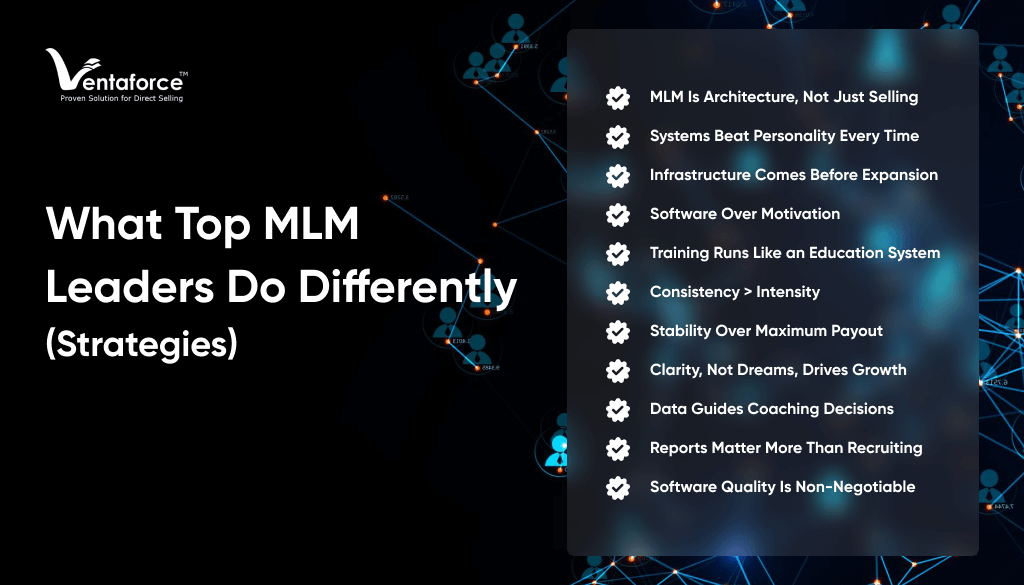
First Principle : MLM Is Not a Sales Business — It Is a Distribution Architecture Business
Average Distributor Behavior : Effort-Centered Thinking
Most distributors enter network marketing with a background shaped by traditional employment or small-scale selling. In those environments, results are closely tied to visible effort. As a result, average distributors naturally focus on questions such as:
- How many hours did I work today ?
- How many calls did I make ?
- How many people did I speak to ?
- How motivated do I feel right now ?
These questions seem logical, but they reveal an effort-based mental model.
Leader Behavior : Structure-Centered Thinking
Top MLM leaders operate from a completely different mental framework. Instead of asking how much they worked, they ask how well the system worked.
Their core questions are structural:
- What happens in my business when I step away for a week ?
- Can a new distributor succeed without constant guidance ?
- Is the process simple enough to be explained and repeated in under 30 minutes ?
- Does growth increase clarity—or create confusion ?
These questions reveal a leverage-based mental model.
Leaders do not aim to do more.
They aim to make themselves less necessary.
Example : Amway Global Leaders
Many top Amway leaders have publicly stated that their breakthrough occurred when they stopped “doing MLM” and started designing a distribution system. They focused on education, leadership pipelines, and standardized operations.
“You don’t build income in network marketing. You build structure—and income flows through it.”
— Leadership principle taught across Amway organizations
This mindset shift alone explains why some distributors plateau early while others build global organizations.
Their time is spent on :
- Improving systems
- Reviewing reports
- Refining training
- Strengthening structure
This work is invisible—but exponentially more valuable.
Amway’s Success Story – How Strategy, Systems, and People Built a Global MLM Empire
Second Principle : Top MLM Leaders Focus on Systems, Not Personality-Driven Growth
Many distributors believe:
- “If I can explain it well, my team will grow”
- “If I motivate them enough, they’ll succeed”
- “If I stay involved, things won’t break”
This creates dependency, not duplication.
Why Personality-Based MLM Fails
When a business depends on personality :
- Results depend on mood and energy
- Success cannot be duplicated
- Teams become dependent on a few strong individuals
- Growth slows when leaders get tired or busy
A great speaker may recruit many people, but if those people cannot repeat the same process, growth stops with that person.
This is why many “star performers” never build large, stable teams.
Direct Selling Leader Ray Higdon: Learning the Hard Way
Ray Higdon, a former top MLM earner and respected industry trainer, has openly shared that his early years in MLM were difficult—not because he lacked effort, but because he lacked systems.
He depended on :
- Personal calls
- One-on-one explanations
- His own daily activity
That model worked only while he was active.
As Ray explains :
“If your income depends on your personal activity, you don’t have a business—you have a job.”
— Ray Higdon
This realization changed how he built his organization.
What Leaders Mean by “Systems”
Top MLM leaders design their business so that average people can succeed, not just top performers.
A good system:
- Does not require special talent
- Works even when motivation is low
- Guides people step by step
- Produces consistent results
Leaders do not ask, “Can I do this well?”
They ask, “Can this be repeated by someone new?”
Core Systems Top Leaders Build
Top MLM organizations rely on a few key systems :
1. Standard Presentations
Everyone shares the same message. This avoids confusion and keeps the opportunity clear.
2. Automated Onboarding
New distributors know exactly what to do next, without waiting for personal guidance.
3. Centralized Communication
Important updates come from one place, not scattered across calls, messages, or chats.
4. Clear and Transparent Commissions
People understand how they get paid. Trust increases. Conflicts decrease.
5. Reliable MLM Software Platforms
Software tracks teams, calculates commissions, and supports growth without errors.
These systems remove guesswork and reduce mistakes.
Core Systems Top Leaders Why Systems Always Beat Personality
Personality varies.Systems stay consistent.
When systems are strong :
- New people feel confident
- Duplication happens naturally
- Leaders are not overwhelmed
- Growth becomes predictable
When systems are weak :
- People rely on leaders for everything
- Mistakes increase as teams grow
- Confusion spreads
- Duplication collapses
This is why experienced MLM leaders invest more time in building systems than in personal selling.
The Real Leadership Shift
Average distributors try to become better performers.
Top MLM leaders try to build better MLM systems.
That shift—from doing more to designing better—is what turns network marketing into a real business.
Third Principle : Average Distributors Focus on Selling. Leaders Focus on Infrastructure
The Sales Trap
Most average distributors believe success in MLM comes from doing more selling and recruiting. Their thinking usually sounds like this :
- If I sell more products, I will earn more
- If I recruit more people, my business will grow
- If I stay very active, success will follow
At the beginning, this approach may show results. But over time, it creates a serious problem: burnout.
When income depends mainly on personal selling :
- Earnings stop when activity slows
- Pressure keeps increasing
- Leaders become exhausted
- Teams depend too much on one person
Selling creates short-term income. It does not create stability by itself.
Infrastructure Thinking : How Leaders See the Business
Top MLM leaders understand an important truth:
Selling is temporary. Infrastructure is permanent.
This means :
- A sale happens once
- A system works every day
- Effort ends, but structure continues
Leaders still sell and recruit—but they do it to build systems, not to carry the business forever.
Top MlM Lader Mark Yarnell’s Perspective
Mark Yarnell, Co-Founder of Neways International and a respected MLM author, strongly emphasized this idea throughout his teachings.
He explained that long-term residual income does not come from constant effort. It comes from systems that continue to work without the leader’s daily involvement.
“Residual income comes from residual structure.”
— Mark Yarnell
This thinking separates business builders from product sellers.
What Infrastructure Means in MLM
Infrastructure is the foundation that supports growth. Strong MLM infrastructure includes :
- Accurate genealogy systems
So every distributor is placed correctly and team structures remain clear.
- Commission calculation engines
To ensure payouts are correct, on time, and trusted.
- Rank qualification logic
So promotions are automatic, fair, and transparent.
- Reporting and analytics
Leaders can see performance, identify problems early, and guide teams properly.
- Compliance-ready operations
To protect the company and distributors as the business grows globally.
These systems reduce confusion, mistakes, and conflicts.
Why Leaders Choose Infrastructure Before Expansion
Modern MLM leaders know that fast growth without infrastructure creates chaos. When systems are weak :
- Errors increase
- Trust decreases
- Leaders spend time fixing problems instead of leading
That is why experienced leaders focus on Direct Selling software architecture first, then expansion.
Simple Truth
Average distributors try to sell their way to success.
Top MLM leaders build infrastructure that allows everyone to succeed.
That is how MLM turns from hard work into a long-term business.
Fourth Principle : Why Top MLM Leaders Trust Software More Than Motivation
How Average Distributors Operate
Many distributors rely on motivation-driven strategies :
- Weekly pep talks or calls
- Emotional rallies or events
- Short-term incentives
- Dependence on the upline for energy
These approaches may boost activity briefly, but the effect fades quickly. Once the emotional high ends :
- Team members lose focus
- Activity drops sharply
- Growth slows
- Leaders must constantly intervene
This creates dependency, not duplication.
How Top Leaders Operate
Top MLM leaders replace reliance on emotion with structured systems supported by software :
- Real-time dashboards → Track team activity and performance instantly
- Performance metrics → See who is performing, where help is needed
- Automated alerts → Identify issues before they escalate
- Activity tracking → Ensure consistency without constant supervision
Instead of motivating every day, leaders manage Direct Selling business efficiently and consistently.
Example : Nu Skin Enterprises
Nu Skin’s global success illustrates the power of technology in MLM :
- Leaders can manage distributors across multiple countries
- Performance and commissions are tracked accurately
- Decision-making is data-driven, not emotional
- Training and onboarding are systemized for easy duplication
Software allows leaders to focus on strategy and growth, not firefighting.
The 2026 Reality
In modern MLM, organizations operate across :
- Multiple time zones
- Global teams
- Complex commission structures
Without strong software, leaders cannot maintain control, trust, or growth. Motivation alone is insufficient for sustainable, scalable MLM leadership.
Key Takeaway
Motivation sparks action.
Software sustains and scales it.
Top MLM leaders understand this and prioritize technology and systems over speeches and rallies.
Secrete Tip #1
Fifth Principle: Training Is the Real Product of Successful MLM Organizations
Many new distributors focus only on selling products. Top MLM leaders understand a deeper truth:
The product brings people in, but training keeps them active and growing.
In other words, training—not just the product—is the real engine of long-term success.
Why Average Distributors Fail
Average distributors often assume :
- Explaining the product once is enough
- People will figure it out on their own
- Motivation or sales alone will make the team grow
This approach leads to :
- Confusion among new recruits
- Poor duplication of success
- High dropout rates
Without proper training, even great products cannot create a sustainable business.
How Top Leaders Think About Training
Top MLM leaders treat training like a structured education system, not just a presentation. They focus on:
- Teaching skills, not just selling
- Guiding distributors through clear, repeatable steps
- Building leaders, not just recruits
Training becomes a tool to scale the business, because it allows new distributors to duplicate success without constant hand-holding.
Direct Selling Leader John C. Maxwell’s Perspective
John Maxwell, a leadership educator who works with many global direct selling companies, emphasizes:
“Everything rises and falls on leadership.”
In MLM, leadership grows only when people are trained to lead themselves. Structured training ensures that beginners become capable distributors, and capable distributors become leaders.
How Leaders Implement Training
Successful MLM organizations use training systems that include :
- Step-by-step onboarding → Every new distributor knows exactly what to do
- Progressive learning →Beginner → Intermediate → Advanced levels
- Automated alerts → Identify issues before they escalate
- Tracking and reinforcement →Software tracks who has completed training
- Centralized knowledge libraries →Videos, documents, scripts, and presentations
When training is standardized, duplication happens naturally. Teams grow consistently, without depending solely on the top leader.
Why Training Is More Important Than Motivation
Motivation inspires short-term effort. Training builds long-term capability.
- Motivation fades quickly; trained skills last
- Motivation reaches people emotionally; training reaches them practically
- Motivation drives action once; training enables ongoing action
This is why top leaders spend more time building training systems than giving speeches or motivational talks.
Key Takeaway
In modern MLM, the real product is not the item being sold—it is the knowledge and capability you deliver to your team.
Leaders who prioritize training build self-sufficient teams, scalable businesses, and long-term income streams.
- Did You Know?
Companies with structured training systems experience significantly higher distributor engagement and lower early-stage dropout.
Sixth Principle : What Top MLM Leaders Have in Common Globally
Across companies like Herbalife, Forever Living, USANA, Market America, and Amway, top leaders consistently demonstrate :
- Long-term thinking
- Early technology adoption
- Heavy investment in education
- Strong belief in ethical growth
- Data-driven decision-making
Top Direct Selling Leader Todd Falcone (Trainer, Worked Across Multiple MLM Companies)
Todd Falcone emphasizes discipline over hype:
“Success in network marketing comes from boring, consistent execution of simple systems.”
This principle is universal among top earners.
Secrete Tip #2
Seventh Principle: Leaders Design for Stability, Not Maximum Payout
Many new distributors assume that the fastest way to earn in MLM is to chase the highest payouts and rank jumps. They focus on plans that promise quick bonuses or temporary incentives.
Top MLM leaders think differently. They understand that short-term spikes often destroy long-term success.
Why Chasing Maximum Payout Can Backfire
When distributors focus only on high payouts :
- Teams become unstable
- Burnout increases among distributors
- Conflicts over commissions arise
- Growth is often temporary
Quick wins may feel good, but they rarely create sustainable businesses.
How Leaders Approach Compensation
Top leaders prioritize stability and predictability over short-term gains. They design their organization to:
- Deliver consistent commissions over time
- Avoid disputes caused by unclear or complex payouts
- Encourage duplication without confusion
- Build trust in the system and the leadership
Example in Practice
Experienced MLM leaders carefully choose Direct Selling platforms or MLM software that allow :
- Clear commission breakdowns
- Accurate, transparent calculations
- Automatic rank promotions
- Scalable, long-term compensation logic
By focusing on structure rather than spikes, leaders create residual income that grows steadily.
Key Takeaway
Average distributors chase bonuses.
Top MLM leaders design businesses where income flows predictably and grows safely, even when they step back.
Stability over shortcuts is what turns network marketing into a long-term business.
Eighth Principle: Leaders Sell Clarity, Not Dreams
One of the biggest mistakes new distributors make is over-promising lifestyles or quick riches. They often sell :
- “Financial freedom in months”
- “Luxury cars and vacations”
- “Fast money if you work hard enough”
While these statements sound exciting, they create false expectations, confusion, and disappointment.
Why Selling Dreams Fails
When distributors focus on dreams instead of clarity :
- People join for the wrong reasons
- Dropout rates increase when reality doesn’t match the hype
- Teams lack focus on actual processes and skills
- Trust in the leader and company is damaged
Dreams may attract attention, but they don’t build sustainable businesses.
How Top Leaders Sell Clarity
Top MLM leaders focus on educating and guiding their teams instead of selling fantasy lifestyles. They clearly explain :
- How the business works step by step
- How commissions and ranks are earned
- What daily activity is required
- How training and support are delivered
Clarity removes confusion and builds confidence and trust in the system.
Eric Worre’s Perspective
Eric Worre, founder of Network Marketing Pro, emphasizes:
“People don’t need to be convinced. They need to be educated.”
Top leaders follow this principle by teaching how success is achieved, rather than promising what success looks like.
Why This Matters
When clarity is sold instead of dreams :
- Team members know exactly what to do
- Duplication becomes easier
- Long-term results improve
- Teams are more motivated by achievable goals
Clarity attracts serious distributors who are willing to work consistently, rather than dream-chasers who quit quickly.
Key Takeaway
Average distributors sell hope.
Top MLM leaders sell understanding and clear steps.
Clarity builds trust. Trust builds teams. Teams build sustainable MLM businesses.
Ninth Principle : Data-Driven Leadership: Coaching Instead of Guessing
One of the biggest differences between average distributors and top MLM leaders is how they make decisions.
Average distributors often rely on intuition or feelings :
- “I think my team is inactive”
- “I feel growth is slow”
- “Maybe I should recruit more”
This approach is guesswork, and guesswork rarely leads to consistent growth.
How Top Leaders Use Data
Top MLM leaders rely on facts, reports, and analytics. They ask :
- Who is performing well and why?
- Where are people struggling?”
- Which parts of the system break during growth?
- What behaviors need correction or coaching?
By tracking activity, sales, recruitment, and duplication, leaders can identify problems early and guide their teams effectively.
Tools and Methods
Data-driven leadership often includes :
- Activity tracking → Daily or weekly monitoring of calls, presentations, and follow-ups
- Team dashboards → Clear visibility of who is advancing and who needs help
- Performance metrics → Rank progress, sales volume, and retention
- Reporting and alerts → Immediate notifications for issues, bottlenecks, or inconsistencies
This allows leaders to coach based on evidence, not guesswork.
Example: Market America
Market America’s global MLM model emphasizes data transparency :
- Leaders can see results across regions
- Coaching is targeted to where it’s needed most
- Teams duplicate proven behaviors efficiently
- Growth becomes predictable and measurable
Why This Matters
When leaders rely on data instead of intuition :
- Decisions are faster and more accurate
- Mistakes are minimized
- Team members feel supported
- Growth scales more smoothly
This is coaching instead of hoping, which separates successful MLM leaders from average distributors.
Key Takeaway
Average distributors guess and react.
Top MLM leaders analyze and coach.
What you measure, you can improve.
Data-driven leadership ensures that duplication, growth, and income are predictable and sustainable, not random.
Secrete Tip #3
Tenth Principle : Leaders Spend More Time on Reports Than Recruiting
Many new distributors believe that recruiting constantly is the key to success. They spend most of their time :
- Making calls
- Holding presentations
- Chasing leads
While activity is important, top MLM leaders know that data and reports are far more valuable than nonstop recruiting.
Why Reports Matter More Than Recruiting
When leaders rely only on recruiting :
- They react instead of plan
- They duplicate inconsistently
- They miss weak points in their team
- Growth is random and unpredictable
Top leaders flip the approach: they focus on understanding their organization first, then act.
How Leaders Use Reports
Top MLM leaders use reports and analytics to :
- Track team activity and performance
- Identify where new distributors are struggling
- Spot duplication problems early
- Measure progress toward rank and income goals
- Make strategic decisions on where to invest time and resources
In other words, reports tell leaders where action is actually needed, rather than where they feel it’s needed.
Real-World Practice
Leaders often spend more time analyzing MLM dashboards than making calls because :
- One hour of reviewing reports can prevent weeks of lost effort
- Coaching based on data scales better than coaching by guesswork
- Teams learn more consistently when interventions are targeted
This is why reliance on reports creates stability, predictability, and scalable growth.
Eric Worre’s Insight
“What you measure, you can improve.”
— Eric Worre
Top MLM leaders take this principle seriously. They don’t just measure volume or sales—they measure behaviors that create duplication, leadership, and sustainable growth.
Key Takeaway
Average distributors chase activity.
Top MLM leaders analyze activity, then coach smartly.
The more you understand your team through reports, the less you have to do manually—and the more your business grows on autopilot.
Eleventh Principle : Why Top MLM Leaders Never Compromise on Software
In modern MLM, Direct Selling software is not just a tool—it is the backbone of a scalable business.
Top leaders know that even the best products, strategies, and motivation fail if the technology behind the organization is weak, unreliable, or complicated.
Why Average Distributors Underestimate Software
Many distributors treat software as :
- A back-office requirement
- A technical formality
- Something only the company or IT team needs to worry about
This mindset leads to :
- Errors in commissions and genealogy
- Confusion in rank progression
- Miscommunication across teams
- Loss of trust from distributors
Without reliable software, growth is fragile and short-lived.
How Leaders Think Differently
Top MLM leaders view MLM software as a leadership tool that ensures :
- Accuracy – Every commission, rank promotion, and bonus is calculated correctly.in commissions and genealogy
- Transparency – Distributors can see their progress and payouts clearly.
- Scalability – The system can handle thousands of distributors without breaking.
- Automation – Repetitive tasks are managed automatically, freeing leaders to coach and strategize.
- Compliance – Reports and operations follow legal requirements, protecting both leaders and the company.
Software becomes a partner in leadership, not just a convenience.
Real-World Example
Global MLM companies like Nu Skin, Amway, and Market America invest heavily in MLM software platforms because :
- Leaders need to manage international teams efficiently
- Data accuracy builds trust and reduces conflicts
- Automation allows leaders to focus on coaching rather than micromanaging
Without strong software, even the most motivated teams will struggle with duplication, commissions, and growth.
Why Top Leaders Refuse to Compromise
Experienced leaders understand that manual processes or weak software are a hidden bottleneck:
- Errors slow down growth
- Teams lose trust quickly
- Leaders spend more time fixing problems than building
Investing in robust, reliable MLM software ensures that the business can scale without constant supervision.
Key Takeaway
Average distributors hope motivation and effort will carry the business.
Top MLM leaders know that software guarantees stability, clarity, and scalable growth.
In modern network marketing, the right technology is not optional—it is the foundation of leadership and long-term success.
Final Conclusion: Leadership Is Designed, Not Discovered
Success in MLM doesn’t happen by chance. It’s not about being the most extroverted, the most persuasive, or the most motivated. True leadership is designed, step by step, system by system.
Top MLM leaders succeed because they focus on the things that really matter :
- Building systems that work without them
- Training their teams to duplicate success
- Using data and software to make smart decisions
- Prioritizing stability over short-term payouts
- Selling clarity instead of unrealistic dreams
The difference is clear: average distributors work hard and hope for results, while leaders create structures that multiply their efforts. When you design your business with intention, your organization grows naturally, duplication happens, and income becomes sustainable.
In MLM, leadership isn’t discovered—it’s built. Start designing your systems, training, and processes today, and you’ll create not just income, but a business that lasts.
Think Like a Leader. Build Systems, Not Short-Term Hustles. Invest in a Modern MLM Software System and Scale Your Organization 10X.
Frequently Asked Questions (FAQ)
Yes. MLM leadership is learned, not inherited. Top leaders are not always extroverts or great speakers. They succeed because they build systems, follow structured training, and use data and software to guide their teams. Leadership in MLM is a skill that develops with the right processes and tools.
Yes, but selling alone is not enough. Product sales create short-term income, while systems, training, and infrastructure create long-term residual income. Top MLM leaders sell to build momentum, then rely on systems to scale the business.
Motivation is emotional and temporary. Software is consistent and reliable. Top leaders use software to track performance, manage teams, calculate commissions accurately, and maintain clarity. This reduces dependency on leaders and enables sustainable growth.
Good MLM software provides :
- Standard onboarding processes
- Clear dashboards and reports
- Automated commission calculations
- Structured rank tracking
This allows new distributors to follow the same steps easily, making duplication faster and more reliable.
Growth without systems often leads to :
- Commission errors
- Confusion in team structure
- Loss of trust
- High distributor dropout rates
This is why experienced leaders build infrastructure before aggressive expansion.
Reports show what is actually happening in the business. Leaders use data to:
- Identify weak areas early
- Coach the right people
- Improve duplication
- Make smart, strategic decisions
Recruiting without understanding the data leads to unstable and unpredictable growth.
It means explaining the business honestly and clearly instead of making unrealistic promises. Top leaders focus on:
- Clear income expectations
- Step-by-step processes
- Real effort and timelines
This builds trust and attracts serious, long-term distributors.
Products bring people in, but training keeps them active and successful. Structured training helps distributors:
- Understand the business
- Build confidence
- Duplicate correctly
- Grow into leaders
Without training, even the best product cannot build a strong organization.
Compliance protects both the company and distributors. Strong MLM software ensures:
- Accurate records
- Legal reporting
- Ethical compensation practices
Top leaders understand that compliance is not optional—it is essential for long-term success.
Ventaforce is designed to support:
- Scalable MLM infrastructure
- Accurate commission and genealogy systems
- Data-driven leadership
- Training and duplication at scale
It helps leaders focus on building teams and systems, not fixing operational problems
The biggest mistake is relying only on personal effort and motivation. Sustainable success comes from systems, training, and structure—not from working harder every day.
Yes—but only for leaders who embrace technology, data, training, and transparency. MLM without modern systems is no longer sustainable in today’s global, digital environment.