MLM Business Products Explained: Understanding What Truly Drives Long-Term Success (2026)
Understanding, Choosing, and Scaling the Right Products in Modern Network Marketing
The multi-level marketing (MLM) and direct selling industry has entered a defining phase in 2026. While global participation continues to rise, so do customer expectations, regulatory oversight, and competition across markets such as India, the United States, Europe, Southeast Asia, Africa, and the Middle East.
In today’s environment, no compensation plan, recruitment strategy, or MLM software platform can compensate for a weak product. Sustainable growth is driven by one core factor: products that deliver real, repeatable value to real customers.
This guide explains what MLM business products are, identifies the strongest product categories worldwide, and outlines how entrepreneurs can select compliant, profitable, and scalable products for long-term success.
What Is an MLM Business Product?
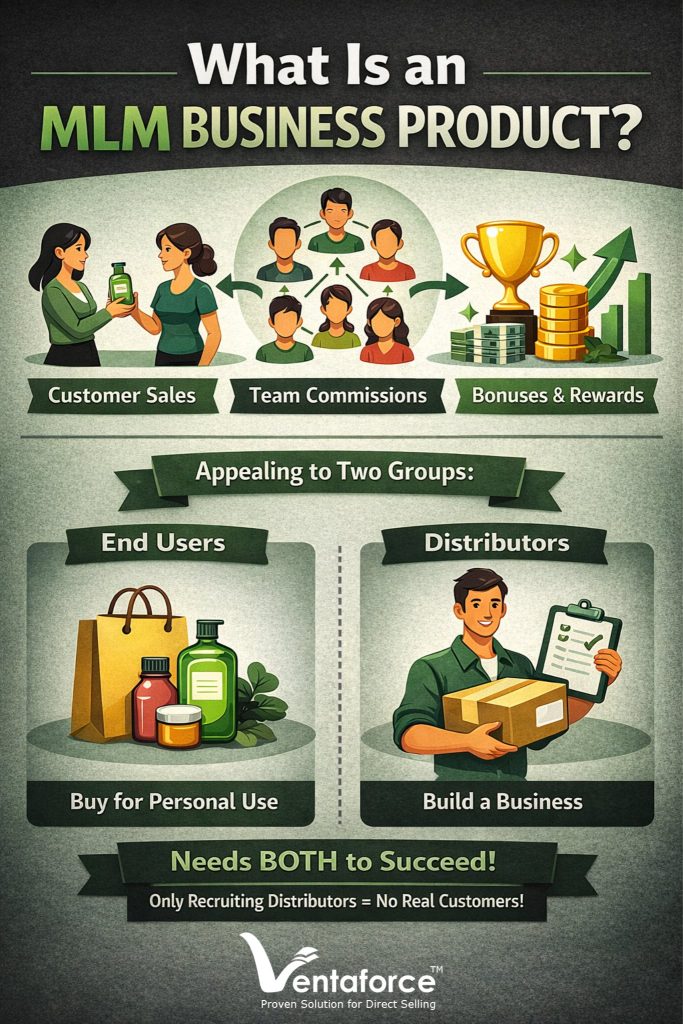
An MLM business product is the primary good or service offered through a network-based sales model. Unlike traditional retail, products are marketed and sold by independent distributors who earn income through multiple streams:
- Direct retail profit from customer sales
- Commissions generated from group or team sales volume
- Performance incentives, leadership bonuses, and rank advancements
For an MLM business to remain viable, its products must appeal to two distinct but equally important groups:
- End users, who purchase the product strictly for its utility or benefit
- Distributors, who promote the product while building a business
If a product only attracts distributors but fails to retain genuine customers, it creates compliance risks, poor retention, and eventual collapse—regardless of the country of operation.
Why Direct Selling Product Choice Is More Critical Than Ever in 2026
Across global markets, MLM is no longer an emerging concept. It is a mature industry facing tighter scrutiny and more informed consumers.
Global Factors Reshaping MLM Product Strategy
- Stronger consumer protection laws worldwide
- Increased action against misleading health or income claims
- Digital-first purchasing behavior across age groups
- Social commerce replacing traditional offline selling
- Declining tolerance for overpriced or low-value subscriptions
- Retention and customer lifetime value becoming key growth metrics
In 2026, products no longer support the business—products define the business.
Core Characteristics of High-Performing MLM Products Worldwide
Before evaluating specific categories, successful MLM or Direct Selling companies ensure their products meet these universal standards:
1. Genuine Market Demand
The product must address a clear, recurring problem such as health support, convenience, financial protection, productivity, or lifestyle improvement.
Products that solve ongoing needs consistently outperform trend-based or novelty items.
2. Strong Repeat-Purchase Behavior
Long-term Direct Selling success depends on predictable revenue. The most effective products encourage:
- Monthly or habitual usage
- Subscription or auto-delivery models
- Ongoing consumption or service access
One-time or rarely used products force constant recruitment, which is no longer sustainable.
3. Fair and Defensible Pricing
Modern consumers compare prices instantly. Successful MLM products are priced based on:
- Comparable retail alternatives
- Clear differentiation or quality advantages
- Real value—not inflated margins to fund commissions
Unjustified pricing leads to churn, distributor frustration, and brand damage.
4. Regulatory and Compliance Readiness
MLM products must align with regulations across multiple regions, including:
- Consumer protection laws
- Product labeling and disclosure requirements
- Advertising and claims standards
- Income representation guidelines
Compliance is no longer a legal checkbox—it is a competitive advantage.
5. Simple, Clear Product Explanation
If a distributor cannot explain the product’s value clearly in under one minute, adoption slows. Products must be:
- Easy to understand
- Easy to demonstrate
- Easy to communicate across cultures and languages
Complexity increases training costs and dropout rates.
How to Choose The Best MLM Products for Your Network Marketing Business
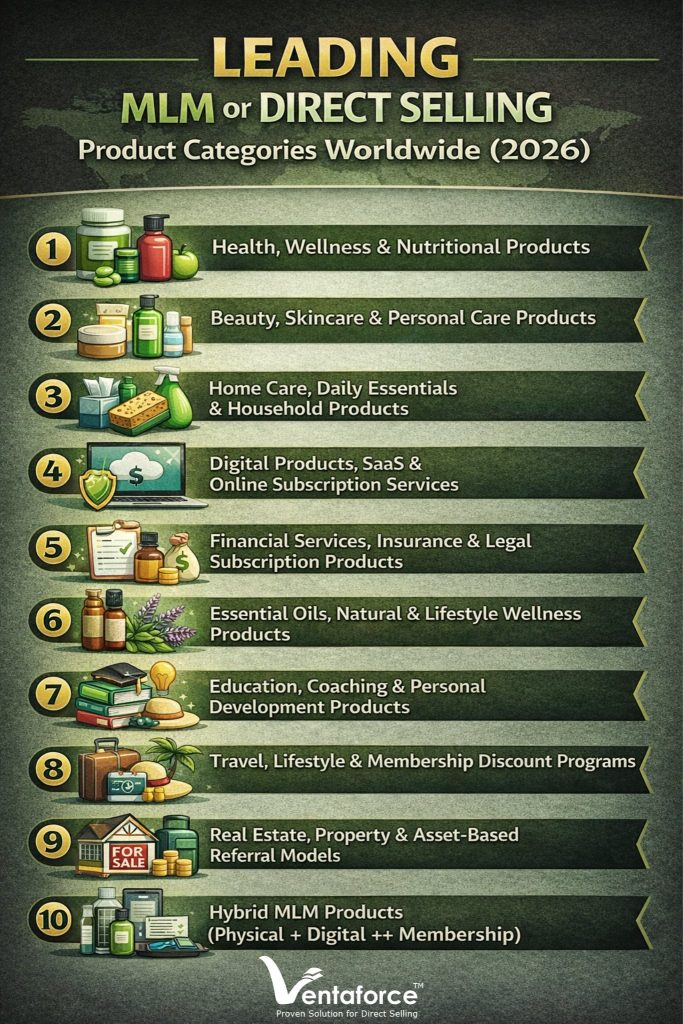
Leading MLM or Direct Selling Product Categories Worldwide (2026)
1. Health, Wellness & Nutritional Products
Estimated Global Market Share: 35–40%
Health and wellness products remain the dominant category in global MLM, spanning supplements, functional foods, immunity support, digestive health, weight management, and daily nutrition.
Why this category leads globally?
Health products fit naturally into the MLM model because they:
- Address ongoing, universal needs
- Encourage daily or monthly consumption
- Create habit-based usage and repeat orders
- Support subscription and autoship programs
In markets such as India, the United States, Southeast Asia, and parts of Europe, consumers increasingly prioritize preventive health over reactive care—driving strong long-term demand.
Common product formats:
- Protein and nutrition shakes
- Vitamins and mineral supplements
- Immunity and gut-health formulations
- Functional beverages and super foods
Key success factors:
- Evidence-based formulations
- Clear usage instructions
- Conservative, compliant health messaging
Compliance considerations:
Health claims are heavily regulated worldwide. Products must avoid medical promises and ensure all marketing aligns with regional authorities such as FDA, EFSA, FSSAI, and similar bodies.
Popular global MLM companies:
- Amway (Nutrilite)
- Herbalife
- USANA Health Sciences
- Forever Living Products
- Nature’s Sunshine
- Vestige (India-focused)
2. Beauty, Skincare & Personal Care Products
Estimated Global Market Share: 20–25%
This category includes skincare, cosmetics, hair care, anti-aging solutions, grooming products, and clean beauty formulations.
Why it performs consistently?
Beauty products are:
- Highly visual and demonstrable
- Easy to promote through social and influencer marketing
- Strongly driven by before-and-after experiences
- Naturally repeatable when results are visible
This category performs exceptionally well on platforms like Instagram, YouTube, and short-form video channels, making it ideal for modern digital-first MLM strategies.
Common product formats:
- Skincare regimens
- Anti-aging creams and serums
- Hair growth and scalp treatments
- Men’s grooming solutions
Key success factors:
- Visible, realistic results
- Ingredient transparency
- Lifestyle-focused branding
Compliance considerations:
Claims related to age reversal, medical skin conditions, or guaranteed results must be avoided to remain compliant.
Popular global MLM companies:
- Mary Kay
- Nu Skin
- Avon
- Oriflame
- Rodan + Fields
- Forever Living (personal care range)
3. Home Care, Daily Essentials & Household Products
Estimated Global Market Share: 10–12%
This category includes everyday household items such as cleaning solutions, laundry products, air and water purification systems, and eco-friendly home essentials.
Why it sustains long-term growth?
Home care products succeed because they:
- Replace items people already buy monthly
- Are price-comparable with retail brands
- Fit naturally into repeat-purchase behavior
In many global markets, environmentally conscious and chemical-free alternatives are driving rapid adoption.
Common product formats:
- Multi-surface cleaners
- Laundry detergents
- Reusable home essentials
- Water and air filtration systems
Key success factors:
- Demonstrable cost savings or safety benefits
- Reliable supply and logistics
- Simple, practical messaging
Popular global MLM companies:
Claims related to age reversal, medical skin conditions, or guaranteed results must be avoided to remain compliant.
Popular global MLM companies:
- Amway (Home Care range)
- Melaleuca
- Atomy
- Norwex
- Vestige (Home Care segment)
- 4Life
4. Digital Products, SaaS & Online Subscription Services
Estimated Global Market Share: 6–8% (fastest-growing category)
Digital MLM products include software platforms, AI-powered tools, business automation systems, online education, and membership-based digital services.
Why this category is expanding rapidly?
Digital products offer:
- Zero inventory and shipping costs
- Instant global delivery
- High scalability and profit margins
- Seamless integration with MLM software
This category appeals strongly to tech-savvy consumers and entrepreneurs, particularly in emerging digital economies.
Common product formats
- AI productivity tools
- Online learning platforms
- Digital business services
- Subscription-based memberships
Key success factors:
- Clear ongoing value
- Regular feature updates
- Strong customer support
Compliance considerations:
Digital products must clearly communicate deliverables and avoid misleading income or skill-acquisition claims.
Popular MLM companies & platforms:
- Market America (digital services)
- iGenius
- Success Factory
- LiveGood (hybrid digital + wellness)
5. Financial Services, Insurance & Legal Subscription Products
Estimated Global Market Share: 7–9%
This category includes financial education, insurance referrals, identity protection, credit monitoring, and legal support services offered through subscription models.
Why it performs well?
These products:
- Provide long-term, recurring value
- Solve high-impact, real-world problems
- Generate predictable monthly revenue
They perform particularly well in mature markets where consumers are proactive about financial security.
Common product formats:
- Financial education platforms
- Legal access memberships
- Identity theft protection services
- Insurance advisory services
Compliance considerations:
This category requires strict adherence to licensing, disclosures, and jurisdiction-specific regulations.
Popular global MLM companies:
- Primerica
- World Financial Group (WFG)
- LegalShield
- ACN (essential services)
6. Essential Oils, Natural & Lifestyle Wellness Products
Estimated Global Market Share: 6–7%
Includes aromatherapy oils, natural remedies, holistic wellness products, and lifestyle-based natural solutions.
Why customers remain loyal?
This category benefits from:
- Emotional engagement and lifestyle branding
- Community-driven usage
- Routine incorporation into daily life
Key success factors:
- Product purity and sourcing transparency
- Education-based selling
- Conservative wellness claims
Popular global MLM companies:
- doTERRA
- Young Living
- Melaleuca (natural wellness)
- Norwex (eco-lifestyle focus)
7. Education, Coaching & Personal Development Products
Estimated Global Market Share: 2–3%
This category covers leadership training, skill development, business education, and personal growth programs.
Why demand continues to grow?
Global interest in:
- Entrepreneurship
- Remote work
- Skill enhancement
has increased the appeal of structured learning and coaching subscriptions.
Compliance considerations:
Products must focus on education—not guaranteed income or success outcomes.
Popular global MLM companies:
- iGenius
- Success Factory
- Legacy Education Platforms
8. Travel, Lifestyle & Membership Discount Programs
Estimated Global Market Share: 3–4%
Includes travel clubs, hotel discounts, lifestyle benefits, and membership-based savings programs.
Why it attracts distributors?
Travel products appeal emotionally but must be supported by:
- Transparent pricing
- Real, verifiable savings
- Easy-to-use platforms
This category has faced scrutiny in the past, making compliance and value delivery critical.
Popular global MLM companies
- InCruises
- Travorium
- WorldVentures (legacy model)
- DreamTrips (earlier model)
9. Real Estate, Property & Asset-Based Referral Models
Estimated Global Market Share: 1–2% (niche)
These models focus on education, referrals, or revenue sharing rather than direct property sales.
Why it remains niche?
- High ticket size
- Long sales cycles
- Complex regulatory environments
This category suits experienced professionals rather than mass-market distributors.
Popular companies / models:
- eXp Realty (revenue-sharing model)
- Keller Williams (profit-sharing structure)
- Realty ONE Group
10. Hybrid MLM Products (Physical + Digital + Membership)
Estimated Global Market Share: 5–6% and rising
Hybrid models combine physical products with digital platforms, education, mobile apps, and membership perks.
Why this is the future of MLM?
Hybrid products:
- Increase engagement
- Reduce churn
- Offer multiple value touchpoints
- Support long-term customer retention
They are increasingly adopted by global MLM leaders seeking sustainable growth.
Popular global MLM companies
- Amway
- Herbalife
- Nu Skin
- LiveGood
How to Choose the Right MLM Product for Your Business
Step 1: Clearly Define Your Target Customer
Every successful MLM product begins with a clear understanding of who the end user is.
Ask yourself:
- Who will use this product daily or monthly?
- What specific problem does it solve for them?
- Is the problem urgent, recurring, or essential?
- Would they buy this product without a business opportunity attached?
Products designed only for distributors, rather than real customers, struggle with retention and raise compliance concerns in most markets.
Key rule:
If the product does not stand on its own in the open market, it is a high-risk choice.
Step 2: Evaluate Real Market Demand
Before launching or promoting any MLM product, demand must be validated beyond internal presentations.
Effective validation methods include:
- Online search behavior and trend analysis
- Comparison with existing retail or D2C products
- Customer reviews and repeat purchase indicators
- Performance of similar products in established MLM companies
Products with proven demand reduce dependency on aggressive recruiting and allow distributors to focus on customer acquisition and retention.
Step 3: Assess Repeat Purchase and Retention Potential
Sustainable MLM businesses are built on recurring revenue, not one-time sales.
Strong MLM products typically:
- Are consumable or subscription-based
- Offer clear reasons for monthly reordering
- Deliver ongoing value that improves with continued use
Products that require constant upselling or pressure-based autoships often result in high churn and distributor burnout.
Ask:
Does this product naturally encourage long-term usage?
Step 4: Analyze Pricing and Value Positioning
In 2026, customers globally compare prices instantly. MLM products must be priced fairly and defensibly.
Key pricing questions:
- How does the product compare to retail alternatives?
- Is the price justified by quality, formulation, or service depth?
- Are commissions funded by real value or inflated pricing?
Overpriced products damage brand trust and make customer retention difficult—especially in price-sensitive markets.
Step 5: Verify Regulatory and Compliance Readiness
Compliance is no longer optional in MLM. Product claims and marketing practices must align with regulations across all target markets.
Critical compliance areas include:
- Product labeling and ingredient transparency
- Advertising and health-related claims
- Income representation and earnings disclosures
- Distributor training and compliance monitoring
Products that invite regulatory scrutiny put the entire organization – and every distributor – at risk.
Step 6: Confirm Ease of Explanation and Demonstration
If distributors cannot explain the product clearly and confidently, conversion rates suffer.
Effective MLM products:
- Have a simple, clear value proposition
- Are easy to demonstrate visually or practically
- Require minimal technical or scientific explanation
As a guideline, a distributor should be able to explain:
- What the product does
- Who it is for
- Why it is valuable
— within 60 seconds or less.
Step 7: Review Supply Chain Reliability and Scalability
Even the best product fails if fulfillment is inconsistent.
Evaluate:
- Manufacturing capacity and quality control
- Inventory management systems
- Global shipping and logistics capabilities
- Contingency plans for shortages or recalls
Reliable fulfillment builds distributor confidence and protects brand reputation.
Step 8: Ensure Alignment With Modern MLM Software
In 2026, product success is tightly connected to technology.
Your MLM product must integrate seamlessly with software systems that manage:
- Autoship and subscriptions
- Commission calculations
- Customer and distributor dashboards
- Compliance tracking and reporting
- Multi-currency and multi-language operations
Without robust MLM software, operational friction increases and scalability becomes difficult.
Step 9: Evaluate Digital and Social Marketability
Traditional offline selling methods are no longer sufficient.
Successful MLM products today:
- Are suitable for ethical social media promotion
- Translate well into short-form video content
- Comply with platform-specific advertising rules
- Support content-based, value-driven marketing
Products that rely on secrecy, exaggerated claims, or hype struggle in transparent digital environments.
Step 10: Test Ethical and Brand Alignment
Finally, assess whether the product aligns with your personal and professional values.
Ask yourself:
- Would I recommend this product to family or friends?
- Would I use it myself long-term?
- Does it enhance or damage my personal brand?
- Can it be promoted honestly without exaggeration?
Ethical alignment leads to higher trust, better retention, and long-term business sustainability.
Common Mistakes Global MLM Entrepreneurs Must Avoid
Across all regions, many MLM businesses fail not because of poor effort, but due to avoidable strategic mistakes. In 2026, global entrepreneurs should be cautious of the following:
-
Choosing commissions over customer value
Products without genuine consumer demand struggle with retention and long-term sustainability. -
Relying on hype instead of product quality
Short-term trends fade quickly, while weak products damage credibility. -
Overpromising income or product results
Exaggerated claims invite regulatory action and erode trust worldwide. -
Ignoring local and international compliance rules
Each market has its own regulations; failure to adapt messaging and documentation creates serious risk. -
Underinvesting in technology and MLM software
Outdated systems cause payout issues, poor reporting, and operational inefficiencies. -
Focusing on recruitment while neglecting retention
Sustainable growth comes from repeat customers, not constant replacement of distributors.
Avoiding these mistakes helps build ethical, compliant, and scalable MLM businesses across global markets.
Role of Technology in Scaling MLM Products
In 2026, technology is a core growth driver for every successful MLM business. Modern MLM software enables companies to automate operations, ensure compliance, and scale product sales across multiple markets without complexity.
The right technology platform helps businesses:
- Manage subscriptions and autoship products seamlessly
- Calculate commissions accurately and in real time
- Monitor compliance and control marketing claims
- Support multi-currency and multi-language operations
- Provide transparent dashboards for distributors and customers
Without robust technology, even high-quality MLM products struggle to scale globally. With the right systems in place, product-led growth becomes faster, more efficient, and sustainable.
Future Trends in MLM or Direct Selling Business Products
As the MLM industry continues to mature globally, product strategies are shifting toward sustainability and transparency. In the coming years, successful MLM businesses will focus on:
- Subscription-first and consumable products that support recurring revenue
- Digital and hybrid offerings combining physical products with apps, education, or memberships
- AI-driven personalization to improve customer experience and retention
- Compliance-first product messaging aligned with global regulations
- Transparent pricing and sourcing to build long-term trust
MLM companies that adapt to these trends will be better positioned to scale ethically and competitively beyond 2026.
Final Thoughts: Products Build Trust, Trust Builds MLM Businesses
As the global MLM and direct selling industry moves deeper into 2026, one reality is clear: long-term success is no longer driven by hype, recruitment pressure, or short-term incentives. It is driven by trust—and trust is built through products.
When an MLM product delivers real value, is fairly priced, compliant across markets, and designed for repeat use, it creates confident customers and credible distributors. This trust reduces churn, strengthens personal brands, and allows businesses to grow organically across regions and cultures.
The most successful MLM companies today are:
- Product-first, not compensation-first
- Customer-driven, not recruiter-dependent
- Technology-enabled, not manual and opaque
- Compliance-focused, not risk-prone
By choosing the right products and supporting them with strong systems and ethical practices, MLM entrepreneurs can build businesses that last—not just through 2026, but for the long term.
In MLM, products create trust, trust creates loyalty, and loyalty builds sustainable global businesses.
Your Products Deserve a Stronger MLM System
Even the best MLM products fail without:
- Accurate commission tracking
- Scalable genealogy management
- Subscription and repeat-order automation
- Real-time performance insights
Ventaforce MLM Software helps MLM companies turn great products into profitable, long-lasting businesses.
Frequently Asked Questions (FAQ)
An MLM business product is the core good or service sold to customers, such as supplements, skincare, household items, digital tools, or services. It must deliver real, repeatable value independent of the business opportunity.
Health & wellness, beauty & personal care, and home essentials together account for the largest share of global MLM sales, due to strong recurring demand, subscription potential, and widespread consumer adoption across regions like India, the US, Europe, and Southeast Asia.
Yes. Services like financial education, insurance, legal protection, digital tools, and subscription-based memberships are valid MLM products worldwide, provided they offer clear, tangible value to end customers.
Yes, but only in a limited, niche form. Real estate MLM models focus on referrals, revenue sharing, or educational programs rather than direct property sales. This category is small globally but growing, particularly in professional markets.
Digital products avoid inventory, shipping, and storage costs, allowing for instant global delivery, higher margins, and faster scalability. They are especially popular with tech-savvy consumers and entrepreneurs in emerging digital economies.
Compliance is essential worldwide. Regulatory bodies in the US, EU, India, and other regions actively monitor product claims, advertising, and income representations. Non-compliance can result in fines, reputational damage, or business closure.
A globally compliant MLM product has:
- Genuine customer demand
- Transparent and defensible pricing
- No exaggerated health or income claims
- Sales driven by customers, not recruitment
Yes. Products that combine physical goods, digital services, and membership benefits increase engagement, reduce churn, and provide multiple points of recurring value for customers and distributors.
High-quality, evidence-backed products foster customer trust, repeat purchases, and referrals, enabling distributors to grow their networks without relying on aggressive recruiting or hype-driven marketing.
Successful MLM products will be:
- Subscription-driven for recurring revenue
- Compliance-first across regions
- Tech-enabled with integrated software and digital tools
- Transparent in pricing and sourcing
- Focused on long-term customer value and retention