
The concept of combining real estate with network marketing has gained attention in recent years. With rising property prices, fractional ownership models, and digital property platforms, many entrepreneurs are exploring Real Estate MLM (Multi-Level Marketing) as a home-based or hybrid income opportunity.
But the real question remains:
Is Real Estate MLM legitimate? Or is it risky?
Let’s break it down with clarity, industry insights, myths vs facts, and inspirational examples.
What Is Real Estate MLM ?
Real Estate MLM is not traditional product-based MLM. Instead, it is typically a revenue-sharing brokerage model where :
- Agents sell real estate.
- They earn direct commission from property transactions.
- They may earn revenue share or override income from agents they introduce — but only when those agents close real deals.
This model formalizes what has historically existed informally in brokerage referral networks.
Myth 1: It’s a Pyramid Scheme
Fact : Pyramid schemes pay for recruitment. Legitimate real estate MLM models pay commissions from verified property transactions.

How Real Estate MLM Works Globally
1. Agent Registration
Individuals join a brokerage platform as licensed real estate agents or advisors (depending on local legal requirements).
2. Direct Sales Commission
Agents earn commission from property transactions — residential, commercial, or land deals.
3. Revenue Sharing Model
Some companies provide tiered revenue sharing :
- When an agent introduces another productive agent.
- Revenue share is paid from brokerage income generated by actual sales.
- Recruitment alone does not generate income.
4. Cloud-Based Infrastructure
Modern real estate MLM companies operate :
- Virtually (no physical offices required)
- With digital dashboards
- Using automated commission systems
Myth 2 : Anyone Can Join Without Credentials
Fact : In most countries, real estate licensing or compliance requirements apply.
Real Estate MLM Industry Insights :
Global brokerage networks using revenue-sharing models have expanded rapidly over the past decade. The evolution of cloud-based real estate platforms has reshaped how agents operate, earn, and scale internationally.
Notable Examples in the Industry
- eXp Realty : A cloud-based brokerage that offers a multi-tier revenue share plan for agents who attract others to the firm. eXp Realty is a one of the fastest-growing cloud-based brokerages in the world. Operating across more than 25 countries, eXp Realty has demonstrated that:
- Virtual brokerage models can scale internationally without traditional office infrastructure.
- Revenue-sharing systems can attract entrepreneurial, growth-oriented agents.
- Technology can significantly reduce administrative inefficiencies.
According to public reports from eXp World Holdings, the parent company of eXp Realty, the organization distributed over $230 million in revenue share and equity benefits in 2023, showcasing the scale of performance-based compensation within a transaction-driven framework.
- Keller Williams : Operates a "profit share" system where agents receive a portion of their market center's profits based on the agents they recruited.
- Real Brokerage : Features a revenue-sharing model similar to eXp, aimed at incentivising agent recruitment.
This model aligns with broader industry shifts recognized by organizations such as the National Association of Realtors, which has documented the increasing digitization of brokerage operations and the growing reliance on cloud-based systems, virtual collaboration tools, and remote transaction management.
Core Compensation Models (2026 Trends)
Modern real estate MLMs typically utilize one of these structures, often managed via specialised MLM software to ensure transparency :
- Binary Plan : Features a two-leg structure (left and right). It encourages teamwork because new recruits often "spill over" to support the weaker leg, balancing the network for maximum payouts.
- Matrix Plan : Uses fixed width and depth (e.g., 3x7 or 5x7). This limits how many people an agent can directly sponsor, forcing growth deeper into the organization.
- Revenue/Profit Share (Hybrid) : Popularized by firms like eXp Realty and Keller Williams, these models share a portion of the company’s gross commission or market center profits with agents who help grow the firm.
Is Real Estate MLM Legit Worldwide ?
It is legitimate when :
- Revenue is generated from actual property transactions.
- Agents are licensed where required.
- Compensation is transparent.
- Compliance frameworks are respected.
- Software systems ensure payout accuracy.
It becomes risky when :
- Recruitment is rewarded over transactions.
- There is no verifiable property activity.
- Compliance is ignored.
Myth 3 : It’s Passive Income
Fact : Real estate requires active prospecting, negotiation, and client servicing.
- Did You Know ?
- Real estate remains one of the world’s largest asset classes.
- Referral-based real estate commissions are already common in traditional brokerage.
- Women participation in direct selling globally exceeds 70%, making property referral networks an emerging opportunity for female entrepreneurs.
- Digital automation has reduced the administrative burden of commission tracking in large networks.
How Real Estate MLM Empowers Women & Home-Based Entrepreneurs
Real estate MLM can be appealing because :
- It can be operated remotely
- Flexible networking through social media
- High-ticket commission potential
- No inventory management
Many women entrepreneurs prefer commission-based referral businesses because they can balance family responsibilities while building professional networks.
Success often comes from relationship-building skills rather than large financial investment.
Inspirational Case : eXp Realty Model
eXp Realty pioneered a global cloud-based brokerage structure where :
- Agents work remotely.
- There are no traditional franchise offices.
- Revenue share rewards agents who attract productive professionals.
- Technology manages commission distribution transparently.
This inspired many entrepreneurs worldwide to rethink brokerage structures.
The key inspiration point:
Technology + Revenue Sharing + Real Transactions = Scalable Model
Risks to Evaluate Worldwide
Before joining or launching a real estate MLM model, verify :
- Company registration and licensing
- Legal compliance in each operating country
- Transparent compensation structure
- Clear commission documentation
- No recruitment-only payout emphasis
Real estate is a regulated industry. Any compensation tied to property must comply with local laws.
Myth 4 : It’s a Shortcut to Wealth
Fact : Success depends on productivity, networking skills, market knowledge, and consistency.
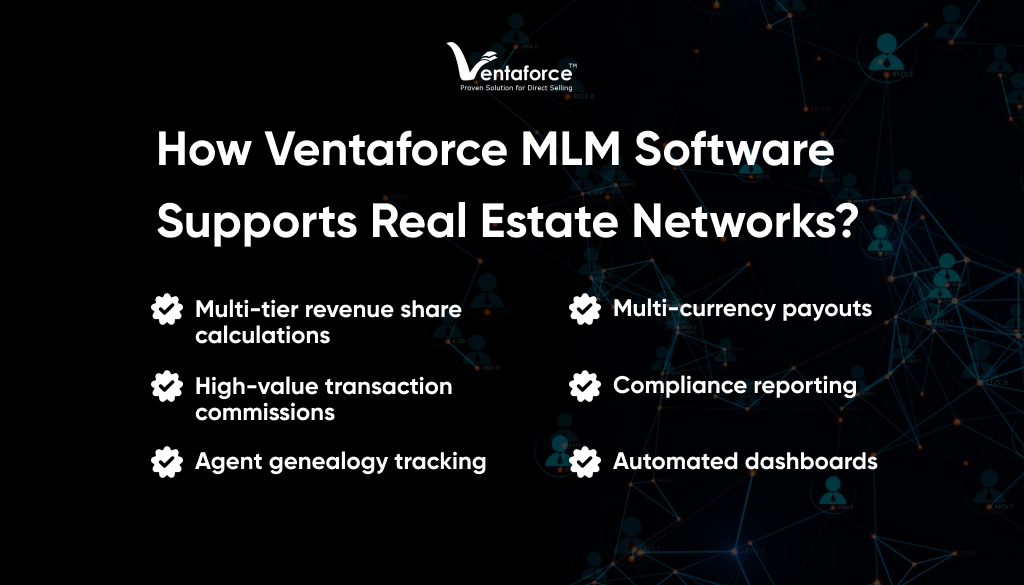
How MLM Software Supports Real Estate Networks ?
Structured real estate MLM models require strong backend systems to manage :
- Multi-tier revenue share calculations
- High-value transaction commissions
- Agent genealogy tracking
- Multi-currency payouts
- Compliance reporting
- Automated dashboards
Without advanced MLM software infrastructure, scaling such networks globally becomes operationally risky.
Technology ensures :
- Accuracy
- Transparency
- Trust
- Scalability
How MLM Software Supports Real Estate Networks ?
A Real Estate MLM business opportunity can be legitimate and scalable when built on :
- Real property transactions
- Licensed brokerage operations
- Transparent revenue sharing
- Strong digital infrastructure
It becomes risky when driven primarily by recruitment incentives without real sales activity.
For professionals seeking high-ticket, performance-based income with scalable networking potential, it can represent a modern evolution of traditional brokerage — but only when structured correctly.
Ready to Launch a Scalable Real Estate MLM Platform?
Automate Revenue Sharing, Manage Broker Networks & Ensure Global Compliance with Advanced Real Estate MLM Software. No Manual Calculations. No Commission Errors. No Compliance Risks.
Frequently Asked Questions (FAQ)
Real Estate MLM (Multi-Level Marketing) is a structured brokerage model where agents earn commissions from property transactions and may also receive revenue share from agents they introduce — but only when real sales occur.
It combines traditional real estate brokerage with a revenue-sharing structure supported by digital systems.
Yes, Real Estate MLM is legal when:
- Income is generated from actual property transactions
- Agents are properly licensed
- Compensation is transparent
- Recruitment alone does not generate income
If a model rewards recruitment without real property sales, it may be illegal in many jurisdictions.
A revenue sharing platform tracks:
- Property transactions
- Commission splits
- Multi-tier overrides
- Agent genealogy
- Performance bonuses
Revenue share is paid from brokerage income generated by real estate deals — not from joining fees.
Real Estate MLM software is a backend system that automates:
- Multi-level commission calculations
- Agent downline tracking
- Revenue share distribution
- Compliance reporting
- Multi-currency payouts
- Dashboard analytics
It ensures accuracy, transparency, and scalability in large brokerage networks.
Without real estate MLM software:
- Commission errors increase
- Manual calculations create disputes
- Revenue sharing becomes difficult to manage
- Global expansion becomes risky
A professional real estate network marketing software system ensures trust and operational efficiency.
Traditional brokerage pays agents commission only on personal sales.
Real Estate MLM may include:
- Revenue-sharing programs
- Multi-tier compensation
- Team-based incentives
- Equity or performance rewards
The core activity remains property transactions.
Yes. Many companies operate as global digital brokerages using cloud-based systems and direct selling platforms for brokers.
However, they must comply with:
- Local licensing laws
- Tax regulations
- Consumer protection requirements
Compliance varies by country.
No — if commissions are tied to real property transactions.
A pyramid scheme pays primarily for recruitment. A legitimate Real Estate MLM model generates income from verified real estate deals.
It may be suitable for:
- Licensed real estate agents
- Entrepreneurs seeking scalable income
- Women entrepreneurs seeking flexible, home-based models
- Brokers building international networks
Success depends on productivity, relationship-building, and market knowledge.
The best Real Estate MLM software should include:
- Custom compensation plan configuration
- Automated revenue sharing engine
- Secure commission management
- Multi-currency wallet system
- Compliance & reporting tools
- Real-time dashboards
- Integration with brokerage CRM systems
Scalability and accuracy are critical.
No. Real estate requires:
- Active prospecting
- Client management
- Negotiation skills
- Market expertise
Revenue sharing can create leveraged income — but it is not fully passive.