Everything you need to know — from fundamentals to statistics, real-time research, technology trends like AI and automation, challenges, and how you can grow 10x.
From Living Room Meetings to AI-Powered Global Networks — The Evolution of Direct Selling
Twenty years ago, direct selling meant living room product demonstrations, handwritten order forms, and long evenings explaining opportunity plans face-to-face. Success depended on local connections, personal charisma, and manual team tracking. Fast forward to today — distributors are building international teams from their smartphones. Commissions are processed instantly through automated MLM software. Artificial intelligence predicts which prospects are ready to join. Entire global organizations operate from digital dashboards.
Direct selling has not disappeared — it has transformed.
And as we move toward 2030, this transformation will accelerate. AI in direct selling software, automation in direct sales, social commerce integration, and next-generation direct selling platforms are reshaping how companies scale and how leaders grow their teams.
If you want to understand where the industry is headed — and how to position your business for exponential growth — this guide will show you the roadmap.
What Is Direct Selling ?
Direct selling is a retail distribution model in which products or services are sold directly to consumers outside of traditional brick-and-mortar stores. Instead of relying on wholesalers or retail shelves, companies distribute products through independent representatives who market and sell directly to customers — often through personal networks, social platforms, online communities, or face-to-face interactions.
According to the World Federation of Direct Selling Associations (WFDSA), direct selling is defined as:
“The marketing of products and services directly to consumers in a non-retail environment through independent sales representatives.”
This model eliminates multiple layers of traditional retail markup and empowers individuals to operate as micro-entrepreneurs.
- Myth
Direct Selling Is a Dying Industry
- Fact
Global retail sales in direct selling exceed $160+ billion annually (WFDSA).
Projections suggest the industry may approach $280+ billion by 2030, driven by digital transformation, mobile commerce, and AI-powered platforms.
The model isn’t dying — it’s digitizing.
Let’s Deep Dive in Direct Selling Industry Fact and Figures :
1.The Size of the Global Direct Selling Industry
Direct selling is not a niche sector. It is a massive global industry.
Global Market Revenue
According to the World Federation of Direct Selling Associations (WFDSA Global Statistics Report 2023):
- Global retail sales in direct selling exceeded $167 billion annually
- More than 114 million independent representatives participate worldwide
- Direct selling operates in over 100 countries
2. Regional Market Distribution:
WFDSA data indicates :
- Asia-Pacific represents the largest regional market share (approx. 45%)
- North America remains one of the most established markets
- Latin America continues to show strong participation growth
This geographic diversity highlights the scalability and cross-border potential of modern direct selling businesses.
3. Industry Growth Projections
Market research platforms such as Statista and global business research firms project continued expansion :
- The global direct selling market is expected to reach approximately $280+ billion by 2030
- Compound Annual Growth Rate (CAGR) estimated between 6–8%
- Health & Wellness remains the dominant category, accounting for over 30–35% of global sales
4. Product Categories Driving Direct Selling
According to industry data :
- Health & Wellness : ~35%
- Cosmetics & Personal Care : ~25%
- Household & Durable Goods
- Lifestyle and Services
The rise of subscription-based health supplements and personal care products has strengthened recurring revenue models within the industry.
5. Who participates more in Direct Selling ?
WFDSA and DSA reports show :
- Approximately 70–74% of direct sellers globally are women
- Many participants join for flexible, part-time income
- Increasing number of full-time digital entrepreneurs
Direct selling has historically provided economic opportunities for :
- Women entrepreneurs
- Stay-at-home professionals
- Students
- Individuals seeking supplemental income
- Emerging market entrepreneurs
- Myth
Direct Selling Is Only for Stay-at-Home Sellers
- Fact
Today’s direct selling ecosystem includes :
- Full-time digital entrepreneurs
- E-commerce influencers
- Health & wellness coaches
- Global remote teams
Mobile-first platforms and automation have professionalized the industry.
6. The Evolution of Direct Selling Models
There are two primary structures :
1. Single-Level Marketing (SLM)
- Representatives earn commission on personal sales only.
2. Multi-Level Marketing (MLM)
- Representatives earn from personal sales and team sales.
- Compensation plans may include Binary, Unilevel, Matrix, or Hybrid models.
According to industry research, MLM structures dominate a significant share of direct selling companies due to their scalability.
7. Digital Transformation : The Modern Shift
Historically, direct selling was :
- Home parties
- In-person product demonstrations
- Paper-based commission tracking
Today, it includes :
- Mobile-first selling apps
- AI-driven distributor dashboards
- Automated commission systems
- Global e-wallet payments
This shift is supported by the broader rise in digital commerce. According to global e-commerce statistics, online retail penetration continues to increase year-over-year, directly influencing how direct selling companies operate.
- Myth
Technology Is Optional in Direct Selling
- Fact
In 2026 and beyond, companies without AI integration, automation, and scalable MLM software face operational inefficiencies and retention challenges.
Technology is now a competitive advantage — not a luxury.
8. Why Direct Selling Continues to Grow
Several factors support its resilience :
- Low barrier to entry for entrepreneurs
- Flexible income opportunities
- Strong community-driven structure
- Product-focused recurring revenue models
- Global scalability through technology
Despite regulatory scrutiny in some regions, legitimate direct selling companies continue to operate under structured compliance frameworks supported by DSA guidelines.
9. Important Clarification: Legal Direct Selling vs Pyramid Schemes
Reputable organizations such as the Direct Selling Association (DSA) emphasize :
- Compensation must be based primarily on product sales
- Transparent refund policies must exist
- Inventory loading practices should be avoided
- Ethical marketing practices are required
Companies aligned with DSA standards maintain higher credibility and consumer trust.
- Myth
Direct Selling Is a Pyramid Scheme
- Fact
Legitimate direct selling companies generate revenue from product sales — not recruitment fees.
According to the Direct Selling Association (DSA) and WFDSA, compliant companies:
- Compensate primarily on product sales
- Offer refund policies
- Avoid mandatory large inventory purchases
- Follow regulatory guidelines
Pyramid schemes, on the other hand, focus on recruitment with little or no real product value — and are illegal in most countries.
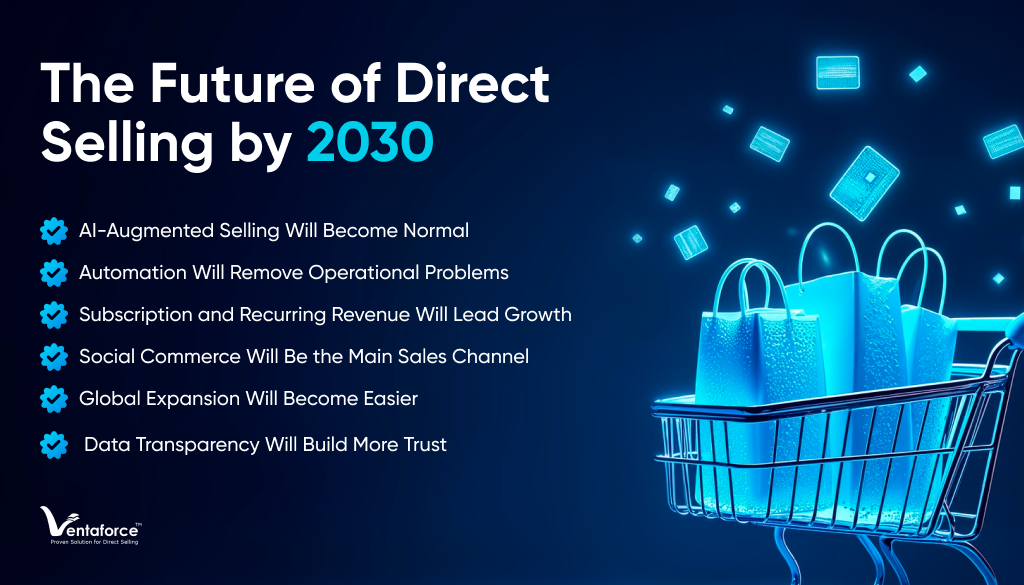
The Future of Direct Selling by 2030
The next five years will shape the next two decades of direct selling.
The industry is not just changing — it is becoming smarter, faster, and more technology-driven. Companies that adapt early will grow stronger. Those that ignore these changes may struggle to compete.
Here is what the future of direct selling is expected to look like by 2030 :
1. AI-Augmented Selling Will Become Normal
Artificial Intelligence (AI) will not replace distributors — it will support them.
Modern AI in direct selling software will help companies :
- Predict which distributors are likely to perform well
- Automatically score and prioritize leads
- Suggest the next best action (call, message, follow-up)
- Forecast commissions and team growth
Instead of relying on guesswork, companies will make decisions based on real data.
This means better planning, smarter targeting, and higher conversion rates.
By 2030, AI support will be a standard feature in professional MLM platforms.
2. Automation Will Remove Operational Problems
Manual systems cause delays, mistakes, and confusion. Automation solves this.
In the coming years, most direct selling companies will use :
- Fully automated commission calculations
- Instant and secure payout systems
- Automated onboarding for new distributors
- AI-based compliance monitoring
Automation reduces human error and ensures everyone gets paid correctly and on time.
When systems are accurate and transparent, trust increases — and trust is the foundation of direct selling.
3. Subscription and Recurring Revenue Will Lead Growth
Automation reduces human error and ensures everyone gets paid correctly and on time.
Health and wellness already dominate global direct selling sales. One major reason is repeat purchasing.
By 2030, more companies will focus on :
- Auto-ship subscription programs
- Monthly product bundles
- Membership-based communities
- Loyalty reward systems
Recurring revenue gives stability.
For distributors, it means consistent income.
For companies, it means predictable cash flow.
This model reduces dependency on constant new recruitment.
4. Social Commerce Will Be the Main Sales Channel
People no longer discover products in stores first — they discover them on social media.
Platforms like :
- TikTok
- YouTube
Are becoming the new storefronts.
Direct sellers are building audiences, sharing product experiences, and closing sales directly from their phones.
To support this, MLM software must integrate with social platforms and offer mobile-friendly checkout systems.
By 2030, social commerce will not be optional — it will be the primary growth driver.
5. Global Expansion Will Become Easier
Technology removes borders.
With advanced MLM software that supports :
- Multiple currencies
- Multiple languages
- Country-specific tax settings
- International payment gateways
Companies can expand into :
- Asia-Pacific
- Latin America
- Africa
- Emerging digital markets
What once required physical offices can now be done digitally.
The companies that build global-ready systems today will dominate tomorrow.
6. Data Transparency Will Build More Trust
One of the biggest concerns in direct selling has always been transparency.
By 2030, modern platforms will provide :
- Real-time commission tracking
- Clear rank progress updates
- Accurate earnings projections
- Complete team performance dashboards
When distributors can clearly see their growth, motivation increases.
Transparency reduces confusion, builds confidence, and improves long-term retention.
Where Direct Selling Will Be in 2030 ?
Here are 10 actionable predictions :
Prediction #1 — AI will run the sales pipeline :
From lead scoring to follow-ups and content personalization.
Prediction #2 — Most direct selling will occur on mobile apps :
Consumers will rarely open desktop sites.
Prediction #3 — Platforms will rival marketplaces :
Direct selling platforms will function like Amazon meets TikTok.
Prediction #4 — Automation will eliminate 70% of manual tasks :
Freeing sellers to focus on relationships.
Prediction #5 — Subscription sales will dominate revenue streams
Prediction #6 — AR product trials will be standard :
No online shop without virtual try-ons.
Prediction #7 — Global scalability with local compliance :
Sellers can expand internationally with regulatory support.
Prediction #8 — Gamification will be a baseline feature :
Driving growth and competition.
Prediction #9 — Blockchain will secure commissions & contracts
Prediction #10 — Training will be AI-driven and real-time
Why MLM Software Is Essential for Global Expansion
How Technology Powers Billion-Dollar Direct Selling Companies
Global expansion in direct selling is no longer about opening physical offices in new countries. Today, growth is powered by technology — specifically advanced MLM software.
If a direct selling company wants to scale from one country to ten, or from 1,000 distributors to 1 million, manual systems will fail. Spreadsheets cannot manage global operations. Paper-based compensation plans cannot handle multi-country complexity.
Modern MLM software is the engine behind global growth.
Let’s deep dive in how mlm software helps to grow your Direct Selling Business
1. Multi-Currency & Multi-Language Support
When expanding internationally, companies must handle :
- Different currencies
- Currency exchange rates
- Country-specific tax rules
- Local language interfaces
- Regional pricing structures
Advanced MLM software automatically manages these complexities.
This allows a company in the US, for example, to expand into :
- India
- Brazil
- Malaysia
- Mexico
- UAE
Without rebuilding the system from scratch.
Technology removes geographical barriers.
2. Automated & Accurate Commission Management
As a network grows internationally, compensation structures become complex :
- Binary structures across time zones
- Unilevel plans with thousands of downlines
- Leadership bonuses
- Rank advancement incentives
- Global performance pools
Without automated MLM software :
- Commission errors increase
- Payment delays happen
- Distributor trust decreases
Billion-dollar companies understand one thing clearly:
If compensation is not accurate and transparent, growth will collapse.
Modern MLM platforms calculate commissions instantly and display them in real time — building confidence across the network.
3. Scalable Cloud Infrastructure
When companies grow internationally, traffic increases dramatically :
- More distributor logins
- More transaction volume
- More commission calculations
- More real-time reporting
Cloud-based MLM software ensures :
- High-speed performance
- Secure data storage
- Scalability without downtime
This infrastructure is essential for enterprise-level growth.
4. Compliance & Regulatory Control
Every country has different regulations for :
- Direct selling
- Commission structures
- Tax reporting
- Distributor contracts
Advanced MLM software includes :
- Compliance tracking
- KYC verification
- Fraud detection
- Automated reporting
This reduces legal risks during global expansion.
Companies that ignore compliance face shutdowns. Companies with built-in compliance grow confidently.
5. Real-Time Analytics for Smarter Expansion
Global growth must be data-driven.
Modern MLM software provides dashboards that show :
- Country-wise sales performance
- Distributor retention rates
- Revenue growth trends
- Conversion analytics
- Churn prediction
This allows leadership to make strategic decisions like :
- Which country to invest more in
- Where training is needed
- Which leaders are emerging
- Which compensation incentives are working
Data turns expansion from a gamble into a calculated strategy.
How Billion-Dollar Companies Invest in Technology to Grow
Leading global direct selling companies invest heavily in digital infrastructure.
Major industry leaders such as :
- Amway
- Herbalife
- Nu Skin
- Mary Kay
Have consistently invested in :
- Digital transformation
- Advanced distributor portals
- AI-based analytics
- Mobile applications
- E-commerce integration
Why?
Because they understand:
Technology increases retention.
Technology increases speed.
Technology increases transparency.
Technology increases global scalability.
Large enterprises allocate millions of dollars annually toward upgrading their technology stack because they recognize that modern direct selling is platform-driven.
The lesson for growing companies is clear:
If billion-dollar companies rely on advanced systems to scale, startups and mid-sized companies must adopt robust MLM software even earlier to compete.
- Myth
Only Top Leaders Make Money
- Fact
Income depends on structure, effort, product demand, and compensation model transparency.
Modern direct selling platforms use :
- Automated rank tracking
- Real-time dashboards
- Performance analytics
This allows distributors to monitor progress clearly, reducing opacity and improving performance optimization.
How MLM Software Directly Drives 10XGrowth in your Direct Selling Business
Let’s break it down simply.
1. Faster Onboarding = Faster Expansion
Automated onboarding systems allow new distributors in any country to :
- Register instantly
- Complete KYC digitally
- Access training modules
- Start selling immediately
Speed increases momentum.
2. Transparent Earnings = Higher Retention
When distributors can see :
- Real-time earnings
- Rank progression
- Bonus qualification
They stay motivated longer.
Retention is more profitable than constant recruitment.
3. Automation = Lower Operational Costs
Without automation, companies need :
- Large administrative teams
- Manual commission verification
- Manual support handling
MLM software reduces operational overhead, increasing profit margins.
4. Global Accessibility = Unlimited Market Reach
With cloud-based MLM software :
- Distributors can log in from anywhere
- Payments can be processed globally
- Leaders can manage international teams
- Customers can purchase 24/7
Expansion becomes continuous, not limited.

Why Ventaforce Direct Selling Software Is Built for 2030
Future-Ready Technology for Next-Generation Direct Selling Companies
The direct selling industry is evolving rapidly. AI-driven selling, global expansion, automation, subscription models, and mobile-first ecosystems are no longer future concepts — they are becoming industry standards.
To compete in 2030, direct selling companies need more than basic MLM software.
They need intelligent infrastructure.
Ventaforce Direct Selling Software is designed not just for today’s needs — but for the demands of the next decade.
1. AI-Ready Architecture for Intelligent Growth
By 2030, AI in direct selling software will be essential.
Ventaforce is built with a scalable architecture that supports:
- Performance analytics
- Smart reporting dashboards
- Predictive growth insights
- Data-driven decision-making
As AI adoption increases across the industry, Ventaforce ensures your business is ready to integrate and scale without rebuilding your system.
Future-ready companies start with adaptable technology.
2. Advanced Compensation Engine for Complex Plans
Modern compensation plans are becoming more sophisticated.
Ventaforce supports :
- Binary plans
- Unilevel structures
- Matrix systems
- Hybrid compensation models
- Custom bonus configurations
- Global leadership pools
As your organization grows from hundreds to thousands — or even millions — of distributors, the commission engine scales effortlessly.
Accuracy builds trust.
Trust builds retention.
Retention builds long-term revenue.
3. Global Expansion Without Technical Barriers
Direct selling is becoming borderless.
Ventaforce enables international growth with :
- Multi-currency support
- Multi-language interfaces
- Region-based tax configuration
- Hybrid compensation models
- Secure global payment gateway integration
- Country-specific compliance settings
Whether you expand into Asia-Pacific, Latin America, Europe, or emerging digital markets, Ventaforce provides the infrastructure to scale confidently.
Technology should remove limitations — not create them.
4. Automation That Reduces Operational Load
Manual systems slow growth and increase costs.
Ventaforce automates :
- Commission calculations
- Rank advancements
- Bonus qualification tracking
- Distributor onboarding
- E-wallet processing
- Performance reporting
Automation minimizes errors and reduces administrative overhead, allowing leadership teams to focus on strategy instead of system management.
Efficiency is the foundation of scalability.
5. Real-Time Transparency for Distributor Confidence
By 2030, transparency will define credibility in direct selling.
Ventaforce provides :
- Real-time commission tracking
- Rank progress visibility
- Earnings projections
- Detailed team performance dashboards
When distributors clearly see their growth path, engagement increases and skepticism decreases.
Transparent systems create long-term loyalty.
6. Mobile-First Experience for the Next Generation
The next generation of distributors operates from smartphones.
Ventaforce delivers :
- Mobile-friendly dashboards
- Instant notifications
- Real-time updates
- Seamless distributor access from anywhere
As social commerce and mobile selling dominate, having a mobile-optimized direct selling platform becomes essential.
2030 will be mobile-driven — and Ventaforce is ready.
7. Security & Compliance Built Into the Core
With increasing regulatory scrutiny worldwide, security is critical.
Ventaforce incorporates :
- Secure cloud infrastructure
- Data protection protocols
- Fraud detection mechanisms
- Compliance monitoring tools
A secure system protects your brand reputation while enabling safe expansion.
Growth without compliance is risky.
Growth with secure systems is sustainable.
8. Designed for Both Startups and Enterprise-Level Companies
Ventaforce is flexible enough to support :
- Startups launching their first MLM company
- Mid-sized companies scaling internationally
- Enterprise-level direct selling organizations
Its modular structure ensures that as your business grows, your software grows with you.
No system migration.
No rebuilding.
No disruption.
Companies that invest in future-ready infrastructure today will define industry leadership tomorrow.
Conclusion : The Next Era of Direct Selling Has Already Begun
Direct selling is not fading. It is evolving.
From living room meetings to AI-powered global ecosystems, the industry has transformed into a data-driven, technology-enabled opportunity platform. Backed by over $167 billion in global retail sales and millions of entrepreneurs worldwide, direct selling remains one of the most resilient and adaptable business models in modern commerce.
But the rules are changing.
By 2030, success in direct selling will depend on :
- Intelligent automation
- AI-supported decision-making
- Subscription-driven revenue models
- Mobile-first distributor experiences
- Global-ready infrastructure
- Transparent, compliant systems
Companies that rely on outdated systems will struggle with inefficiency and retention issues. Companies that invest in scalable technology will unlock exponential growth.
The future belongs to organizations that combine three powerful elements:
Strong products.
Empowered communities.
Advanced digital infrastructure.
This is no longer just about selling products. It is about building intelligent ecosystems that support entrepreneurs worldwide.
If you are launching, scaling, or modernizing a direct selling company, the time to prepare for 2030 is now.
The next five years will define the next twenty.
The question is not whether direct selling will grow — the data already confirms it will.
The real question is :
Will your company be ready to lead that growth?
Ready to Build the Future of Your Direct Selling Business ?
The next decade will reward companies that invest in intelligent systems, automation, and global-ready infrastructure. Don’t let outdated tools limit your growth.
Frequently Asked Questions
Yes, direct selling remains profitable when built on strong products, transparent compensation plans, and modern technology. The global industry generates over $160+ billion annually, and growth is increasingly supported by AI, automation, and subscription-based models. Companies that adapt to digital transformation have higher retention and scalability.
A legitimate direct selling company earns revenue primarily from product sales. Distributors are compensated based on actual sales volume.
A pyramid scheme focuses mainly on recruitment fees and often lacks real product value. Pyramid schemes are illegal in most countries, while compliant direct selling companies follow DSA and regulatory guidelines.
Key difference: Product-driven revenue vs recruitment-driven revenue.
AI will support distributors and companies by:
- Predicting sales trends
- Scoring leads automatically
- Suggesting follow-up actions
- Forecasting commissions
- Detecting compliance risks
AI will not replace distributors. It will help them work smarter, increase conversions, and reduce guesswork.
MLM software manages:
- Commission calculations
- Distributor onboarding
- Rank advancements
- Global payments
- Performance tracking
- Compliance monitoring
Without automation, companies face errors, delays, and scalability issues. Modern MLM software enables accurate, transparent, and global-ready operations.
Yes — if it uses the right technology.
Large companies invest heavily in digital infrastructure. Startups can compete by adopting advanced MLM software early, automating processes, and focusing on niche products with recurring revenue models.
Technology levels the playing field.
Health and wellness leads globally, followed by:
- Personal care and cosmetics
- Nutrition and supplements
- Lifestyle and digital products
Subscription-based products show higher long-term stability and recurring income potential.
To expand globally, companies need:
- Multi-currency support
- Multi-language systems
- Country-specific tax configuration
- Secure global payment gateways
- Compliance tracking tools
Cloud-based MLM software makes international expansion faster and more cost-effective.
Yes. Social commerce is becoming the primary sales channel.
Platforms like Instagram, TikTok, WhatsApp, and YouTube help distributors:
- Build personal brands
- Educate audiences
- Demonstrate products
- Close sales digitally
Mobile-first and social-integrated systems are essential for 2030 growth.
The main challenges include:
- Regulatory compliance
- Distributor retention
- Transparency concerns
- Operational inefficiencies
- Technology adaptation
Companies that invest in automation and compliance tools reduce these risks significantly.
To achieve 10x growth, focus on:
- Strong product-market fit
- Subscription-based recurring revenue
- AI-powered analytics
- Automated commission systems
- Global-ready MLM software
- Transparent compensation plans
- Social commerce integration
Growth today depends on systems, data, and scalability — not just recruitment.
A future-ready company has:
- AI-integrated systems
- Real-time distributor dashboards
- Automated onboarding and payouts
- Global expansion capability
- Transparent compensation structure
- Strong compliance framework
The companies that combine technology with community will dominate the next decade.