Billion-Dollar Blueprint: How the World’s Top 5 Direct Selling Companies Built Global Empires

Deep Growth Strategies from Amway, Herbalife, Mary Kay, Avon, and Oriflame — and How Direct Sellers Can Apply Them Today
Introduction : Why Only a Few Direct Selling Companies Create Billion-Dollar Legacies
The direct selling industry is massive. Thousands of companies have launched over the last five decades. Yet, only a small elite group has managed to survive economic downturns, regulatory shifts, digital disruption, and changing consumer behavior—and still grow into multi-billion-dollar brands.
What separates these companies from the rest is not aggressive recruitment, flashy income claims, or short-term hype.
Their success is built on :
- Clear product philosophy
- Founder-driven vision
- Strong ethical positioning
- Long-term distributor development
- Deep understanding of human behavior
In countries like India, where trust, word-of-mouth, family approval, and community reputation matter deeply, these factors become even more critical. Businesses grow not just through marketing—but through relationships, patience, and consistency, very similar to how traditional family businesses have grown for generations.
This blog explores how the top 5 direct selling companies were built, what they focused on at the time of founding, how they scaled globally, and what today’s direct sellers must learn if they want success in 2026 and beyond.
1. Amway Growth Strategies :
Amway – The Master class in Systems, Duplication, and Long-Term Thinking
Founded: 1959, USA
Core Product Categories: Nutrition, personal care, home care
Original Vision: Enable ordinary people to build income through repeat-use, high-quality products
What Amway Focused on When It Was Founded ?
Amway was built at a time when :
- Jobs were becoming uncertain
- Middle-class families wanted additional income
- Entrepreneurship was limited to the wealthy
The founders did not chase trends. Instead, they focused on daily household consumption—products people must use regardless of economic conditions.
Key early decisions :
- Focus on consumables, not luxury items
- Ensure products needed monthly replenishment
- Maintain strict quality standards
This created predictable demand and allowed distributors to build stable residual income, not one-time sales.
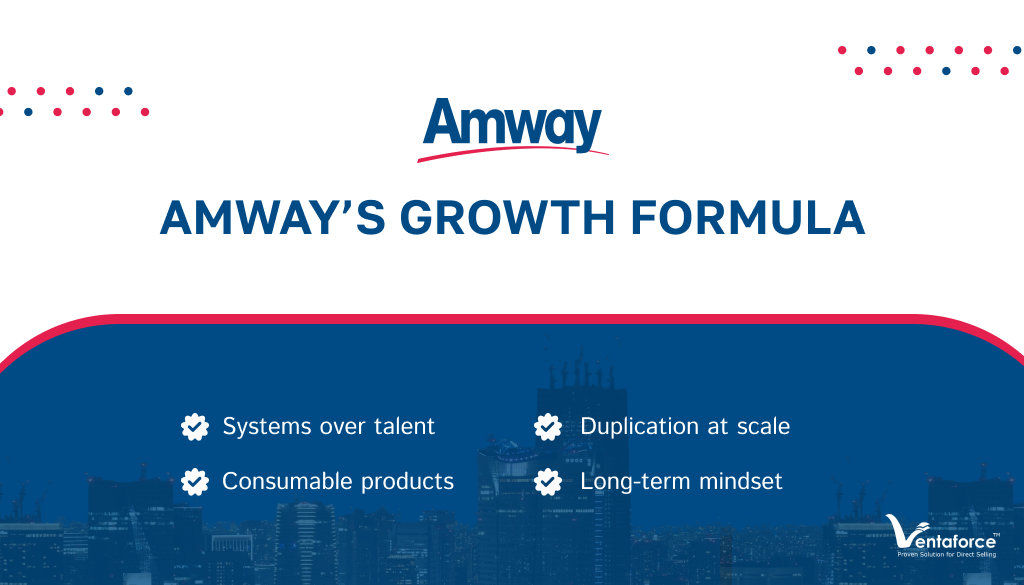
Core Growth Strategy 1 : System before Individual Talent
Amway’s greatest innovation was understanding that most people are not natural salespeople.
So they built :
- Step-by-step onboarding processes
- Simple business presentations
- Weekly learning routines
- Mentorship-driven leadership
This made the business :
- Easy to copy
- Easy to teach
- Easy to scale
In India, this mirrors :
- Coaching institutes
- Traditional apprenticeship models
- Guru–shishya learning culture
Core Growth Strategy 2 : Culture as Business Infrastructure
Amway doesn’t treat culture as motivation—it treats it as infrastructure.
They institutionalized :
- Regular events
- Recognition ceremonies
- Shared values
- Long-term vision building
This created emotional commitment far stronger than commission alone.
Core Growth Strategy 3 : Asset-Building Mindset
Amway consistently teaches distributors to :
- Build organizations, not just sales
- Focus on depth, not shortcuts
- Think in 5–10 year cycles
This mindset shift is why Amway organizations survive leadership changes and market fluctuations.
Key Lesson for Direct Sellers
If your business collapses when you stop working for a week, you don’t have a system—you have a job.
Build repeatable systems, not personality-dependent sales.

Amway’s Success Story – How Strategy, Systems, and People Built a Global MLM Empire
2. Herbalife Growth Strategies :
Herbalife – The Blueprint of Lifestyle Branding and Community-Driven Growth
Founded : 1980, USA
Core Product Categories : Nutrition, weight management, wellness
Original Vision : Improve health outcomes through better nutrition habits
What Herbalife Focused on at the Beginning ?
Herbalife entered the market when :
- Lifestyle diseases were rising
- People were frustrated with quick-fix diets
- Energy, weight, and confidence were emotional pain points
Instead of positioning itself as a supplement company, Herbalife positioned itself as a health and wellness movement.
From day one, distributors were encouraged to :
- Use the products personally
- Track results
- Share real experiences
This authenticity built massive trust.
Core Growth Strategy 1 : Outcome-Based Selling
Herbalife does not sell protein powder.
It sells :
- Energy in the morning
- Confidence in the mirror
- Discipline in daily routine
In India, where people respect results over claims, this approach created credibility.
Core Growth Strategy 2 : Nutrition Clubs and Community Consumption
The Nutrition Club model transformed direct selling.
Instead of :
- One seller → one customer
It became :
- One community → daily engagement
This created :
- Habit formation
- Accountability
- High customer retention
In Indian cities and towns, this works exceptionally well because :
- Group participation drives consistency
- Face-to-face trust is powerful
- Wellness is social, not individual
Core Growth Strategy 3 : Identity-Driven Leadership
Herbalife leaders don’t just earn—they represent a lifestyle.
They model :
- Fitness discipline
- Consistency
- Positive mindset
People follow people they want to become.
Key Lesson for Direct Sellers
If customers only interact with you when buying, retention will be weak.
Create communities, habits, and shared goals.
3. Mary Kay Growth Strategies :
Mary Kay – Leadership through Recognition and Human Psychology
Founded: 1963, USA
Core Product Categories: Skincare, cosmetics, beauty education
Original Vision: Create a people-first business where women could thrive
What Mary Kay Focused on When It Was Founded ?
Mary Kay Ash understood something most businesses ignored:
People leave businesses not because of money—but because they feel unseen.
From the start, the company focused on :
- Respect
- Appreciation
- Personal growth
This emotional foundation built extraordinary loyalty.
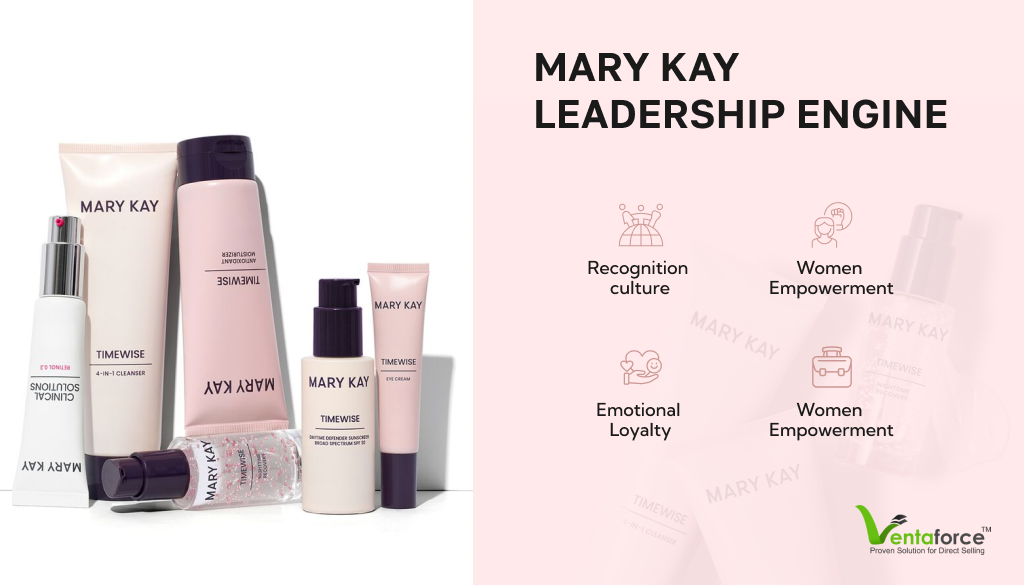
Core Growth Strategy 1 : Recognition as a Strategic Tool
Mary Kay turned recognition into a system, not a bonus.
Recognition includes :
- Titles
- Public appreciation
- Symbolic rewards
- Visible success markers
In Indian culture, where :
- Social respect matters deeply
- Public acknowledgment builds confidence
This approach is extremely effective.
Core Growth Strategy 2 : Leadership Development Over Selling Skills
Mary Kay focuses on :
- Communication
- Confidence
- Emotional intelligence
These skills :
- Improve retention
- Strengthen teams
- Create long-term leaders
Core Growth Strategy 3 : Work-Life Integration
By respecting family priorities, Mary Kay created :
- Sustainable careers
- Low burnout
- Long-term engagement
Key Lesson for Direct Sellers
Money motivates temporarily.
Recognition and respect build decades-long loyalty.
4. Avon Growth Strategies :
Avon – Mass Market Reach through Simplicity and Trust
Founded: 1886, USA
Core Product Categories: Beauty, personal care, fragrances
Original Vision: Make beauty accessible to every household
What Avon Focused on at the Beginning ?
Avon was built on :
- Affordable pricing
- Relatable products
- Door-to-door trust
The goal was not exclusivity—but accessibility.
Representatives became :
- Familiar neighborhood advisors
- Trusted recommendation sources
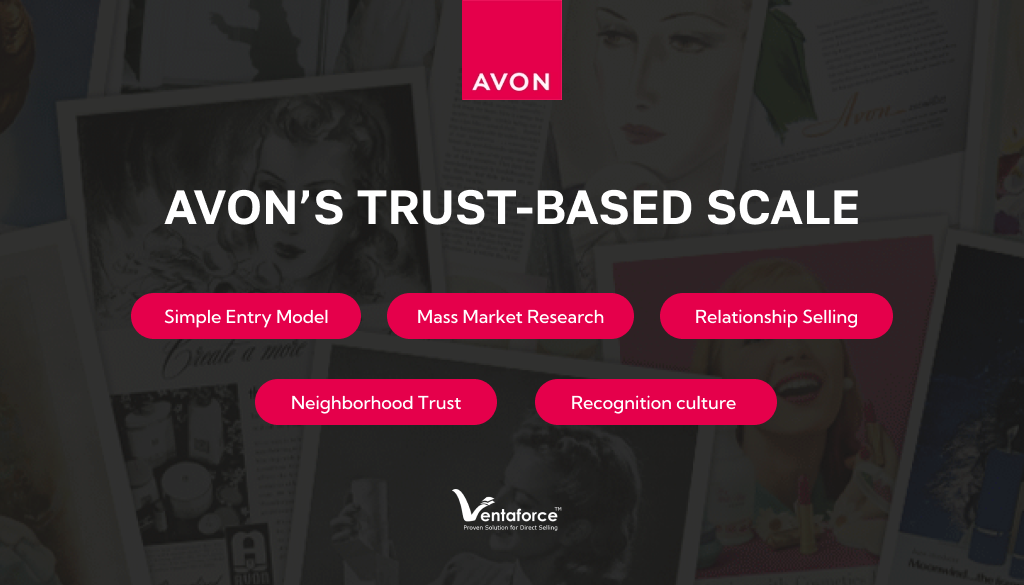
Core Growth Strategy 1 : Low Barrier Entry
Avon allowed :
- Easy joining
- Minimal investment
- Simple product education
This democratized entrepreneurship.
Core Growth Strategy 2 : Relationship-First Selling
Avon representatives didn’t hard-sell.
They :
- Built rapport
- Offered advice
- Earned referrals
This aligns perfectly with Indian neighborhood dynamics.
Key Lesson for Direct Sellers
Growth accelerates when entry feels safe and simple.
Remove fear, complexity, and pressure.
5. Oriflame Growth Strategies :
Oriflame – Digital-First Direct Selling with European Product Credibility
Founded: 1967, Sweden
Core Product Categories: Beauty, skincare, wellness
Original Vision: Combine natural ingredients with scientific innovation
What Oriflame Focused on When It Was Founded ?
Oriflame positioned itself as :
- Nature-inspired
- Science-backed
- Ethically produced
This created premium trust without luxury pricing.
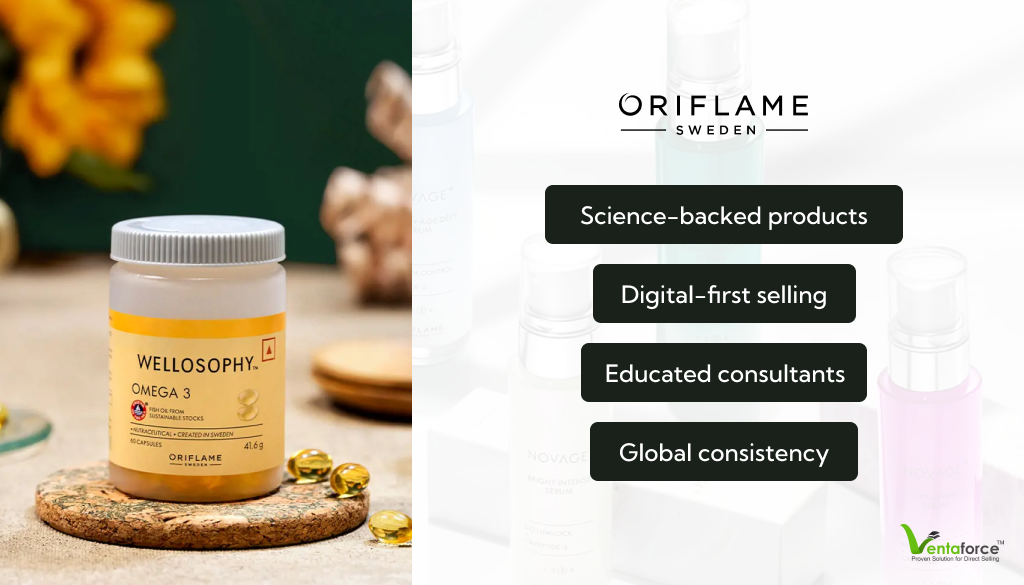
Core Growth Strategy 1 : Product Education as Authority
Oriflame invested heavily in :
- Ingredient transparency
- Skin science education
- Consultant training
Educated sellers become trusted advisors—not pushy marketers.
Core Growth Strategy 2 : Digital-First Adaptation
Oriflame adapted early to :
- E-catalogs
- Online ordering
- Social selling
By 2025, this makes Oriflame especially relevant for :
- Instagram sellers
- WhatsApp consultants
- Hybrid online-offline models in India
Core Growth Strategy 3 : Global Consistency with Local Flexibility
Oriflame maintains :
- Global brand standards
- Local market customization
This balance allows scalability without losing relevance.
Key Lesson for Direct Sellers
In 2025, credibility comes from knowledge + digital presence, not pressure selling.
100 MLM or Direct Selling Industry Statistics 2025: The Ultimate Guide on Direct Selling Trends & MLM Software Benefits
Shared Billion-Dollar Principles across All 5 Companies
- Product solves a daily or emotional problem
- Repeat consumption drives stability
- Systems outperform motivation
- Leadership development ensures longevity
- Trust scales faster than hype
Practical Action Plan for Direct Sellers in 2026
Ask yourself :
- Would I use this product without commission ?
- Can a beginner copy my process ?
- Am I building customers or just recruits ?
- Do people trust me enough to refer ?
Final Thought: Build Like a Billion-Dollar Company—Even If You’re Starting Small
Every empire featured in this blog started small.
Every leader once had zero customers, zero teams, and zero experience.
The success of Amway, Herbalife, Mary Kay, Avon, and Oriflame proves one fundamental truth about direct selling:
Billion-dollar companies are not built by extraordinary people—they are built by ordinary people executing extraordinary systems consistently.
The only remaining variable is your discipline in applying it—every day, over time.
Build patiently.
Lead ethically.
Duplicate simply.
That is how billion-dollar businesses are built—and how lasting success in direct selling is created.
You’ve just explored the exact growth principles used by the world’s most successful direct selling companies. This blueprint is proven. The only difference between readers and leaders is execution.
Ready to Apply These Strategies in Your Own Business ?
Whether you are a beginner, an active distributor, or a team leader, the fastest way to grow is to see the systems in action—not just read about them. This is your moment to move from information to implementation.
Frequently Asked Questions (FAQ)
Most companies fail because they rely on short-term recruitment, hype, or inconsistent products. Billion-dollar companies succeed because they focus on product value, duplication systems, distributor education, and trust, allowing them to scale globally and survive market changes.
Yes. All major direct selling companies featured in this blog were designed for ordinary people, not professional sales experts. Their systems are built to be simple, teachable, and duplicable, allowing beginners to succeed with consistency and training.
Systems are far more important than motivation. Motivation is temporary, but systems create predictable results. Billion-dollar companies grow because their processes work even when individuals have low energy or limited experience.
Products are the foundation. Long-lasting companies focus on high-quality, repeat-use products that solve daily or emotional problems. Without strong products, no compensation plan or marketing strategy can sustain growth.
Yes. Direct selling is more relevant than ever because it thrives on trust, personalization, and community—qualities that traditional advertising often lacks. Companies that combine relationship-based selling with digital tools continue to grow globally.
Common reasons include:
- Inconsistent action
- Lack of training and mentorship
- Over focus on recruitment instead of customers
- Absence of simple systems
- Unrealistic expectations
Successful companies reduce failure by prioritizing education, leadership, and ethics
It means explaining the business honestly and clearly instead of making unrealistic promises. Top leaders focus on:
- Clear income expectations
- Step-by-step processes
- Real effort and timelines
This builds trust and attracts serious, long-term distributors.
Leading direct selling companies maintain global brand standards while adapting product offerings, communication styles, and training methods to local cultures. This balance allows them to scale internationally without losing trust or relevance.
Leadership ensures stability, retention, and duplication. Sales generate income, but leadership creates organizations. Billion-dollar companies invest heavily in developing confident, ethical leaders who can guide teams long-term.
No. Digital tools support direct selling, but they do not replace relationships. The most successful sellers use digital platforms to educate, communicate, and support, while trust is still built through consistency and authenticity.
Yes—when approached as a long-term business model. Financial independence comes from building systems, loyal customers, and leadership structures that continue generating value over time, even without daily effort.
Yes—but only for leaders who embrace technology, data, training, and transparency. MLM without modern systems is no longer sustainable in today’s global, digital environment.